http://www.gamespot.com/pages/unions/forums/show_msgs.php?topic_id=25535979&union_id=12740
That link is an interesting little series of essays posted on a messageboard (you don't have to be a member to read it, and they go all the way through the first page before it turns into posts and responses rather than actual essays) that neatly describes one of the reasons I like the King of Fighters games so much. My interest in these kinds of games waxes and wanes with time, but it never goes away (just a few months ago, it faded and I was really into reading fantasy novels and D&D books; now I desperately want a PS2 so I can buy a few games that are out that will round out my collection... for now. Until KoF XII, Street Fighter IV and Super Street Fighter 2 HD Remix come out for Xbox 360 and PS3 anyway.) Now, I'm back staring at these bizarre manga/anime like Asian plainclothes superheroes of martial arts games and loving them as much as ever.
I've got more to say on the subject, but I'll get back to it in another post. In the meantime, read the link above. It's refreshing, for a fan like me, who wandered into KoF late after exhausting Capcom's games (again, like me) explaining exactly what about them so captivates me.

Monday, August 11, 2008


Thursday, August 07, 2008
2-D still lives
Just when I thought it was safe to claim that my favorite video game genre was effectively dead and my rather largish collection was more or less complete... it's not true anymore.
Just recently we've had releases of stuff that's never been easily (or legally) available stateside on good systems in better than arcade perfect formats: Street Fighter Alpha Anthology, the Fatal Fury Battle Archives (including the fabulous Real Bout games), King of Fighters XI and more.
And now, we're getting a Street Fighter II Hi Def Remix; Street Fighter 4, King of Fighters '98 Ultimate remake of 98 (quite possibly the best of the series), King of Fighters XII, with an all new vastly improved look, and who knows what else.
To say nothing of Arcana Heart, which is probably even more anime-like than Guilty Gear in some ways (and therefore not really my cuppa tea, but still important in helping to revitalize the genre.)
I'm not sure whether I should be disappointed or excited that I'm not yet done collecting after all!
Just recently we've had releases of stuff that's never been easily (or legally) available stateside on good systems in better than arcade perfect formats: Street Fighter Alpha Anthology, the Fatal Fury Battle Archives (including the fabulous Real Bout games), King of Fighters XI and more.
And now, we're getting a Street Fighter II Hi Def Remix; Street Fighter 4, King of Fighters '98 Ultimate remake of 98 (quite possibly the best of the series), King of Fighters XII, with an all new vastly improved look, and who knows what else.
To say nothing of Arcana Heart, which is probably even more anime-like than Guilty Gear in some ways (and therefore not really my cuppa tea, but still important in helping to revitalize the genre.)
I'm not sure whether I should be disappointed or excited that I'm not yet done collecting after all!
Tuesday, July 22, 2008
Click Click Drone
"You know I hate to ask
But, are friends electric?
Only, mine’s broke down
And now I’ve no one to love."
Those lyrics by Tubeway Army nearly thirty years ago have proven strangely prophetic... my main online "hangout" has been unavailable all day today (and pretty iffy for several weeks, actually) and although I don't actually spend that much time there during the day, its amazing how much I miss it if I can't connect at all. Makes it seem like there's something important that I've forgotten to do.
Weird. Now I need to get out and talk to some real people tonight to shake off the funky feeling that I'm actually living in some kind of cyberpunk nightmare. Although I know intellectually that that's not true, of course (I actually have about as active a social life as I can stand at the moment; any more going on and I'd be overloaded and need some time to myself.)
The post title is a "famous" line from the John Foxx "hit single" "Underpass." I put famous and hit in quotes, because actually it wasn't all that commercially successful, but in a fair world John Foxx would be better known today that Gary Numan. Gary Numan himself repeatedly said he was imitating Foxx, particularly from his swan song album with Ultravox Systems of Romance which is also often called the "first synthpop album." If you hear songs like "Dislocation" and "Quiet Men" it's easy to see where Numan is coming from with that claim. Sadly, when John Foxx went solo and produced his landmark album Metamatic it was overshadowed by Numan's own success. Foxx's work is much more polished, and while I'm a big Numan fan, and I think some at least of his songs are truly brilliant, I think Foxx is a better musicial and composer both.
But, are friends electric?
Only, mine’s broke down
And now I’ve no one to love."
Those lyrics by Tubeway Army nearly thirty years ago have proven strangely prophetic... my main online "hangout" has been unavailable all day today (and pretty iffy for several weeks, actually) and although I don't actually spend that much time there during the day, its amazing how much I miss it if I can't connect at all. Makes it seem like there's something important that I've forgotten to do.
Weird. Now I need to get out and talk to some real people tonight to shake off the funky feeling that I'm actually living in some kind of cyberpunk nightmare. Although I know intellectually that that's not true, of course (I actually have about as active a social life as I can stand at the moment; any more going on and I'd be overloaded and need some time to myself.)
The post title is a "famous" line from the John Foxx "hit single" "Underpass." I put famous and hit in quotes, because actually it wasn't all that commercially successful, but in a fair world John Foxx would be better known today that Gary Numan. Gary Numan himself repeatedly said he was imitating Foxx, particularly from his swan song album with Ultravox Systems of Romance which is also often called the "first synthpop album." If you hear songs like "Dislocation" and "Quiet Men" it's easy to see where Numan is coming from with that claim. Sadly, when John Foxx went solo and produced his landmark album Metamatic it was overshadowed by Numan's own success. Foxx's work is much more polished, and while I'm a big Numan fan, and I think some at least of his songs are truly brilliant, I think Foxx is a better musicial and composer both.
Gap
Well, it's been quite a while since I've made an entry. A lot of real life personal stuff has intruded, and quite frankly I've simply been preoccupied.
I haven't, however, forgotten this blog to become yet another fallow, abortive attempt at journalizing online.
This post is mostly just a "hey-o" to say that I'm still alive, I still think about things on occasion, and I still wish to post such thoughts. I'll continue to do so as time permits. At this very moment, I don't have anything in particular on my mind, however. I've been busy enough that many of my usual hobbyist pursuits have been pushed to the backburner; I haven't thought much about fantasy novels, dinosaurs, video games, music or anything much like that (other than that I discovered that Gary Numan remade his own song "Metal" and bought it for $.89 from Amazon. Check it out; it's very cold and poignant.)
I haven't, however, forgotten this blog to become yet another fallow, abortive attempt at journalizing online.
This post is mostly just a "hey-o" to say that I'm still alive, I still think about things on occasion, and I still wish to post such thoughts. I'll continue to do so as time permits. At this very moment, I don't have anything in particular on my mind, however. I've been busy enough that many of my usual hobbyist pursuits have been pushed to the backburner; I haven't thought much about fantasy novels, dinosaurs, video games, music or anything much like that (other than that I discovered that Gary Numan remade his own song "Metal" and bought it for $.89 from Amazon. Check it out; it's very cold and poignant.)
Monday, June 23, 2008
80s Music Videos
I've been trawling about Youtube for 80s music videos. Again.
I saw one that I think was new to me: Van Stephenson's "Modern Day Delilah." Which, lets face it—with a video about an actual hairdresser is just to corny to be fer real.
Check out some Real Life too; one of my favorite 80s bands, and often mistaken for a one hit wonder. Most people remember "Send Me an Angel" thanks to about half a dozen movies that used it in their soundtrack, but they hardly put out a bad song. "God Tonight", "Face to Face", "Catch Me I'm Falling", "Girl Jesus" and the very creepy "Sister Sister" are among my other favorite tracks of theirs.
Their "Catch Me I'm Falling" is no relation to Pretty Poison's "Catch Me (I'm Falling)" although that's an 80s song that's good fer a laugh too.
I saw one that I think was new to me: Van Stephenson's "Modern Day Delilah." Which, lets face it—with a video about an actual hairdresser is just to corny to be fer real.
Check out some Real Life too; one of my favorite 80s bands, and often mistaken for a one hit wonder. Most people remember "Send Me an Angel" thanks to about half a dozen movies that used it in their soundtrack, but they hardly put out a bad song. "God Tonight", "Face to Face", "Catch Me I'm Falling", "Girl Jesus" and the very creepy "Sister Sister" are among my other favorite tracks of theirs.
Their "Catch Me I'm Falling" is no relation to Pretty Poison's "Catch Me (I'm Falling)" although that's an 80s song that's good fer a laugh too.
Wednesday, June 18, 2008
David Hardy
Huh. The artist who did the two pictures I scanned and posted below: he's still kickin' around, apparently, and has a website with a lot of work on it. Some of them are from the book I just bought, but most of them are newer. Some of them are also unrepentantly retro, which I like.
Also, here's an unfortunately small image of an updated version of the Milky Way picture that I loved so much.

Also, here's an unfortunately small image of an updated version of the Milky Way picture that I loved so much.

Used books
While unsuccessful in my goal of finding used copies of Dresden Files novels, my search of the used bookstores in the area did allow me to find two things I wasn't looking for. The first was Leigh Brackett's Outlaw of Mars which is a reprint of two of her earlier very slim novels (probably more properly novellas) The Secret of Sinharat and People of the Talisman. Although I never had this particular printing of these under this particular title, I did have the two of them together as an "Ace Double Book"—although that has now been lost for some time, sadly.


The cover art on this book is really bad. It looks sorta like airbrushed van art with Eric John Stark as a vaguely humanoid creature sitting on the back of a dinosaur. He's pale and blonde with very stylish hair (for the late sixties or seventies); like some kind of Swedish ABBA groupie (nevermind that Brackett described as as extremely dark skinned; either an adaptation to or a consequence of a childhood spent on Mercury baking under the cruel sun.)
Despite the terrible cover art, I'm extremely gratified to replace my copy for only $2. The book is recently back in print again thanks to our friends at Paizo's Planet Stories line, but I haven't been to thrilled at buying a new trade paperback copy when I'd hoped I could find other copies used. An introduction by Michael Moorcock and better cover art aren't worth that much. As a testament to the quality of these two stories, this is at least the fourth time that they have been reprinted in book form. If you haven't ever read them before, buy the Paizo version, or trawl through Amazon for one of the older copies.
The other book I stumbled upon as a $6 well-maintained copy of The New Challenge of the Stars; a book that was quite formative to me as a child. The thrust of the book is that it attempts to apply science fact to science fiction about space travel. It does so in fairly non-technical terms (it was originally in the children's section of my public library as a kid). It was published in 1977 and at least some elements of this new (at the time) fangled hit movie called Star Wars can be found in it (Star Wars is mentioned two or three times in the text and the cover art is a not-so-subtle homage to the Death Star and Star Destroyers.)
Really, though, the book's easily worth more than the $6 I paid for it for the art alone. Every page has at least one—occasionally two—top class paintings on it. From scenes from H. G. Wells' War of the Worlds to pictures of pioneering lunar colonies, astronauts walking around on Mars, to planetscapes from worlds with closely paired binary twin suns and such sci-fi go-to concepts as generation ships made out of hollowed out asteroids.
Two paintings in particular stuck with me, and I've even mentioned them in posts here in the past. That surely merits me putting the book on a scanner and sharing a couple of the images. This lower painting is a night time landscape from a planet outside the Milky Way, and the top is a night time view from a planet inside a globular cluster.


Monday, June 16, 2008
Triassic Park
The more I read about it, the more I find the Triassic fascinating. When it started, 251 million years ago, the world was still reeling from the single most devastating mass extinction ever: "the day the earth almost died." For millions of years afterward—the entire Early Triassic epoch and possibly much of the Middle Triassic—the entire biosphere can be fairly called "impoverished." Some therapsids bounced back—Lystrosaurus was an early Triassic animal that's well known for it's astonishing recovery, and other dicynodonts seem to have followed in short order. Carnivorous therocephalians and cynodonts spread early as well. One very interesting development was the rise of the thecodonts. (I realize that under cladistic nomenclature, Thecodontia no longer exists. However, its often necessary to refer to paraphyletic groups and even paleontologists do it all the time. I also don't like having to use cumbersome technical jargon when an existing term works quite well. So rather than say "non-dinosaurian and non-crocodilian archosauriomorphs" I still use the word thecodont. I use therapsid and other terms the same way. Trust me: its better than the alternatives.)
Very early on, big-headed "red crocodiles" like the erythrosuchians became the apex predators of the early Triassic. Because environmental conditions were similar, this may have been like in the Australian Pliocene when pristichampsian crocodiles and giant komodo dragons became apex predators, lording it over the mammals. Very likely, these large thecodont predators were cold-blooded as well, although many of the therapsids may no longer have been.
Anatomical clues suggest that the thecodonts may have been developing warm-bloodedness throughout this time as well. By the time they became true archosaurs, they may well have already been well on that path, since crurotarsians and ornithodirans both show anatomical evidence associated with warm-bloodedness. Certainly later ornithodirans had it; birds, dinosaurs and pterosaurs.
Modern crocodilians are a strange case, and throw a potential monkey wrench in the idea of warm-blooded archosaurs since they are a fairly late group and are clearly cold-blooded. However, they also have several anatomical adaptations that serve no purpose for a cold-blooded creature, and Triassic crocodilians have even more such adaptations (fully erect gait, active terrestrial lifestyle, etc.) Most likely, as crocodilians inherited the semi-aquatic ambush predator role from their cousins, the spectactularly misnamed phytosaurs, they lost their warm-bloodedness as a result.
In fact, that constant state of transition is characteristic of the Triassic and what makes it so fascinating. During the Jurassic and Cretaceous, individual species and genera may have had a relatively rapid turnover, but entire dynasties did not. We see, for example, a steady, uninterrupted progression from primitive ornithopods through iguanodonts and on into duck-billed dinosaurs; an arc that lasted well over 100 million years and that was full of highly successful animals throughout. While this is probably the most extreme example amongst dinosaurs, the basic pattern is visible throughout—dinosaur dynasties were long-lived. Crocodilians even have them beat; they took over the semi-aquatic ambush predator role at the very beginning of the Jurassic 200 million years ago and still have the niche locked up.
This was not true of the Triassic. Looking at the big picture, of course, the Triassic is the story of the gradual replacement of therapsid-held guilds with thecodont-held ones. As the Triassic wound down, both megadynasties produced their best designs: specifically mammals and dinosaurs respectively. The dinosaurs inherited (or wrested control of) an empire that their thecodont ancestors had built over the course of less than 40 or so million years and held it for over 160 million years while the mammals—who's ancestors had been so dominant since the Permian—lost theirs and had to bide their time until the post-Cretaceous extinctions opened the door for them to spread again.
But on the smaller scale, dynasties turned over with astonishing frequency during the Triassic. The semi-aquatic ambush predator guild was held by presterosuchids and champsosuchids in the early Triassic, who gave way to the only distantly related phytosaurs by the mid-Triassic, just a few million years later, who themselves ceded it to the crocodilians by the end of the period. Apex predators at the beginning were erythrosuchids who ceded to rauisuchians (themselves possibly a polyphyletic group) and ornithosuchians who moved over for therapod dinosaurs. Large herbivores were initially dicynodonts who faded quickly to be challenged by aetosaurs and others, who in turn were challenged by the rhynchosaurs, who in turn were replaced by revueltosaurs and silesaurs, which were replaced by true dinosaurian prosauropods and ornithischians.
Everywhere you look during the Triassic, we see churn and change. Entire dynasties rise up only to last a few million years before going extinct and being replaced by unrelated (or at beast very distantly related) new ones. There's also still a lot we don't know about the Triassic. The relationship between various thecodont groups is poorly understood and entire clans like the revueltosaurs and silesaurs were completely unknown and unguessed at as recently as five years ago—their importance to the larger faunal picture even less time than that—at most a year or two.
Although compared to the gigantic and dramatic fauna of later dinosaur eras the Triassic seems understated, in my opinion its got a unique and very compelling charm all its own.
Very early on, big-headed "red crocodiles" like the erythrosuchians became the apex predators of the early Triassic. Because environmental conditions were similar, this may have been like in the Australian Pliocene when pristichampsian crocodiles and giant komodo dragons became apex predators, lording it over the mammals. Very likely, these large thecodont predators were cold-blooded as well, although many of the therapsids may no longer have been.
Anatomical clues suggest that the thecodonts may have been developing warm-bloodedness throughout this time as well. By the time they became true archosaurs, they may well have already been well on that path, since crurotarsians and ornithodirans both show anatomical evidence associated with warm-bloodedness. Certainly later ornithodirans had it; birds, dinosaurs and pterosaurs.
Modern crocodilians are a strange case, and throw a potential monkey wrench in the idea of warm-blooded archosaurs since they are a fairly late group and are clearly cold-blooded. However, they also have several anatomical adaptations that serve no purpose for a cold-blooded creature, and Triassic crocodilians have even more such adaptations (fully erect gait, active terrestrial lifestyle, etc.) Most likely, as crocodilians inherited the semi-aquatic ambush predator role from their cousins, the spectactularly misnamed phytosaurs, they lost their warm-bloodedness as a result.
In fact, that constant state of transition is characteristic of the Triassic and what makes it so fascinating. During the Jurassic and Cretaceous, individual species and genera may have had a relatively rapid turnover, but entire dynasties did not. We see, for example, a steady, uninterrupted progression from primitive ornithopods through iguanodonts and on into duck-billed dinosaurs; an arc that lasted well over 100 million years and that was full of highly successful animals throughout. While this is probably the most extreme example amongst dinosaurs, the basic pattern is visible throughout—dinosaur dynasties were long-lived. Crocodilians even have them beat; they took over the semi-aquatic ambush predator role at the very beginning of the Jurassic 200 million years ago and still have the niche locked up.
This was not true of the Triassic. Looking at the big picture, of course, the Triassic is the story of the gradual replacement of therapsid-held guilds with thecodont-held ones. As the Triassic wound down, both megadynasties produced their best designs: specifically mammals and dinosaurs respectively. The dinosaurs inherited (or wrested control of) an empire that their thecodont ancestors had built over the course of less than 40 or so million years and held it for over 160 million years while the mammals—who's ancestors had been so dominant since the Permian—lost theirs and had to bide their time until the post-Cretaceous extinctions opened the door for them to spread again.
But on the smaller scale, dynasties turned over with astonishing frequency during the Triassic. The semi-aquatic ambush predator guild was held by presterosuchids and champsosuchids in the early Triassic, who gave way to the only distantly related phytosaurs by the mid-Triassic, just a few million years later, who themselves ceded it to the crocodilians by the end of the period. Apex predators at the beginning were erythrosuchids who ceded to rauisuchians (themselves possibly a polyphyletic group) and ornithosuchians who moved over for therapod dinosaurs. Large herbivores were initially dicynodonts who faded quickly to be challenged by aetosaurs and others, who in turn were challenged by the rhynchosaurs, who in turn were replaced by revueltosaurs and silesaurs, which were replaced by true dinosaurian prosauropods and ornithischians.
Everywhere you look during the Triassic, we see churn and change. Entire dynasties rise up only to last a few million years before going extinct and being replaced by unrelated (or at beast very distantly related) new ones. There's also still a lot we don't know about the Triassic. The relationship between various thecodont groups is poorly understood and entire clans like the revueltosaurs and silesaurs were completely unknown and unguessed at as recently as five years ago—their importance to the larger faunal picture even less time than that—at most a year or two.
Although compared to the gigantic and dramatic fauna of later dinosaur eras the Triassic seems understated, in my opinion its got a unique and very compelling charm all its own.
Shotgun
Wow. Yeah, busy. I started the notes for that last post at least two weeks ago, and never finished it, and never posted it. Now I've got a lot of topics to hit scattershot.
I just said that I thought an inherent weakness of the comic book medium was its inability to express strong emotion. Then I read the story arc in Ultimate Spiderman where Norm and Harry Osborne are killed. I'm gonna hafta retract my earlier statement. Comics can pack an emotional punch.
Part of the reason I've been so busy is that I've finally broken down and picked up The Dresden Files and found them great fun to read. I charged through the first three books before running out of what was readily available at my local libraries, and rather than wait for #4 to get turned back in, I think I'm gonna trawl through the local used bookstores to see if I can find a copy on the cheap. I find it very amusing that Butcher—who wanted to write high fantasy and only penned the first Dresedn novel to prove a point; namely that it'd be formulaic and terrible—was caught quote off guard by the success of the series.
In general, I think that's a mistake our society often makes; discounting formula. Those formulae exist for a reason: namely because they're brilliant. They work. They've been repeatedly tried "in the field" and proven themselves over and over again. Writers ignore formula at their peril. That doesn't mean it should be strictly followed either, but it should never be ignored. In general, I'd much rather see a well-done execution of formula—with a twist—than something innovative that doesn't work and is barely readable.
In addition to the Dresden books, I've just read the first four Myth Adventures (RIP Robert Asprin) books again as well as some nonfiction—a book that posits that the evolution of the first eyes and an active predatory lifestyle is responsible for the Cambrian Explosion as well as a big encyclopedia-like dinosaur book by Thomas Holtz. Dr. Holtz's text tries to strike a balance between being sufficiently technical while still being accessible to "readers of all ages" and I don't know that it always works—its probably too dense for kids or casually interested laymen, and for more serious laymen (like myself) the tone sometimes inadvertently feels condescending. The appendix which lists every dinosaur genus known up to the date of publication (2007) plus time, location and a few other details, however, is priceless.
It's also heavily (and exclusively) illustrated by Luis Rey, who is an extremely talented paleoartist, albeit one who occasionally frustrates me. He's well-known for some fairly bold moves—even an illustration of little Eoraptor has protofeathers, for example, a decision I applaud and an idea I enjoy. However, his use of colors and textures is often staggering; he loads his dinos up with so many bizarre colors, feathers, wattles and frills that many of his illustrations look like killer turkeys or peacocks that just went through a crash course clown school. I'm also not a fan of his frequent use of facial closeups with extreme perspective on the rest of the body. Kinda like looking at a dinosaur through the peephole in your front door.
One thing that I hadn't quite put together on my own, though, was the correllation between carnosaur and the really large sauropods; I guess it hadn't occured to me that somewhere between the Cenomanian some 95 million odd years ago (when Acrocanthosaurus, Giganotosaurus and Carcharodontosaurus lived) and the Santonian some 85 million years ago, the size of the sauropds drastically reduced. If the relationship between carnosaurs and gigantic sauropods is indeed that strong, its no wonder that as the larger sauropods faded away that the carnosaurs ceded their top predator niches to tyrannosaurs and abelisaurs. And maybe that's why I like carnosaurs so much; Tyrannosaurus chasing down a Triceratops or a hadrosaur is cool enough, but to me carnosaurs vs. big sauropods is the most iconic dinosaur imagery. So, from the early Gasosaurus vs. Shunosaurus to later encounters like Giganotosaurus vs. Argentinosaurus or Acrocanthosaurus vs. Sauroposeidon or Carcharodontosaurus vs. Paralititan, those are my favorite "dinosaur moments."
And really; nobody does them better than the Late Jurassic Morrison Formation. The Morrison is our own homegrown formation after all (my mom grew up in Cleveland, UT—literally within walking distance of the Cleveland-Lloyd quarry.) It was one of the first described dinosaurian faunal assemblages, and remains one of the best known. Its also one of the most diverse, and it has some of the worlds most famous dinosaurs. Depending on how picky you are about accepting new names for similar animals, you've still got a very diverse assemblage. Tons of both bony and lobe-finned fishes lived in the rivers and lakes, as did frogs, salamanders and turtles. A number of crocodilians lived there, including terrestrial, cursorial crocs like Fruitachampsa. Although preservational bias works against them, half a dozen or so pterosaurs are known as well. Lizards, sphenodonts and champsosaurs round out the reptilian non-dinosaurian fanua while various types of primitive mammals (docodonts, multituberculates, triconodonts, symmetrodonts and dryolestoids) polish off the list.
The dinosaurs are—of course—the most famous and dramatic critters from the Morrision though. Carnosaurs like Allosaurus, Epanterias, Saurophaganax and possibly Marshosaurus were joined by megalosaurs Torvosaurus and Edmarka to make up most of the large and medium-sized meat-eaters, while Ceratosaurus and Elaphrosaurus hint at the future diversity of the abelisaurs and noasaurs yet to come. There's even some interesting small predators like Coelurus, Ornitholestes, Tanycolagreus, early troodontids like Koparion and the poorly known Stokesosaurus. Only recently with highly developed cladistic tools and good comparative specimens like Dilong and Guanlong have we come to realize that "Old Stokes" is actually a very early (and primitive) tyrannosaur.
Tyrannosaurs aren't the only group to make early appearances in the Morrision. Although Europe's Callovosaurus is marginally older, the Morrison's Dryosaurus and Camptosaurus are among the earliest well-known iguanodonts. Gargoyleosaurus and Mymoorapelta are among the first ankylosaurs. Stegosaurs and hypsilophodontids were fairly old hat by the time the Morrison rolled around, but are particularly well-represented with two species of Stegosaurus itself plus Hesperosaurus shoutin' out for the former and Drinker, Laosaurus, Nanosaurus, Othneilia and Othnielosaurus for the latter.
The most dramatic dinosaurs from the Morrison are definately its dizzying variety of sauropods however. Haplocanthosaurus, Atlantosaurus, Dyslocosaurus, Dystophaeus, Eobrontosaurus and Suuwassea join such famous names as Brachiosaurus, Camarasaurus, Apatosaurus, Barosaurus, Diplodocus, Seismosaurus, Supersaurus and the mysterious Amphicoelias which may have rivalled Argentinosaurus for largest land animal. Ever.
I just said that I thought an inherent weakness of the comic book medium was its inability to express strong emotion. Then I read the story arc in Ultimate Spiderman where Norm and Harry Osborne are killed. I'm gonna hafta retract my earlier statement. Comics can pack an emotional punch.
Part of the reason I've been so busy is that I've finally broken down and picked up The Dresden Files and found them great fun to read. I charged through the first three books before running out of what was readily available at my local libraries, and rather than wait for #4 to get turned back in, I think I'm gonna trawl through the local used bookstores to see if I can find a copy on the cheap. I find it very amusing that Butcher—who wanted to write high fantasy and only penned the first Dresedn novel to prove a point; namely that it'd be formulaic and terrible—was caught quote off guard by the success of the series.
In general, I think that's a mistake our society often makes; discounting formula. Those formulae exist for a reason: namely because they're brilliant. They work. They've been repeatedly tried "in the field" and proven themselves over and over again. Writers ignore formula at their peril. That doesn't mean it should be strictly followed either, but it should never be ignored. In general, I'd much rather see a well-done execution of formula—with a twist—than something innovative that doesn't work and is barely readable.
In addition to the Dresden books, I've just read the first four Myth Adventures (RIP Robert Asprin) books again as well as some nonfiction—a book that posits that the evolution of the first eyes and an active predatory lifestyle is responsible for the Cambrian Explosion as well as a big encyclopedia-like dinosaur book by Thomas Holtz. Dr. Holtz's text tries to strike a balance between being sufficiently technical while still being accessible to "readers of all ages" and I don't know that it always works—its probably too dense for kids or casually interested laymen, and for more serious laymen (like myself) the tone sometimes inadvertently feels condescending. The appendix which lists every dinosaur genus known up to the date of publication (2007) plus time, location and a few other details, however, is priceless.
It's also heavily (and exclusively) illustrated by Luis Rey, who is an extremely talented paleoartist, albeit one who occasionally frustrates me. He's well-known for some fairly bold moves—even an illustration of little Eoraptor has protofeathers, for example, a decision I applaud and an idea I enjoy. However, his use of colors and textures is often staggering; he loads his dinos up with so many bizarre colors, feathers, wattles and frills that many of his illustrations look like killer turkeys or peacocks that just went through a crash course clown school. I'm also not a fan of his frequent use of facial closeups with extreme perspective on the rest of the body. Kinda like looking at a dinosaur through the peephole in your front door.
One thing that I hadn't quite put together on my own, though, was the correllation between carnosaur and the really large sauropods; I guess it hadn't occured to me that somewhere between the Cenomanian some 95 million odd years ago (when Acrocanthosaurus, Giganotosaurus and Carcharodontosaurus lived) and the Santonian some 85 million years ago, the size of the sauropds drastically reduced. If the relationship between carnosaurs and gigantic sauropods is indeed that strong, its no wonder that as the larger sauropods faded away that the carnosaurs ceded their top predator niches to tyrannosaurs and abelisaurs. And maybe that's why I like carnosaurs so much; Tyrannosaurus chasing down a Triceratops or a hadrosaur is cool enough, but to me carnosaurs vs. big sauropods is the most iconic dinosaur imagery. So, from the early Gasosaurus vs. Shunosaurus to later encounters like Giganotosaurus vs. Argentinosaurus or Acrocanthosaurus vs. Sauroposeidon or Carcharodontosaurus vs. Paralititan, those are my favorite "dinosaur moments."
And really; nobody does them better than the Late Jurassic Morrison Formation. The Morrison is our own homegrown formation after all (my mom grew up in Cleveland, UT—literally within walking distance of the Cleveland-Lloyd quarry.) It was one of the first described dinosaurian faunal assemblages, and remains one of the best known. Its also one of the most diverse, and it has some of the worlds most famous dinosaurs. Depending on how picky you are about accepting new names for similar animals, you've still got a very diverse assemblage. Tons of both bony and lobe-finned fishes lived in the rivers and lakes, as did frogs, salamanders and turtles. A number of crocodilians lived there, including terrestrial, cursorial crocs like Fruitachampsa. Although preservational bias works against them, half a dozen or so pterosaurs are known as well. Lizards, sphenodonts and champsosaurs round out the reptilian non-dinosaurian fanua while various types of primitive mammals (docodonts, multituberculates, triconodonts, symmetrodonts and dryolestoids) polish off the list.
The dinosaurs are—of course—the most famous and dramatic critters from the Morrision though. Carnosaurs like Allosaurus, Epanterias, Saurophaganax and possibly Marshosaurus were joined by megalosaurs Torvosaurus and Edmarka to make up most of the large and medium-sized meat-eaters, while Ceratosaurus and Elaphrosaurus hint at the future diversity of the abelisaurs and noasaurs yet to come. There's even some interesting small predators like Coelurus, Ornitholestes, Tanycolagreus, early troodontids like Koparion and the poorly known Stokesosaurus. Only recently with highly developed cladistic tools and good comparative specimens like Dilong and Guanlong have we come to realize that "Old Stokes" is actually a very early (and primitive) tyrannosaur.
Tyrannosaurs aren't the only group to make early appearances in the Morrision. Although Europe's Callovosaurus is marginally older, the Morrison's Dryosaurus and Camptosaurus are among the earliest well-known iguanodonts. Gargoyleosaurus and Mymoorapelta are among the first ankylosaurs. Stegosaurs and hypsilophodontids were fairly old hat by the time the Morrison rolled around, but are particularly well-represented with two species of Stegosaurus itself plus Hesperosaurus shoutin' out for the former and Drinker, Laosaurus, Nanosaurus, Othneilia and Othnielosaurus for the latter.
The most dramatic dinosaurs from the Morrison are definately its dizzying variety of sauropods however. Haplocanthosaurus, Atlantosaurus, Dyslocosaurus, Dystophaeus, Eobrontosaurus and Suuwassea join such famous names as Brachiosaurus, Camarasaurus, Apatosaurus, Barosaurus, Diplodocus, Seismosaurus, Supersaurus and the mysterious Amphicoelias which may have rivalled Argentinosaurus for largest land animal. Ever.
Orcses
Yup. I've decided. Orcs. Goblins. Hobgoblins. Those names need to be something else. Thurses? Probably not. But I'll think of something.
Meanwhile, I still haven't made the updates to my novel material because I've been so busy.
Meanwhile, I still haven't made the updates to my novel material because I've been so busy.
Thursday, May 29, 2008
Orcs and Half-orcs
Three posts today; I'm on a bit of a roll! I'm a very visually minded person and when I added orcs, goblins and vazhar to Dark•Heritage, I had a very definite look in mind for them. Unfortunately, the word 'orc' comes with a visual connontation now that's difficult to shed and it doesn't work for me. I've toyed with the idea of giving them a new name; Tolkien got the word from a kenning in Beowulf that referred to orc-Þyrs and orcneas—if Tolkien can coopt orc, I can coopt Þyrs, modernize the spelling to thurse and use that. But I'm undecided.


Hobgoblins are another race that sadly suffers from poor illustration. I tend to think of them as looking more like the illustrations of githyanki really, except without the crazy hair, spots, and pathological emaciation.
In any case, orcs always start with Tolkien and his descriptions aren't exactly comprehensive. He refers to swart, black and sallow skin, fangs, red eyes, squint eyes, being short, being hairy, having long ape-like arms (at least on some individuals) and a few other adjectives that occasionally point to a contradictory—or more likely varied and diverse—description. In general, the Lord of the Rings movies did a reasonably credible job of depicting them; not exactly what I would have done, but I can't really fault them in general and I actually like the look. Warhammer and Warcraft, on the other hand, have cemented the orc look as a kind of parody with physiques like hairless gorillas with kelly green skin ("Faith and begora! Yer after me Lucky Charms!"), gigantic lower jaws and chins that look so heavy its a marvel that they can even close their mouths at all, an in general a lot of campiness. D&D has varied over the years, from orange-skinned men with pigs-heads to today's situation where many of the core illustrations don't even match the description of them. The Monster Manual, the Dungeonmaster's Guide and Savage Species all have Warhammer-esque orcs with green skin and heads bigger than watermelons, 75% of which is pure jaw. The thought of these monstrosities mating with humans—even as the product of rape—to produce half-orcs is frankly too vile to consider.
Some of the more recent illustrations are better, and for my money the best orc illustrations out there are on some fo the Freeport covers by Wayne Reynolds. The Pirate's Guide to Freeport and the Freeport Trilogy covers are the best, showing orcs that are stocky and robust with a thicker skeleto-muscular system than humans, coarse hair, wide, spreading, flat noses (and faces), prominent tusks in the lower jaw, large pointed ears, and grayish skin. They don't look human, but they also don't really look like monsters. They're humanoids—or demihumans if you prefer—with a tendency towards savagery and lack of high culture, but no more monstrous really than an elf or a dwarf. I tend to think of orcs as if they were hold-out populations of Neanderthal men in the Middle Ages rather than monsters or bogeymen.
Here's a few great pictures (also from WAR's online gallery) of what I think half-orcs should look like as well.
Hobgoblins are another race that sadly suffers from poor illustration. I tend to think of them as looking more like the illustrations of githyanki really, except without the crazy hair, spots, and pathological emaciation.
Pirates
Perhaps the inspiration for the changes mentioned in my last post is how much fun I'm having running the "Mezzovian Main" game. Maybe its because for that game I whipped up a CD-R of mp3 soundtracks including all three Pirates of the Caribbean movies, all three Indiana Jones movies, both Mummy movies and Van Helsing (I realise a fourth Indy sountrack is now available—in fact I already have it—and that a third Mummy will be out before summer's over, but I made this CD-R at least six months ago) and I've been listening to it frequently while reading or otherwise puttering about the house. This in turn has prompted me to reread my systemless Pirates' Guide to Freeport book by Green Ronin which is an absolutely fantastic book, and very cleverly done. It also removes some of the campiness of the original d20 Freeport book for the 3e rules. A number of companion books have also been released providing rules support, further mechanical options, and in every way simply more detail period for d20 (D&D 3.5), True20 and Savage Worlds, with a Castles & Crusades companion on the way and a blog post by Chris "Famous Pramas" for adapting it into Warhammer Fantasy Roleplaying.
Despite all these mechanical options, it's obvious where the settings roots lie: it's traditional D&D with a heavy flavor overlay of the "Golden Age" of Caribbean piracy and with roots digging deeply into Lovecraftiana. It's somewhat campy, melodramatic and fun, but not too campy or melodramatic meaning that it can be played pretty straight.
I literally just finished rereading it last night and have immediately plowed into Five Fingers: Port of Deceit, and interesting comparison to the Freeport line because it uses very similar themes and imagery but it does so in a more serious fashion and despite the fact that its not systemless (being in fact a D&D book via that d20 license), the setting feels much less D&D-like than Freeport does. D&D and I have an interesting love-hate relationship; although I often scoff at obvious D&Disms and profess to eschew them, I find myself drawn back to many of them time and time again (hence the on again off again orcs in Dark•Heritage, although orcs are bigger than D&D certainly.) Right now, the fickle vagaries of my taste are much more tolerant of the D&Disms which leads to a slight favoring of Freeport over Five Fingers (previously I've said the opposite although it's always a photo finish between them.) I even kinda like the occasional campiness, something Five Fingers doesn't bother with. Five Fingers is like Charles Dickens—but without the plucky, curiously virtuous protagonists who always manage to rise above the dark, sooty nastiness that surrounds them; Five Fingers oozes dark sooty nastiness.
In any case, I've always thought of Dark•Heritage as more of a setting for fiction than for gaming, although the various fiction attempts I'vemade have been short and abortive, while the gaming iterations have gone through a few successful versions now. Luckily, this change will not require me to make any changes to my novel outline, although I will have to go back and rework everything currently written to accomodate the changed details. Le sigh.
Dark•Heritage Mk. III
I thought about changing the name yet again as I now have some additional interesting things going on—specifically that Dark•Heritage has marched on from Mk. II to Mk. III. The rules haven't changed much (for the roleplaying aspect of the setting anyway) with the exception that I'm thinking of slapping an E6 or E8 style ceiling on level advancement—but I've made a few fairly significant changes to the setting.
Most significantly, I've hybridized Dark•Heritage Mk. II with the "Mezzovian Main" pirate setting I'm using for my D&D game right now. The Strachina Basin is no longer a vast desert like the Taklamakan and Razina an important Silk Road stop like Kucha; the Strachina is now a peninsula like Italy or the Peloponnesse with Razina an important maritime city-state like Carthage, Knossos or early Republican era Rome. Although, honestly, its my intention to make it as much like Tortuga or Port Royale from the "Golden Age of Piracy"—these are more geographical similarities rather than cultural.
I've toned down the exotica just a bit; the main human culture around Razina is cosmopolitan, but not unlike what you'd expect to see in any American or European (or Canadian, or Australian, etc.) city. Familiarity breeds characters the audience can relate to, after all. There are a few desert-dwelling races of humans that look exotic still, though, as well as the chalky white inhabitants of my "Valles Marineris". I've also returned to an older idea that had been kicking around in my earlier notes but which I had abandoned of bringing orcs into the setting. I'm also going to bring a few more guys too—dimorphic goblins with a goblin and hobgoblin caste, and maybe even the "vazher"; mortal descendents of otherworldly afrit.
A core conceit of Dark•Heritage has always been that humanity is not native to Kael; a group of refugees fleeing the Deluge on earth ended up here. I'm now saying that the Deluge w2as but part of a "Multiversal Catastrophe" that struck inhabited worlds all over the place, flinging groups of refugees across the cosmos in a multi-front diaspora. I have to admit that this broadening of the catastrophe that brought people to Kael (and now also orcs, goblins and vazher too) was probably influenced by the scene in Magican: Master where Pug (Milamber) sees teh inhabitants of Kelewan enter the world, fleeing the depredations of "the Enemy." But hey; I never claimed to be original here, and in fact I'll be the first to say that I'm doing nothing but recombining elements that I've stolen from other sources that I like.
One interesting side effect of this change just occured to me while finishing up this post is that the geography of the circum-Mezzovian setting will now fairly closely resemble that of my friend Corey's Barsoom setting (I'd give you a link, but it actually just vanished a few weeks ago in one of the vagaries of the Internet; I believe the server it was housed on crashed and the data was lost or something like that.) I don't see that as a bad thing however; despite the fact that it's unintentional the two of us have long noticed a surprising convergence of tastes and ideas about this kind of thing, and if a change I make to my setting inadvertently causes a chance even closer resemblance to the setting that he's used so successfully before, then I've probably stumbled upon a good thing.
Most significantly, I've hybridized Dark•Heritage Mk. II with the "Mezzovian Main" pirate setting I'm using for my D&D game right now. The Strachina Basin is no longer a vast desert like the Taklamakan and Razina an important Silk Road stop like Kucha; the Strachina is now a peninsula like Italy or the Peloponnesse with Razina an important maritime city-state like Carthage, Knossos or early Republican era Rome. Although, honestly, its my intention to make it as much like Tortuga or Port Royale from the "Golden Age of Piracy"—these are more geographical similarities rather than cultural.
I've toned down the exotica just a bit; the main human culture around Razina is cosmopolitan, but not unlike what you'd expect to see in any American or European (or Canadian, or Australian, etc.) city. Familiarity breeds characters the audience can relate to, after all. There are a few desert-dwelling races of humans that look exotic still, though, as well as the chalky white inhabitants of my "Valles Marineris". I've also returned to an older idea that had been kicking around in my earlier notes but which I had abandoned of bringing orcs into the setting. I'm also going to bring a few more guys too—dimorphic goblins with a goblin and hobgoblin caste, and maybe even the "vazher"; mortal descendents of otherworldly afrit.
A core conceit of Dark•Heritage has always been that humanity is not native to Kael; a group of refugees fleeing the Deluge on earth ended up here. I'm now saying that the Deluge w2as but part of a "Multiversal Catastrophe" that struck inhabited worlds all over the place, flinging groups of refugees across the cosmos in a multi-front diaspora. I have to admit that this broadening of the catastrophe that brought people to Kael (and now also orcs, goblins and vazher too) was probably influenced by the scene in Magican: Master where Pug (Milamber) sees teh inhabitants of Kelewan enter the world, fleeing the depredations of "the Enemy." But hey; I never claimed to be original here, and in fact I'll be the first to say that I'm doing nothing but recombining elements that I've stolen from other sources that I like.
One interesting side effect of this change just occured to me while finishing up this post is that the geography of the circum-Mezzovian setting will now fairly closely resemble that of my friend Corey's Barsoom setting (I'd give you a link, but it actually just vanished a few weeks ago in one of the vagaries of the Internet; I believe the server it was housed on crashed and the data was lost or something like that.) I don't see that as a bad thing however; despite the fact that it's unintentional the two of us have long noticed a surprising convergence of tastes and ideas about this kind of thing, and if a change I make to my setting inadvertently causes a chance even closer resemblance to the setting that he's used so successfully before, then I've probably stumbled upon a good thing.
Tuesday, May 27, 2008
M.Y.T.H.ing You
I somehow missed Thieves' World for years. I knew about it, of course. In the mid-80s, I even briefly owned a volume (the fourth, I believe) in the series. Maybe it was bad timing or something, though—at the time I was very interested in multivolume epic high fantasy and Thieves' World was sword & sorcery short stories. Maybe it was nothing more complicated than the fact that I had the fourth volume of the series and the first, second and third were nowhere to be found at my local public library and used bookstores. Don't know. In any case, it didn't click with me and I only read a few stories, sold the book back to the used bookstore and didn't think much about Thieves' World anymore after that.
As it so happens, I was hanging around some used bookstores just a few weeks ago and saw the first volume, and decided to try it out. My tastes had changed since then, and I am much more interestedin sword & sorcery short story anthologies than multivolume epic high fantasy at the moment, or maybe just because it was the first of its kind, but I really enjoyed this book and plowed through it in very short order.
Seeing Robert Asprin's name on the front cover of that made me want to dig out my old M.Y.T.H. Adventures novels; very entertaining and fun novels that he wrote that I've loved for years. In fact, I did dig them out (although I haven't started reading them yet.)
Imagine my surprise, right as all this is happening, to find out that Robert Asprin passed away just a few days ago, unexpectedly, at a relatively young age (he was in his early sixties, I believe.) He was also a neighbor of mine (sorta; living in nearby Ann Arbor) although I hadn't remembered that. I've read a bit of his bio recently and been a bit surprised; I doubt that if we knew each other we'd have gotten along well, ofr instance. Oh, well. Now I'll never get the chance, remote though it always no doubt was, to find out. Although all of his main work was in series that carried on long after they should have been retired gracefully (sadly) I still have a very fond spot in my memory for the first times I read Another Fine Myth.
So, Robert Lynn Asprin: here's M.Y.T.H.ing you. :(
As it so happens, I was hanging around some used bookstores just a few weeks ago and saw the first volume, and decided to try it out. My tastes had changed since then, and I am much more interestedin sword & sorcery short story anthologies than multivolume epic high fantasy at the moment, or maybe just because it was the first of its kind, but I really enjoyed this book and plowed through it in very short order.
Seeing Robert Asprin's name on the front cover of that made me want to dig out my old M.Y.T.H. Adventures novels; very entertaining and fun novels that he wrote that I've loved for years. In fact, I did dig them out (although I haven't started reading them yet.)
Imagine my surprise, right as all this is happening, to find out that Robert Asprin passed away just a few days ago, unexpectedly, at a relatively young age (he was in his early sixties, I believe.) He was also a neighbor of mine (sorta; living in nearby Ann Arbor) although I hadn't remembered that. I've read a bit of his bio recently and been a bit surprised; I doubt that if we knew each other we'd have gotten along well, ofr instance. Oh, well. Now I'll never get the chance, remote though it always no doubt was, to find out. Although all of his main work was in series that carried on long after they should have been retired gracefully (sadly) I still have a very fond spot in my memory for the first times I read Another Fine Myth.
So, Robert Lynn Asprin: here's M.Y.T.H.ing you. :(
Tuesday, May 20, 2008
Diarrhea Silverhands
There's a really annoying little guy who showed up on ENWorld recently who calls himself Aria Silverhands. He's mostly annoying in that he clearly believes that his tastes, preferences and opinions are self-evident "truths." This isn't so bad by itself except that he feels compelled to post comment after self-righteous comment about how wrong people are for, say, liking Eberron. Which he claims to know all about even though clearly he's never read it.
There was some good to come out of Aria's diatribes, though. At one location that has a tradition of finding and pointing out the posts of exactly these kinds of losers, we all had a pretty good laugh at his expense. He also prompted me to give at least a little thought to what I like my fantasy to be like and why.
Now, I like Eberron quite well, and in the interest of full disclosure I should say that up front. It appeals to me much more than, say, Greyhawk which is almost the anti-setting, simply being the D&D baseline, or Forgotten Realms which started out as a weak liberal utopian version of Tolkien that has since accreted various and sundry D&Disms like a magnet grabbing up iron filings.
In contrast, Eberron shows consistency and a strong focus. The "Indiana Jones meets the Maltese Falcon... in D&D" theme is quite strong and carries through from the setting material, to the adventures, to the art. Interestingly (again, highlighting Arai's lack of familiarity with the setting, notwithstanding his vociferous claims otherwise) I think Eberron has the strongest and best developed theme of any of the current settings, and it is as consistent and well-developed as any of the 2e era "themed" settings like Spelljammer, Birthright, Planescape, Dark Sun, etc. Its simply a more subtle theme than some of those—closer to the themeless settings like Greyhawk or Forgotten Realms in "feel" at least, even if only superficially.
I prefer a theme like this. "Generic" high fantasy bores me these days, frankly. When I was in junior high I used to enjoy dabbling in warmed over Tolkien rip-offs, but no more. Now, my first question about a setting is, "what sets it apart and makes it unique?" and if there isn't something significant that can be articulated in just a few sentences, my interest tends to plummet.
Another dubious claim Aria makes about Eberron is its verisimilitude-breaking inclusiveness. Although I can't really argue that point directly, I can make two counter points: Eberron is not designed to include everything in D&D, as Aria claims, it's designed so that individual DMs have a logical place that they can fit any given D&D element, if they so desire. The distinction is significant. Also, Eberron is not, at least, any worse in terms of inclusiveness than Greyhawk or Forgotten Realms, and in fact is considerably less problematic than either of those, in my opinion.
A frequent complaint I hear from folks that is along this same train of thought is the "D&D has become as kooky as the Star Wars cantina scene, with all its crazy races." I say: it hasn't become that way, it's always been that way, and that's a strength of the game, not a weakness. If I want something more limited in theme, I've got better choices already: Decipher's Lord of the Rings game, Mongoose's Conan game, Green Ronin's Black Company or Thieves' World or even Hârn. D&D from the get-go was designed as a fantasy melting pot that took Tolkien, Howard, Leiber, Vance, fairytales, Arthurian romance, Greek mythology, Norse mythology... and any other source that caught Gygax's eye and mixed it all together. Sure; after nearly 35 years, its become even more diverse, but it always has been and that's always been a consistent theme with D&D anyway.
Anyway, there's more to Aria's ranting. He also holds it against Eberron that it was created specifically to be sold via the setting search, but since even he admits that's not rational, I won't argue with it.
At the end of the day, I like Eberron. It's not my favorite published setting for D&D (that would be Iron Kingdoms) nor my favorite game setting to use (since one of the things I like best about DMing is building the setting, nothing ever beats a good homebrew.) But it's good because it provides a strong and compelling theme, and it has some neat twists and stand out from generic fantasy Greyhawkiana. I like fantasy settings to feel exotic, not run of the mill. New races and strange cultures are a plus, not a negative. A sense of lurking danger, intrigue and horror is a plus. A bit of moral realism rather than "black hats" and "white hats" is a good thing.
I like Eberron because it does all these things.
There was some good to come out of Aria's diatribes, though. At one location that has a tradition of finding and pointing out the posts of exactly these kinds of losers, we all had a pretty good laugh at his expense. He also prompted me to give at least a little thought to what I like my fantasy to be like and why.
Now, I like Eberron quite well, and in the interest of full disclosure I should say that up front. It appeals to me much more than, say, Greyhawk which is almost the anti-setting, simply being the D&D baseline, or Forgotten Realms which started out as a weak liberal utopian version of Tolkien that has since accreted various and sundry D&Disms like a magnet grabbing up iron filings.
In contrast, Eberron shows consistency and a strong focus. The "Indiana Jones meets the Maltese Falcon... in D&D" theme is quite strong and carries through from the setting material, to the adventures, to the art. Interestingly (again, highlighting Arai's lack of familiarity with the setting, notwithstanding his vociferous claims otherwise) I think Eberron has the strongest and best developed theme of any of the current settings, and it is as consistent and well-developed as any of the 2e era "themed" settings like Spelljammer, Birthright, Planescape, Dark Sun, etc. Its simply a more subtle theme than some of those—closer to the themeless settings like Greyhawk or Forgotten Realms in "feel" at least, even if only superficially.
I prefer a theme like this. "Generic" high fantasy bores me these days, frankly. When I was in junior high I used to enjoy dabbling in warmed over Tolkien rip-offs, but no more. Now, my first question about a setting is, "what sets it apart and makes it unique?" and if there isn't something significant that can be articulated in just a few sentences, my interest tends to plummet.
Another dubious claim Aria makes about Eberron is its verisimilitude-breaking inclusiveness. Although I can't really argue that point directly, I can make two counter points: Eberron is not designed to include everything in D&D, as Aria claims, it's designed so that individual DMs have a logical place that they can fit any given D&D element, if they so desire. The distinction is significant. Also, Eberron is not, at least, any worse in terms of inclusiveness than Greyhawk or Forgotten Realms, and in fact is considerably less problematic than either of those, in my opinion.
A frequent complaint I hear from folks that is along this same train of thought is the "D&D has become as kooky as the Star Wars cantina scene, with all its crazy races." I say: it hasn't become that way, it's always been that way, and that's a strength of the game, not a weakness. If I want something more limited in theme, I've got better choices already: Decipher's Lord of the Rings game, Mongoose's Conan game, Green Ronin's Black Company or Thieves' World or even Hârn. D&D from the get-go was designed as a fantasy melting pot that took Tolkien, Howard, Leiber, Vance, fairytales, Arthurian romance, Greek mythology, Norse mythology... and any other source that caught Gygax's eye and mixed it all together. Sure; after nearly 35 years, its become even more diverse, but it always has been and that's always been a consistent theme with D&D anyway.
Anyway, there's more to Aria's ranting. He also holds it against Eberron that it was created specifically to be sold via the setting search, but since even he admits that's not rational, I won't argue with it.
At the end of the day, I like Eberron. It's not my favorite published setting for D&D (that would be Iron Kingdoms) nor my favorite game setting to use (since one of the things I like best about DMing is building the setting, nothing ever beats a good homebrew.) But it's good because it provides a strong and compelling theme, and it has some neat twists and stand out from generic fantasy Greyhawkiana. I like fantasy settings to feel exotic, not run of the mill. New races and strange cultures are a plus, not a negative. A sense of lurking danger, intrigue and horror is a plus. A bit of moral realism rather than "black hats" and "white hats" is a good thing.
I like Eberron because it does all these things.
Monday, May 19, 2008
4e
As the time until 4e's release is now better counted in days rather than weeks or months, I thought it appropriate to ramble a bit more about it again. Even if I have very little to say that's new.
4e—or Dungeons & Dragons, Fourth Edition I should say—still fills absolutely zero need for me. I'm reasonably happy with Third Edition still, and don't exactly feel that starting my rather extensive collection all over again from scratch is a good use of my time and resources. Luckily, my gaming group seems to think the same way; if anything, I may be more curious about the new edition than any of us, although my feelings are best described as curiousity only.
That said, I'm going to talk a bit more about the "implied setting" which is where I think the 4e team really got it right. That said; they got it right by doing things that I'm already doing, or at least can easily do myself regardless of ruleset. For the most part, I see what they've done as taking a few somewhat hesitant steps in the same directions I've already gone. Not suggesting for a moment that they copied from me; I see rather a small, subcultural zeitgeist away from "traditional" high fantasy tropes and more towards the often older sword & sorcery conventions and traditions.
Here's a few 4e "innovations" in "implied setting" that match some fairly consistent homebrew things that I do already:
4e—or Dungeons & Dragons, Fourth Edition I should say—still fills absolutely zero need for me. I'm reasonably happy with Third Edition still, and don't exactly feel that starting my rather extensive collection all over again from scratch is a good use of my time and resources. Luckily, my gaming group seems to think the same way; if anything, I may be more curious about the new edition than any of us, although my feelings are best described as curiousity only.
That said, I'm going to talk a bit more about the "implied setting" which is where I think the 4e team really got it right. That said; they got it right by doing things that I'm already doing, or at least can easily do myself regardless of ruleset. For the most part, I see what they've done as taking a few somewhat hesitant steps in the same directions I've already gone. Not suggesting for a moment that they copied from me; I see rather a small, subcultural zeitgeist away from "traditional" high fantasy tropes and more towards the often older sword & sorcery conventions and traditions.
Here's a few 4e "innovations" in "implied setting" that match some fairly consistent homebrew things that I do already:
- Emphasis on "exotic" races; downplay of "standard" races. The addition of the dragonborn, tiefling and eladrin as standard new races (as well as the elimination of the gnome) is seen as a huge change in focus by most gamers. Whenever possible, I eliminate elves, dwarves, halflings and gnomes and replace them with something else. I'm also a big fan of the idea of tieflings, although I'm a little unsure of the 4e execution.
- Magic is a dark and dangerous art, most often practiced by the power hungry and unscrupulous. Although the new warlock class isn't nearly as strong with this vibe as the dangerous and unsettling magic I like to use. I actually prefer a much lower (and more dangerous) type of magic than the D&D default.
- Although its still unknown how well this will work, a stated design goal of 4e is to extend the "sweet spot" of gameplay. I've done this by adopting the E6 houserules, which keeps gameplay much more firmly in the realm of what you tend to read in fantasy fiction.
- Outsiders and their realms have been reorganized to make them eaiser and more natural to use, while redundant critters have been eliminated. Although I still believe they hold too firmly on to sacred cows as it is here, too. I prefer to lump all hostile outsiders together and assume that they could come from one of many varied—and relatively easily reached—Hellish courts.
Supernatural
In addition to the movies that I saw over the weekend, I checked the DVR and was suprised to find that I had six episodes of Supernatural saved up through the season finale, which aired last Thursday. This post will have a few major spoilers.
Even more suprising than the number that racked up without me paying attention was the fact that I actually managed to watch all six of them this weekend. I was a little surprised by the "sudden" rise of Lilith as a major villain—kinda outta the blue for me, although maybe watching them in closer succession on DVD later that'll prove not to be the case. Old yellow-eyes seemed much more developed and entrenched whereas Lilith's rise seems like a flash in the pan comparatively.
A few other suprises; Bela down like a chump, Ruby apparently down off camera and Dean dead with his soul in Hell. The hint that Sam's psychic powers weren't really gone, just dormant, on the other hand doesn't surprise me at all.
Its always a bummer when they end a season on a cliffhanger, but I daresay the writers know what they're doing with that. Its a good move, no matter how much I may not like it. In my case, I wasn't likely to drop out of watching this show, though. Its my favorite show on TV and I haven't missed a single episode. Heck; I've bought seasons One and Two on DVD already. I have no doubt I'll do the same with Season Three and almost certainly beyond as well.
I don't yet know if I prefer the first season with its urban legends and ghost stories or the more demonic focused subsequent seasons; I do know that the episode with the "crocuta" made me roll my eyes, though. A soul-eating scavenger? OK, the idea's fine, but once you know that the scientific name of the spotted hyena is Crocuta crocuta the charm kinda wears off.
Then again, I suspect few people happen to know off the top of their heads that crocuta is the scientific name of the hyena...
Even more suprising than the number that racked up without me paying attention was the fact that I actually managed to watch all six of them this weekend. I was a little surprised by the "sudden" rise of Lilith as a major villain—kinda outta the blue for me, although maybe watching them in closer succession on DVD later that'll prove not to be the case. Old yellow-eyes seemed much more developed and entrenched whereas Lilith's rise seems like a flash in the pan comparatively.
A few other suprises; Bela down like a chump, Ruby apparently down off camera and Dean dead with his soul in Hell. The hint that Sam's psychic powers weren't really gone, just dormant, on the other hand doesn't surprise me at all.
Its always a bummer when they end a season on a cliffhanger, but I daresay the writers know what they're doing with that. Its a good move, no matter how much I may not like it. In my case, I wasn't likely to drop out of watching this show, though. Its my favorite show on TV and I haven't missed a single episode. Heck; I've bought seasons One and Two on DVD already. I have no doubt I'll do the same with Season Three and almost certainly beyond as well.
I don't yet know if I prefer the first season with its urban legends and ghost stories or the more demonic focused subsequent seasons; I do know that the episode with the "crocuta" made me roll my eyes, though. A soul-eating scavenger? OK, the idea's fine, but once you know that the scientific name of the spotted hyena is Crocuta crocuta the charm kinda wears off.
Then again, I suspect few people happen to know off the top of their heads that crocuta is the scientific name of the hyena...
Weekend movies
This last weekend was relatively relaxed for me, and characterized by long stretches of sitting and watching stuff. We watched (as a family) 2005's The Lion, the Witch and the Wardrobe on Friday night and then went and saw Prince Caspian early Saturday afternoon. I think I liked the newer movie slightly better. Not only was it darker in tone, it also had more swashbuckling action and more intrigue. My younger son Alex agreed with me; the increased fighting and sense of danger (relative to the first movie in the series) made it an obvious improvement. My oldest son Spencer thought—if you'll forgive me for trotting out an ENWorld in-joke—that it lost its sense of wonder. He prefers the first movie, particularly when they first arrive in Narnia and explore around without understanding what's going on.
If you've read much of my blog, you could probably guess that I was fascinated by the Telmarines. The movie's producers decided to make them very Mediterranean in look and dress, as well as casting almost all Spanish and Italian actors (with accents) to play them. Prince Caspian himself, although played by a British actor, had a relatively thick accent which was specifically modelled on Mandy Patinkin's Inigo Montoya—according to the actor. Near the end when the Telmarine army is on the march, they appear to be equal parts samurai, conquistadores, and Roman legionnaires.
To anyone who likes fantasy, I recommend the flim as a great adaptation of a great chapter of a classic series. Supposedly, The Voyage of the Dawn Treader is already underway. That book in particular was always a favorite of mine.
Speaking of movies—I don't know how this snuck up on me, but apparently in July there is a big budget new adaptation of Journey to the Center of the Earth starring Brendan Frasier. We saw the trailer for that and it looks good. Of course—it's got dinosarus. Knowing me, they'd have had to really screw things up for me not to like it.
If you've read much of my blog, you could probably guess that I was fascinated by the Telmarines. The movie's producers decided to make them very Mediterranean in look and dress, as well as casting almost all Spanish and Italian actors (with accents) to play them. Prince Caspian himself, although played by a British actor, had a relatively thick accent which was specifically modelled on Mandy Patinkin's Inigo Montoya—according to the actor. Near the end when the Telmarine army is on the march, they appear to be equal parts samurai, conquistadores, and Roman legionnaires.
To anyone who likes fantasy, I recommend the flim as a great adaptation of a great chapter of a classic series. Supposedly, The Voyage of the Dawn Treader is already underway. That book in particular was always a favorite of mine.
Speaking of movies—I don't know how this snuck up on me, but apparently in July there is a big budget new adaptation of Journey to the Center of the Earth starring Brendan Frasier. We saw the trailer for that and it looks good. Of course—it's got dinosarus. Knowing me, they'd have had to really screw things up for me not to like it.
Friday, May 16, 2008
Novel
I mentioned abyssmal progress on a novel recently. Abyssmal is right. I've had the setting and characters in mind for at least four years and the core conceits of the setting go back further than that. Early draft plot outlines exist from almost four years ago too.
I've really wrestled with the outline since, and I have something that I think is pretty strong. I've got two or three abortive attempts to write the thing under my belt too. My problem, I've decided, is that I'm daunted and intimidated by the prospect of writing this thing. From prior experience, I expect that if I can power through to 30,000 words or so that that feeling will go away. Of course, then I'll have to deal with fatigue and attention span issues about the project, so maybe I just can't win. I don't have a specific goal for wordcount, but I'd be surprised if I could do the story justice in less than 90,000 words. I'd also be surprised if I could sell it unless it's over 100,000.
I've really wrestled with the outline since, and I have something that I think is pretty strong. I've got two or three abortive attempts to write the thing under my belt too. My problem, I've decided, is that I'm daunted and intimidated by the prospect of writing this thing. From prior experience, I expect that if I can power through to 30,000 words or so that that feeling will go away. Of course, then I'll have to deal with fatigue and attention span issues about the project, so maybe I just can't win. I don't have a specific goal for wordcount, but I'd be surprised if I could do the story justice in less than 90,000 words. I'd also be surprised if I could sell it unless it's over 100,000.
Movies
Speaking of seeing movies, we've seen a fair amount recently. Two weeks ago we caught Iron Man which is possibly the best comic book movie made to date. Robert Downey, Jr. is perfectly cast as Tony Stark, and it manages to avoid bogging down in exposition—a common theme with the first superhero movies in a series. It still didn't have quite as much superhero action as I'd like, but now that all the setup is done, they can jump right to it for Iron Man 2. That same evening, we saw Baby Momma, a movie for which I had literally no expectations. It was reasonably funny and entertaining.
Speed Racer was more disappointing. Don't get me wrong; I chuckled a few times and enjoyed bits of it, but the movie is really a mess. The plot is riddled with incoherent details which—surprisingly—have little impact on the movie as a whole. One reviewer called the movie "Hot Wheels on acid" which seemed pretty appropriate. Not that I have any idea what an acid trip is like.
The Wachowski Brothers have an annoying tendency to derail their movies with pretentious, ham-handed, self-righteous preachiness, and Speed Racer is no exception. It's simply that it's so absurd here that it feels almost satirical rather than serious (which who knows? Maybe it is.) All in all, it wasn't as tedious as turgid as the Matrix sequels or V for Vendetta but it still rates as a thumbs down—with the caveat that there are some things about it that are interesting.
This looks like a good summer for movies. This weekend Prince Caspian starts, next weekend the new Indiana Jones with still a new Hulk, a new Mummy, a new Batman, a new Pixar flick, Hancock, and more still on the way.
Speed Racer was more disappointing. Don't get me wrong; I chuckled a few times and enjoyed bits of it, but the movie is really a mess. The plot is riddled with incoherent details which—surprisingly—have little impact on the movie as a whole. One reviewer called the movie "Hot Wheels on acid" which seemed pretty appropriate. Not that I have any idea what an acid trip is like.
The Wachowski Brothers have an annoying tendency to derail their movies with pretentious, ham-handed, self-righteous preachiness, and Speed Racer is no exception. It's simply that it's so absurd here that it feels almost satirical rather than serious (which who knows? Maybe it is.) All in all, it wasn't as tedious as turgid as the Matrix sequels or V for Vendetta but it still rates as a thumbs down—with the caveat that there are some things about it that are interesting.
This looks like a good summer for movies. This weekend Prince Caspian starts, next weekend the new Indiana Jones with still a new Hulk, a new Mummy, a new Batman, a new Pixar flick, Hancock, and more still on the way.
Paper Blog
For the moment, I no longer have the capability to access my blog as easily and frequently as I used to, so I'm keeping a few notes in good old-fashioned hand-written journal style that I can transfer to the blog later. This is the first entry recorded that way. Plus, new title!
I've been reading a lot again. Sometimes I find it difficult to read because my time available for such pursuits is low and so many competing activities vie for my time. Specifically: I've been trying to watch a number of movies lately, and making very little progress. I've been trying to write a novel and making an embarrassingly little amount of headway. I've been trying to play through Jade Empire and had to quit again (I somehow screwed up the romance with Silk Fox again, though, so that's not just about time.) Of course, those are the things that just compete for my free time, which with all the things going on in the evenings is already a vanishingly small commodity as it is.
But at the moment, more things are suffering because I've been in the mood to read. I just read Thieves' World, the first short story anthology by Robert Aspring in the infamous shared world sword & sorcery mileu. After a fitful start, I plowed through Book I of the Lord of the Rings in short order. I've been really anxious to read Raymond Feist's Riftwar Saga again, but over the years it appears that I've lost my copies of the first three books, so I'm waiting to get my hands on them again.
I can afford to wait; I've still got plenty of the Lord of the Rings to read and the first Malazan Book of the Fallen book by Erikson to read, and some Leigh Brackett to read, and... and more, of course. As always, my queue of books to read is quite long. But that's the way I like it. I like to have plenty of things waiting in the wings to read. Speaking of which, I want to pick up some Jim Butcher and Brandon Sanderson soon too—I've heard great things about both. And, as always, since I have some friends who rave constantly about the merits of Brust (Corey and Scott, mostly) I want to see exactly what it is that I'm missing. Finally, I enjoyed the first three Black Company books by Glen Cook well enough (alhough the writing style wasn't exactly to my taste) so I want to go on and read the rest of them. I've even—Heaven help me—been seized by a desire to reread the Belgariad. Clearly my hunger for fantasy fiction, which had been slumbering for some time, has awaken with a vengeance.
I've been reading a lot again. Sometimes I find it difficult to read because my time available for such pursuits is low and so many competing activities vie for my time. Specifically: I've been trying to watch a number of movies lately, and making very little progress. I've been trying to write a novel and making an embarrassingly little amount of headway. I've been trying to play through Jade Empire and had to quit again (I somehow screwed up the romance with Silk Fox again, though, so that's not just about time.) Of course, those are the things that just compete for my free time, which with all the things going on in the evenings is already a vanishingly small commodity as it is.
But at the moment, more things are suffering because I've been in the mood to read. I just read Thieves' World, the first short story anthology by Robert Aspring in the infamous shared world sword & sorcery mileu. After a fitful start, I plowed through Book I of the Lord of the Rings in short order. I've been really anxious to read Raymond Feist's Riftwar Saga again, but over the years it appears that I've lost my copies of the first three books, so I'm waiting to get my hands on them again.
I can afford to wait; I've still got plenty of the Lord of the Rings to read and the first Malazan Book of the Fallen book by Erikson to read, and some Leigh Brackett to read, and... and more, of course. As always, my queue of books to read is quite long. But that's the way I like it. I like to have plenty of things waiting in the wings to read. Speaking of which, I want to pick up some Jim Butcher and Brandon Sanderson soon too—I've heard great things about both. And, as always, since I have some friends who rave constantly about the merits of Brust (Corey and Scott, mostly) I want to see exactly what it is that I'm missing. Finally, I enjoyed the first three Black Company books by Glen Cook well enough (alhough the writing style wasn't exactly to my taste) so I want to go on and read the rest of them. I've even—Heaven help me—been seized by a desire to reread the Belgariad. Clearly my hunger for fantasy fiction, which had been slumbering for some time, has awaken with a vengeance.
Wednesday, May 07, 2008
New dinosaurs
I've always quite liked Todd Marshall's paleo-illustrations, so I was very pleased when—after hearing about the description of two new abelisaur and carcharadontosaurid dinosaurs from Niger (by Paul Serreno—who else)—I did a GIS and found out that he had whipped up some nifty B&W illustrations of the guys. Both are from the Elrhaz formation, which straddles the Aptian-Albian boundary at roughly 112 Million Years Ago. Both are very basal members of their clades as well.


I have to say that finding out about the diverse—and different—dinosaur faunas of Cretaceous India, Africa and South America is one of the most exciting things to happen to dinosaurs in the last 10-15 years or so. Not that I don't love T. rex and Triceratops and all those fellas as much as the next guy, or that I thought the North American and Asian correspondences weren't pretty interesting, but it's fascinating to see that the "global" late Jurassic fauna went entirely different directions in the former Gondwana continents than it did in the northern hemisphere.
Anyway, I mentioned art, so I should post it. Here's Kryptops palaios, the basal abelisaur.
And here is the basal carcharadontosaur Eocarcharia dinops, described as very similar to Acrocanthosaurus but without the vertebral spines:
Dino-adventures
Some of my personal tastes and predilections are probably well known to anyone who's read more than a post or two of my blog, so here's another rather predictable post. About art.
I've been on a hunt for some time now to get as much cool fantasy art in digital format as I can. The best way to do this is to raid the online galleries of fantasy artists, I've found, and here's two of my favorite pictures. The first is the cover to H.E.X.—a roleplaying game set in a Pellucidar-like hollow earth. This won an ENnies Award for best cover art in 2007, by the way. Very much deserved. The artist is Stephen Daniele.

The next is by Daryl Mandryk, who did a bunch of concept art for Turok, so he knows a thing or two about guys shooting dinosaurs. This one is unrelated to Turok, though—as near as I can tell—it's just a really cool image.

I've been on a hunt for some time now to get as much cool fantasy art in digital format as I can. The best way to do this is to raid the online galleries of fantasy artists, I've found, and here's two of my favorite pictures. The first is the cover to H.E.X.—a roleplaying game set in a Pellucidar-like hollow earth. This won an ENnies Award for best cover art in 2007, by the way. Very much deserved. The artist is Stephen Daniele.
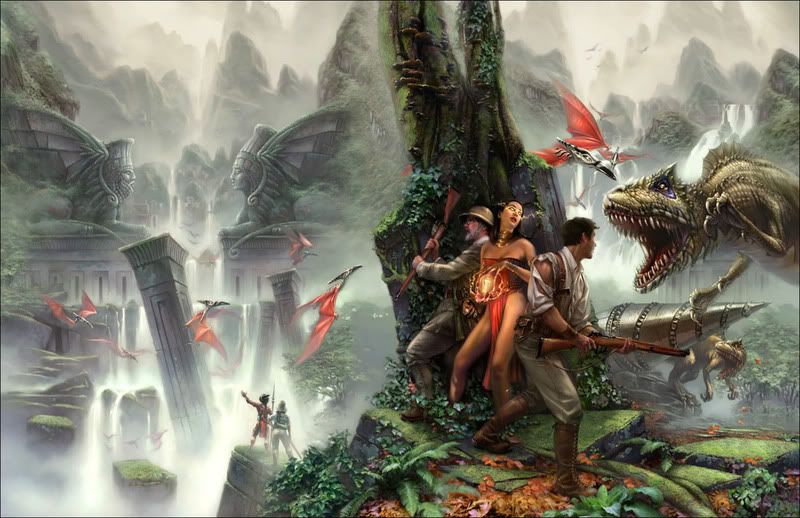
The next is by Daryl Mandryk, who did a bunch of concept art for Turok, so he knows a thing or two about guys shooting dinosaurs. This one is unrelated to Turok, though—as near as I can tell—it's just a really cool image.
Tuesday, May 06, 2008
Ignore this post
This post is just for my own benefit. I'm trying to make a list of Ray Feist books in the order in which I believe they should be read. Although I say that I like him, I've actually only read a few of his books; I'm thinking of expanding my Ray Feist repertoire. The ones in bold are ones that I've already read while ones in italics are announced but not yet released. I'm skipping a few that aren't part of the "main chronology" although I am adding in the adjunct tangent set on Kelewan because they are so highly regarded. Switching from blue to black and vice versa indicates moving to a new sub-series within the greater series.
- Magician: Apprentice
- Magician: Master
- Silverthorn
- A Darkness at Sethanon
- Daughter of the Empire
- Servant of the Empire
- Mistress of the Empire
- Prince of the Blood
- King's Buccaneer
- Shadow of a Dark Queen
- Rise of a Merchant Prince
- Rage of a Demon King
- Shards of a Broken Crown
- Talon of the Silver Hawk
- King of Foxes
- Exile's Return
- Flight of the Nighthawks
- Into a Dark Realm
- Wrath of a Mad God
- Rides a Dread Legion
- Return of the Demon King
- A Kingdom Beseiged
- A Crown Imperiled
- Magician's End
More fantasy hackery
Thinking of the blog post I wrote yesterday, it's not surprising that I've become a bit disenchanted with High Fantasy as a genre. J. R. R. Tolkien is probably my favorite single writer ever, and remains so, and I have a fond nostalgia for C. S. Lewis and Lloyd Alexander as well. Ray Feist is another one that I like quite a bit.
But once you go beyond that, you get to writers like R. A. Salvatore, Terry Brooks, David Eddings, Ursula LeGuin, Stephen R. Donaldson, Terry Goodkind, Robert Jordan—all writers that inspire in me reactions somewhere between polite disinterest to active hatred. Not a fan of most of their stuff.
So the last few years, I've wandered a bit away from High Fantasy, and am only cooly curious about what's going on in the field.
Because I have a friend who continually raves about them, I'll try out some Brust and Erikson eventually too. Maybe when George R. R. Martin finally finishes his work, I'll have a look at that.
Otherwise, I'm finding myself more and more turning back to older, sword & sorcery style authors and enjoying the vibe of that much more vibrant, pulpy kind of writing quite a bit. I've also enjoyed some Glen Cook, but I don't know exactly what kind of fantasy I'd call his work.
But once you go beyond that, you get to writers like R. A. Salvatore, Terry Brooks, David Eddings, Ursula LeGuin, Stephen R. Donaldson, Terry Goodkind, Robert Jordan—all writers that inspire in me reactions somewhere between polite disinterest to active hatred. Not a fan of most of their stuff.
So the last few years, I've wandered a bit away from High Fantasy, and am only cooly curious about what's going on in the field.
Because I have a friend who continually raves about them, I'll try out some Brust and Erikson eventually too. Maybe when George R. R. Martin finally finishes his work, I'll have a look at that.
Otherwise, I'm finding myself more and more turning back to older, sword & sorcery style authors and enjoying the vibe of that much more vibrant, pulpy kind of writing quite a bit. I've also enjoyed some Glen Cook, but I don't know exactly what kind of fantasy I'd call his work.
Plate tectonics
I've recently become mildly annoyed with some sources on plate tectonics that I've looked at, because they treat the "Eurasian plate" as if it were, in fact, a single plate, which it is not. If it were, there would be no explanation at all for all the mountains that are smack-dab in the middle of the plate, and we'd only be able to explain the Alps (as the boundary between Europe and Africa) and the Himalayas (where the Indian plate has charged into the flank of Eurasia.) Where then did all the other mountains come from, including the Urals, the Caucasus, the Zagros, etc.?
The fact is, that Eurasia has a much more interesting history than simply being the Eurasian plate forever. Siberia was once a unique continent, and the Urals formed when Baltica charged into them. Baltica then split along what become the Mid-Atlantic rift, separating Europe from North America. Khazakstania was a separate plate as well, and China is largely made up of the Amur plate. Smaller plates, such as Okhotsk plate, the Anatolian plate the Sunda plate, etc. also contributed to what it today called the Eurasian plate. Some of these have been stuck together (and moved together) for so long that at the moment they are behaving as a single plate, but others are not—the Amur and Anatolian plates are both slowly rotated, for instance, in place.
When you've got all that interest, why simply simplify and say, "it's all the Eurasian plate?" Not only is it inaccurate, but it's boring.
The fact is, that Eurasia has a much more interesting history than simply being the Eurasian plate forever. Siberia was once a unique continent, and the Urals formed when Baltica charged into them. Baltica then split along what become the Mid-Atlantic rift, separating Europe from North America. Khazakstania was a separate plate as well, and China is largely made up of the Amur plate. Smaller plates, such as Okhotsk plate, the Anatolian plate the Sunda plate, etc. also contributed to what it today called the Eurasian plate. Some of these have been stuck together (and moved together) for so long that at the moment they are behaving as a single plate, but others are not—the Amur and Anatolian plates are both slowly rotated, for instance, in place.
When you've got all that interest, why simply simplify and say, "it's all the Eurasian plate?" Not only is it inaccurate, but it's boring.
Monday, May 05, 2008
Fantasy hackery
When I was a kid, I benefitted a lot from living in a place that had nearly year-long clement weather. I also benefitted from living before the age of paranoia in which we live now; so my parents didn't worry overly much that I galivanted all over town as a child. I also happened to live in a town that was the perfect size; small enough to have that small town feel; large enough to have just about everything I could want to go see.
I can't remember if I started this in kindergarten or not, but certainly by 1st grade, I was riding my bike to school. With the benefit of Yahoo! Maps, I could chart how far that as, and it was about three quarters of a mile through residential streets. I get about two and a half miles to the public library, which by the time I was twelve, I was doing almost weekly, especially during the summer. There also was a used bookstore, Half Price Books, that wasn't very far from me either, and I used to make regular forays in that direction as well. I had a couple of decent new books stores within easy striking distance as well.
As you can probably guess based on the above, I was a rather voracious reader as a kid. I typically tell people that I used to read books by the truckload. And I very rarely gave up on books; even ones that were particularly bad. This was before the "paper crisis" that made prices increase dramatically in the early 90s; relatively slim novels still cost $1.99 at the time, and even large, thicker ones were rarely more than $3.99 or $4.99 for the absolute largest ones. Not that I had a ready source of cash before I turned 16 and got a regular job, but books were cheap enough that I between the library, the new bookstores and the used bookstores (where I'd also turn in books I was done with and didn't figure I'd ever read again) I had a pretty steady flow of books coming into the house. Good thing, too, given the rate at which I could read them.
Although my reading interests were fairly diverse, in the fiction department I certainly read much more science fiction and fantasy than anything else. I read a few westerns, a few other adventure tales, some modern thriller/bestseller types, and even on slow days I'd pick up a handful of my sisters romances, but I usually read fantasy and sci-fi, and a lot of non-fiction.
There's a lot of fairly bad science fiction and fantasy, too—but like I said, as a kid I usually perservered and read them anyway. There's a lot of good stuff out there too, after all. One of my favorite discoveries from this time was Edgar Rice Burroughs. I used to watch a Filmation Tarzan series as a kid that I really liked (and which was surprisingly faithful to the tone of ERB's Tarzan) and I had heard of the John Carter of Mars books, so I readily dove into both of those and started a long-lived love affair that continues to this day. I also read, at a friend's recommendation, the Chronicles of Prydain, which was my first High Fantasy series. The next year I finally (and belatedly) discovered Tolkien at the age of 12.
As a curious coincidence, not long after I discovered fantasy and read most of what I could get my hands on at the libraries and bookstores, Margaret Weis and Tracy Hickman published the first Dragonlance books. I remember seeing the small section of the shelf rather rapidly balloon out as novels were published four or five a year, and calendars (with cool Larry Elmore art) popped up and obviously a minor little craze was going on around the property. So by 1987 or 1988 or so, I found a copy of the three Dragonlance original trilogy novels (including one signed by Margaret Weis) at my used bookstore and picked them up. They were better than I expected, and remain one of the very few game-related fiction pieces that I thought was good enough to keep (other than that, I think the original three R. A. Salvatore Forgotten Realms novels are the only ones. And I've had second thoughts about those from time to time.)
One series I discovered and like quite a bit was by Raymond Feist; the original Riftwar Saga. Although not technically game fiction, as it turns out, the setting of Midkemia on which the action takes place, was in fact a roleplaying game setting that Feist and his friends used. He set the first book 500 years before his game (which means that all the books he's published for Midkemia take place way before his game; I'm a little curious what the setting looked like at the time of his game, actually.) There's also the possibility that Kelewan and the Tsurani Empire—the other major world described in the Riftwar Saga—was heavily influenced by Tekumel and their own Tsolyáni Empire.
The reason I bring this up is that I recently (finally) moved all my fantasy books from the boxes in the basement, where they were a real pain to get to, to a large bookcase that I have in my bedroom. In doing so, I discovered that I am missing some of my books—and among them are the first three Riftwar books, which I consider a high priority to recover.
I like the Riftwar. I like Midkemia. I like Kelewan. Sure; none of them are terribly original; Midkemia feels like a D&D world (and for all intents and purposes, it is—although Feist and the other creators do acknowledge that they very early became dissatisfied with D&D as a system and created their own, the feel is still very similar). However, unlike the farmed out game fiction novels, Feist actually really loves his setting and cares about it, which helps his novels immensely. He's also a skilled enough writer to write what he wants rather than be simply a "novelist for hire." Despite my disdain for "game fiction" however, I do have to admit that a lot of it—maybe most of it—is still the equal to other fantasy "hack" writers; folks like David Eddings or Terry Brooks.
I can't remember if I started this in kindergarten or not, but certainly by 1st grade, I was riding my bike to school. With the benefit of Yahoo! Maps, I could chart how far that as, and it was about three quarters of a mile through residential streets. I get about two and a half miles to the public library, which by the time I was twelve, I was doing almost weekly, especially during the summer. There also was a used bookstore, Half Price Books, that wasn't very far from me either, and I used to make regular forays in that direction as well. I had a couple of decent new books stores within easy striking distance as well.
As you can probably guess based on the above, I was a rather voracious reader as a kid. I typically tell people that I used to read books by the truckload. And I very rarely gave up on books; even ones that were particularly bad. This was before the "paper crisis" that made prices increase dramatically in the early 90s; relatively slim novels still cost $1.99 at the time, and even large, thicker ones were rarely more than $3.99 or $4.99 for the absolute largest ones. Not that I had a ready source of cash before I turned 16 and got a regular job, but books were cheap enough that I between the library, the new bookstores and the used bookstores (where I'd also turn in books I was done with and didn't figure I'd ever read again) I had a pretty steady flow of books coming into the house. Good thing, too, given the rate at which I could read them.
Although my reading interests were fairly diverse, in the fiction department I certainly read much more science fiction and fantasy than anything else. I read a few westerns, a few other adventure tales, some modern thriller/bestseller types, and even on slow days I'd pick up a handful of my sisters romances, but I usually read fantasy and sci-fi, and a lot of non-fiction.
There's a lot of fairly bad science fiction and fantasy, too—but like I said, as a kid I usually perservered and read them anyway. There's a lot of good stuff out there too, after all. One of my favorite discoveries from this time was Edgar Rice Burroughs. I used to watch a Filmation Tarzan series as a kid that I really liked (and which was surprisingly faithful to the tone of ERB's Tarzan) and I had heard of the John Carter of Mars books, so I readily dove into both of those and started a long-lived love affair that continues to this day. I also read, at a friend's recommendation, the Chronicles of Prydain, which was my first High Fantasy series. The next year I finally (and belatedly) discovered Tolkien at the age of 12.
As a curious coincidence, not long after I discovered fantasy and read most of what I could get my hands on at the libraries and bookstores, Margaret Weis and Tracy Hickman published the first Dragonlance books. I remember seeing the small section of the shelf rather rapidly balloon out as novels were published four or five a year, and calendars (with cool Larry Elmore art) popped up and obviously a minor little craze was going on around the property. So by 1987 or 1988 or so, I found a copy of the three Dragonlance original trilogy novels (including one signed by Margaret Weis) at my used bookstore and picked them up. They were better than I expected, and remain one of the very few game-related fiction pieces that I thought was good enough to keep (other than that, I think the original three R. A. Salvatore Forgotten Realms novels are the only ones. And I've had second thoughts about those from time to time.)
One series I discovered and like quite a bit was by Raymond Feist; the original Riftwar Saga. Although not technically game fiction, as it turns out, the setting of Midkemia on which the action takes place, was in fact a roleplaying game setting that Feist and his friends used. He set the first book 500 years before his game (which means that all the books he's published for Midkemia take place way before his game; I'm a little curious what the setting looked like at the time of his game, actually.) There's also the possibility that Kelewan and the Tsurani Empire—the other major world described in the Riftwar Saga—was heavily influenced by Tekumel and their own Tsolyáni Empire.
The reason I bring this up is that I recently (finally) moved all my fantasy books from the boxes in the basement, where they were a real pain to get to, to a large bookcase that I have in my bedroom. In doing so, I discovered that I am missing some of my books—and among them are the first three Riftwar books, which I consider a high priority to recover.
I like the Riftwar. I like Midkemia. I like Kelewan. Sure; none of them are terribly original; Midkemia feels like a D&D world (and for all intents and purposes, it is—although Feist and the other creators do acknowledge that they very early became dissatisfied with D&D as a system and created their own, the feel is still very similar). However, unlike the farmed out game fiction novels, Feist actually really loves his setting and cares about it, which helps his novels immensely. He's also a skilled enough writer to write what he wants rather than be simply a "novelist for hire." Despite my disdain for "game fiction" however, I do have to admit that a lot of it—maybe most of it—is still the equal to other fantasy "hack" writers; folks like David Eddings or Terry Brooks.
Friday, May 02, 2008
Leng Calling
That's Falco's "Vienna Calling." While I was trying to think of a better name for my "DarkDnD" site I had the idea "Leng Calling." It got that song stuck in my head.
Despite that, I do kinda like it. The URL hasn't changed, but the title has. Plus, I get to hear some cheesy 80s Austrian dance music in my head the rest of the morning. It doesn't get much better than that.
Wednesday, April 30, 2008
Minority languages
All two or three of you reading may be saying by now, "enough with the languages, you dolt!" But, as a self-confessed linguiphile, I carry on.
Foolishly—or naïvely—I had learned that the Romance languages were Spanish, Portuguese, Italian, French and Romanian, and I believed that was the whole story. "Minority languages" in Europe would have meant oddball exceptions like Basque, or the Urdu that Pakistani immigrants spoke, or something like that. I never would have guessed that minority languages could include twice as many more extant Romance languages than the list of ones I did know.
My ignorance there isn't really surprising, though—I was surprised and saddened to learn that many speakers of Asturian, for example, weren't even aware of their own language and only assumed that they spoke some really bad hillbilly Spanish. It's only in the last couple of decades or so that awareness of and promotion of these minority languages has been important to the European community.
I have mixed feelings about efforts to preserve languages—if you think about it, you're not really doing the native language speakers of some really obscure language, such as Aragonese with it's highly optimistic number of 30,000 speakers any favors by trying to make them keep it up instead of learning Spanish and entering the broader, cosmopolitan world around them. However, as a self-confessed linguiphile, I also believe that languages are fascinating cultural artifacts worth preserving for their own sake. Ideally, I'd like to see numbers grow for languages, and diversity foster, but in today's increasingly cosmopolitan world-culture I recognize that that's unlikely. Languages grow because they're already big, successful and cosmopolitan, so you can expect to see languages like English, Spanish, Mandarin, etc. grow, at the expense of minority languages. Sadly.
Because of amateur research of late has been into Romance languages, it's there that I'm seeing this most clearly. Have you ever heard of Galician or Asturian, or even if you have, did you recognize that they were completely different languages from Spanish and Portuguese, although closely related to both? Did you realize that a huge chunk of France speaks Occitan as its native language rather than French, or that Occitan and Catalan make up a separate branch of Romance languages? Did you realize that Sardinian was a separate Romance language on it's own little branch, or that Sicilian, Venetian, Piedmontese, Lombard and a number of other languages in northern Italy and southern Switzerland actually aren't Italian, but are instead separate languages? To name just a few!
I did not. And I find the whole thing fascinating. The Romance languages have gone just recently from a fairly pedestrian and utilitarian topic to me (not unusual given the growing prevalence of Spanish in the United States) to one full of mystery, surprise and excitement.
I'm lovin' it. And not in a MadDonald's way.
Foolishly—or naïvely—I had learned that the Romance languages were Spanish, Portuguese, Italian, French and Romanian, and I believed that was the whole story. "Minority languages" in Europe would have meant oddball exceptions like Basque, or the Urdu that Pakistani immigrants spoke, or something like that. I never would have guessed that minority languages could include twice as many more extant Romance languages than the list of ones I did know.
My ignorance there isn't really surprising, though—I was surprised and saddened to learn that many speakers of Asturian, for example, weren't even aware of their own language and only assumed that they spoke some really bad hillbilly Spanish. It's only in the last couple of decades or so that awareness of and promotion of these minority languages has been important to the European community.
I have mixed feelings about efforts to preserve languages—if you think about it, you're not really doing the native language speakers of some really obscure language, such as Aragonese with it's highly optimistic number of 30,000 speakers any favors by trying to make them keep it up instead of learning Spanish and entering the broader, cosmopolitan world around them. However, as a self-confessed linguiphile, I also believe that languages are fascinating cultural artifacts worth preserving for their own sake. Ideally, I'd like to see numbers grow for languages, and diversity foster, but in today's increasingly cosmopolitan world-culture I recognize that that's unlikely. Languages grow because they're already big, successful and cosmopolitan, so you can expect to see languages like English, Spanish, Mandarin, etc. grow, at the expense of minority languages. Sadly.
Because of amateur research of late has been into Romance languages, it's there that I'm seeing this most clearly. Have you ever heard of Galician or Asturian, or even if you have, did you recognize that they were completely different languages from Spanish and Portuguese, although closely related to both? Did you realize that a huge chunk of France speaks Occitan as its native language rather than French, or that Occitan and Catalan make up a separate branch of Romance languages? Did you realize that Sardinian was a separate Romance language on it's own little branch, or that Sicilian, Venetian, Piedmontese, Lombard and a number of other languages in northern Italy and southern Switzerland actually aren't Italian, but are instead separate languages? To name just a few!
I did not. And I find the whole thing fascinating. The Romance languages have gone just recently from a fairly pedestrian and utilitarian topic to me (not unusual given the growing prevalence of Spanish in the United States) to one full of mystery, surprise and excitement.
I'm lovin' it. And not in a MadDonald's way.
Tuesday, April 29, 2008
DarkDND
I've decided that I'll take up the further adventures of Rodrico and Francesca on the wiki that I designed especially for taking up the further adventures of Rodrico and Francesca.
Link here: http://darkdnd.wikispaces.com/
Sorry for the lame name, DarkDnD. I had to think of something quick and that's what I got. That brings to mind another thought I've had about designing fantasy worlds. Few fantasy worlds lack names; it helps the reader distinguish that world from the real world, or from other fantasy worlds, for that matter. Oddly, the real world doesn't really have a name; it's just "the world" or "earth." I sometimes wonder if Earth is a slight mistranslation of the Latin Terra; if what was actually meant was "land" to distinguish it from the oceans and seas.
In any case, it's not really a name. Even Terra isn't really a name, as some sci-fi writers like to use, it's just an ancient tradition to use the Latin name that has been revived to give a slight ring of authenticity and formality, but once you realize that Terra is just the Latin word for earth (or land) then some of that mystique dries up.
Although I certainly don't claim to have done an exhaustive survey, it strikes me that few cultures on our world (in fact, I can't think of a single one) have actually named the world anything other than variants on "the world." Why would they? As far as most of them knew, it was a singular thing. There's no need to name something if there's just one of them. Likewise, most cultures call the sun simply "the sun" and the moon simply "the moon" when translated out of their native languages; because they're also singular entities. They knew of nothing to which to compare them, so there was no need to name them.
So I've given some thought in fantasy worldbuilding exercises, either for gaming or for fiction, to the question. If the inhabitants of your fantasy world have a name for the world, why do they use that name and what does it mean? It's not enough simply to have a cool sounding name "just because." Well, maybe it is, but at least it makes me sit up and wonder why. If it's just for the reader's convenience, that's one thing, but I like to make at least a brief nod towards an "in setting" reason for the name to exist.
For my Dark•Heritage setting, the world is called Kael. However, in that setting, ancient traditions held forth that humanity originally came from another world, therefore they always were cognizant of the idea that there were other worlds beside their own. Knowing of other worlds meant that they needed to name them to distinguish them; otherwise, "the world" begs the question "which world?" Kael, therefore, is an ancient word from very primitive languages that has survived as a relic and which originally meant "new home".
The other setting I've been tinkering with lately I call Jovis. That's a name that I came up with on the fly, and it's not very clever (Jovis is based on the archaic Latin Iovis. The compound Iovis Pater—Father Jove—is the source of the word Jupiter. I used that because Jovis is a world as large as Jupiter; albeit one with a much lesser density, such that the surface gravity is the same as our world.) That's the whole sordid tale of the origin of the name Jovis, and it's really for reader convenience, and in setting the world is rarely named—except by those who travel beyond it. Which of course are very few people, but the main characters of that setting are some such people. My idea there is that few people on Jovis know or use the name Jovis, and that the characters really only learn the name from those they visit outside of the world, or from other travelers who had to come up with a name for the world.
By the way, I fully admit that DarkDnD is an even worse name than Jovis. At the time I created the wiki I had given absolutely no thought to naming the setting; I just wanted someplace I could doodle with the ideas behind it.
Link here: http://darkdnd.wikispaces.com/
Sorry for the lame name, DarkDnD. I had to think of something quick and that's what I got. That brings to mind another thought I've had about designing fantasy worlds. Few fantasy worlds lack names; it helps the reader distinguish that world from the real world, or from other fantasy worlds, for that matter. Oddly, the real world doesn't really have a name; it's just "the world" or "earth." I sometimes wonder if Earth is a slight mistranslation of the Latin Terra; if what was actually meant was "land" to distinguish it from the oceans and seas.
In any case, it's not really a name. Even Terra isn't really a name, as some sci-fi writers like to use, it's just an ancient tradition to use the Latin name that has been revived to give a slight ring of authenticity and formality, but once you realize that Terra is just the Latin word for earth (or land) then some of that mystique dries up.
Although I certainly don't claim to have done an exhaustive survey, it strikes me that few cultures on our world (in fact, I can't think of a single one) have actually named the world anything other than variants on "the world." Why would they? As far as most of them knew, it was a singular thing. There's no need to name something if there's just one of them. Likewise, most cultures call the sun simply "the sun" and the moon simply "the moon" when translated out of their native languages; because they're also singular entities. They knew of nothing to which to compare them, so there was no need to name them.
So I've given some thought in fantasy worldbuilding exercises, either for gaming or for fiction, to the question. If the inhabitants of your fantasy world have a name for the world, why do they use that name and what does it mean? It's not enough simply to have a cool sounding name "just because." Well, maybe it is, but at least it makes me sit up and wonder why. If it's just for the reader's convenience, that's one thing, but I like to make at least a brief nod towards an "in setting" reason for the name to exist.
For my Dark•Heritage setting, the world is called Kael. However, in that setting, ancient traditions held forth that humanity originally came from another world, therefore they always were cognizant of the idea that there were other worlds beside their own. Knowing of other worlds meant that they needed to name them to distinguish them; otherwise, "the world" begs the question "which world?" Kael, therefore, is an ancient word from very primitive languages that has survived as a relic and which originally meant "new home".
The other setting I've been tinkering with lately I call Jovis. That's a name that I came up with on the fly, and it's not very clever (Jovis is based on the archaic Latin Iovis. The compound Iovis Pater—Father Jove—is the source of the word Jupiter. I used that because Jovis is a world as large as Jupiter; albeit one with a much lesser density, such that the surface gravity is the same as our world.) That's the whole sordid tale of the origin of the name Jovis, and it's really for reader convenience, and in setting the world is rarely named—except by those who travel beyond it. Which of course are very few people, but the main characters of that setting are some such people. My idea there is that few people on Jovis know or use the name Jovis, and that the characters really only learn the name from those they visit outside of the world, or from other travelers who had to come up with a name for the world.
By the way, I fully admit that DarkDnD is an even worse name than Jovis. At the time I created the wiki I had given absolutely no thought to naming the setting; I just wanted someplace I could doodle with the ideas behind it.
Thursday, April 24, 2008
Catalan, Occitan, Galician, etc.
So, I googled up some Catalan placenames, and I ended up finding some website that had place names for minority languages all over the place. I got a great list of Catalan names (side by side with the more well-known Spanish or French ones), Occitan placenames, Galician placenames, Aragonese place names and Asturian (I quit after those, but that barely scratched the surface.) I also got a census of names (in Catalan, mostly) from Valencia in 1510, which I thought was really interesting.
So, after trawling around in these fantastic and relatively unknown (in the Anglophone world, anyway) languages, I've come up with the brother/sister team of daemon hunters, Rodrico d'Arnau Domènechoz and Francesca de Sperança Domènechoz. They're twins; but poor Francesca got the short end of the stick when she was born a tiefling—her twin brother is full human.
Orphaned at a relatively young age, but heirs to a modest property in the idyllic and pastoral provincial upcountry of Calça, they were raised as wards of the Church at a small priory in Baix Colomers by a strict and hard (yet kindly underneath it all) man of the cloth. This man, Pare Bartomeu de Nicolau Fontanills was very conservative in his outlook, very wary of heresy or anything untoward. Of course, raising a tiefling child also made him a bit paranoid, and perhaps he overdid it to some extent. In his attempts to ensure that the children didn't fall into darkness themselves, and simultaneously to protect them from suspicion (mostly by trying to ensure as few people even knew about them as possible) he actually incited their curiousity about daemonology and Francesca's darker heritage, as well as giving them an insatiable desire to travel and see all the things that the poor pare denied them.
Despite these mistakes (or possibly exacerbating them) the pare arranged for the best possible education for his wards; they were trained in languages, art, math, science, geography, and fencing, and learned woodcraft and other more practical skills that would help them eventually manage the estate they were to inherit. That never came to be.
Ironically, it was not Francesca, the overtly daemonic-featured sibling who engaged in questionable behavior, it was her brother Rodrico who tampered with forbidden arts, summoning spirits from beyond the world and binding them to his service. While not an overtly evil thing to do, it is one that is heretical and that people fear greatly, equating it (by definition) with witchcraft.
Word of the twins; who had the appearance of daemons (which would be true for Rodrico too when manifesting the sign of a vestige) caused a riot of the peasantry in peaceful little Baix Colomers in which poor Pare Fontanills was killed and Rodrico and Francesca barely escaped with their lives.
More on the twins soon... I've actually started up a space to talk about this stuff. http://darkdnd.wikispaces.com.
So, after trawling around in these fantastic and relatively unknown (in the Anglophone world, anyway) languages, I've come up with the brother/sister team of daemon hunters, Rodrico d'Arnau Domènechoz and Francesca de Sperança Domènechoz. They're twins; but poor Francesca got the short end of the stick when she was born a tiefling—her twin brother is full human.
Orphaned at a relatively young age, but heirs to a modest property in the idyllic and pastoral provincial upcountry of Calça, they were raised as wards of the Church at a small priory in Baix Colomers by a strict and hard (yet kindly underneath it all) man of the cloth. This man, Pare Bartomeu de Nicolau Fontanills was very conservative in his outlook, very wary of heresy or anything untoward. Of course, raising a tiefling child also made him a bit paranoid, and perhaps he overdid it to some extent. In his attempts to ensure that the children didn't fall into darkness themselves, and simultaneously to protect them from suspicion (mostly by trying to ensure as few people even knew about them as possible) he actually incited their curiousity about daemonology and Francesca's darker heritage, as well as giving them an insatiable desire to travel and see all the things that the poor pare denied them.
Despite these mistakes (or possibly exacerbating them) the pare arranged for the best possible education for his wards; they were trained in languages, art, math, science, geography, and fencing, and learned woodcraft and other more practical skills that would help them eventually manage the estate they were to inherit. That never came to be.
Ironically, it was not Francesca, the overtly daemonic-featured sibling who engaged in questionable behavior, it was her brother Rodrico who tampered with forbidden arts, summoning spirits from beyond the world and binding them to his service. While not an overtly evil thing to do, it is one that is heretical and that people fear greatly, equating it (by definition) with witchcraft.
Word of the twins; who had the appearance of daemons (which would be true for Rodrico too when manifesting the sign of a vestige) caused a riot of the peasantry in peaceful little Baix Colomers in which poor Pare Fontanills was killed and Rodrico and Francesca barely escaped with their lives.
More on the twins soon... I've actually started up a space to talk about this stuff. http://darkdnd.wikispaces.com.
Wednesday, April 23, 2008
Italo Disco Top 20
I stumbled across a site (http://www.italo-disco.net/) that has a "Top 20" of the genre on it, and I thought I'd do the same just for fun. The author of that site has more exposure to the genre than I do, but I still have enough to narrow down twenty of my favorites and still have lots left over.
These are simply in alphabetical order by artist:
These are simply in alphabetical order by artist:
- Bad Boys Blue "Pretty Young Thing" — This one skirts the edges of the definition of italo-disco somewhat, but since that definition is pretty arbitrary, and this sounds exactly like an italo-disco song, I'm letting it it slide. Plus, it was part of one of the Gapul megamixes I picked up in Argentina, which was so very formative to my awareness of the genre in the first place. Sadly, I just learned that the lead vocalist died (at the age of 50) from a sudden heart attack earlier this year.
- Baltimora "Tarzan Boy" — For a very long time, this was the only italo-disco song that I knew of, and I wouldn't have called it italo-disco if I hadn't seen it on some Gapul megamixes also and realized that it fit right in. This gets a few bonus points for cracking into the American and British markets; something no other italo-disco song ever did.
- Brian Ice "Talking to the Night" — I'm leaning heavily on the old Gapul megamixes as source material, because that's where I first heard so many of these songs (and therefore, cemented them as favorites in my mind even after I started branching out beyond them.) This was literally the first song on the first mix I heard, and it's been a favorite ever since.
- Den Harrow "Future Brain" — Great song, and apparently a real chart-topper on the continent years ago. Sadly, Den Harrow has recently undergone a Milli Vanilli style controversy; apparently the frontman was merely a model lip synching while other people sang the lyrics. Still; good song. Classic of the genre.
- Fancy "Bolero" — Fancy has the dubious honor of being one of the weirdest looking italo-disco stars. He's also a German and supposedly is a good friend to Siegfried and Roy. Wow. Anyway, I like this song; it's very overblown and overly dramatic, but that's part of the fun. Nobody said these guys took themselves seriously; after all they were disco artists.
- Fun Fun "Baila Bolero" — unlike the superficially similar synthpop genre, female vocalists were relatively common in italo-disco, and this is a great example of two Italian gals singing about a fling with a Spaniard. Ivana Spagna is also supposedly some of the musical talent behind the two front-girls; she was a notable italo-disco star in her own right (although not one that I'm particularly fond of, as it happens.)
- Hivoh "To Be Together" — the sappy teen angst in the lyrics here makes it particular fun. He can't go back to class because they're broken up? Haha. The deadly serious and dark nature of the music accompanying these terribly cheesy lyrics is the icing on the cake. A feature of the genre in general is really bad lyrics, though—I mean, these artists obviously didn't really speak English very well, and not only are the lyrics really bad but so is the delivery of them.
- Hot Cold "Love is Like a Game" — another really fun disco song with female vocals (and another one of my original Gapul favorites.)
- Ken Laszlo "Tonight" — I've already posted the video here earlier; this is probably my single favorite italo-disco song. It's a close call, though.
- Miko Mission "Two For Love" — Although "How Old Are You?" is probably (marginally) a bigger hit, this one wins because I heard it first, and asking a girl if she's old enough to date or not is really creepy.
- Mirage "No More No War" — The sheer chutzpah of recording a song with these lyrics is part of its charm; they're dreadfully sappy and vapid, while giving the superficial appearance of being timely and politically deep. Oh, well. Mostly I just like the beat. Some nice synthlines on this one.
- P. Lion "Happy Children" — P. Lion did a number of songs which are all pretty good, if a bit disposable, but this one actually stands out from that crowd as a bit more substantive and having a bit more artistic merit. Not too much, mind you, but enough to stand out.
- R. Bais "Dial My Number" — Great song. Decent lyrics, which is a change.
- Radiorama "Chance to Desire" — I struggled a bit with which Radiorama song to include, as they actually have a good half dozen or more than are all great songs. Radiorama is another one that wasn't content to be "just" disco music, and they had a number of surprisingly thoughtful and musically deft songs. This one is my favorite of the bunch, though.
- Raff "Self Control" — Another song that I heard on a Gapul megamix, but it also is one of my favorites overall. It seemed really familiar to me, even though I doubt I could have heard it when it was current, but Laura Branigan remade it and it was a minor hit in the states by her.
- Sandy Marton "People From Ibiza" — Sandy Marton had a small string of hits, including "Exotic and Erotic", and "Camel By Camel" and a few others. This one is my favorite. I wasn't aware of Ibiza's reputation as a party island until I looked into it after hearing this song, too.
- Savage "Only You" — I was very tempted to put "Don't Cry Tonight", which is probably a bigger hit for Savage, but I think I like "Only You" a little bit more. They sound very similar anyway; "Don't Cry Tonight" is almost somnambulant it's so slow now. I have to remind myself, but my version is one that I ripped to mp3, opened up in an audio manipulation software, and speeded the tempo up a bit. It's still slowish (and it needs to be) but it's not too slow.
- Silent Circle "Touch in the Night" — Silent Circle was another hit machine, cranking out several songs that are well remembered today. This is probably their most successful and—you probably guessed it—appeared prominantly in my favorite Gapul megamix.
- Silver Pozzoli "Around My Dream" — Despite the clunky lyrics, this is a fun song. Relatively chipper, despite it's laid-back tempo, this is one of the great "feel good" songs of the genre.
- Taffy "I Love My Radio" — A big hit in the UK; unusual for the genre, yet still unknown in the States for the most part. Very nice female vocalist.
If I could admit an even looser definition of "the genre" that included some other club-oriented music from the same time frame, many of it very similar in nature, I'd also add Bobby O's "She Has a Way", Vicious Pink's "Take Me Now", Man 2 Man's "Male Stripper", Paul Lekakkis' "Boom Boom (Let's Go Back to My Room)", Dead or Alive's "You Spin Me Round (Like a Record)" and C.C.C.P.'s "American Soviets." But for now, I'm going to be more strict in genre definition and leave them out of the count.
I'll also point out that youtube has most of these songs on it, if you want to hear them, and the link I presented at the very beginning of the post has very low quality mp3 samples of most of them as well.
Monday, April 21, 2008
Latin names
Considering the fact that as a teenager I learned Spanish pretty fluently and have had an abiding interest in Latin languages ever since, it's a little bit odd, if you think about it, that I never thought of using Latin names for fantasy. I don't mean actual, honest-to-goodness Latin; I mean the various descendents of vulgar Latin; i.e., the Romance languages of today.
It took barsoomcore to show me the light; when I first read about his homebrew Barsoom setting (no relation to Edgar Rice Burroughs' world of the same name; except some vague similarities in tone and ecology). And he had a nation that used Spanish sounding names. barsoomcore's Barsoom was already a big "click" for me; which is unsurprising seeing how similar it was in many ways to ideas I had at the time I first read about it, but this idea of using Spanish names, simple as it may have been, was something that had never occured to me and seemed like a great idea.
As I've poked around a bit, I've actually decided to make it a little—but not much—more exotic than that. Rather than using actual Spanish, I've been combing through namelists and dictionaries of Galician, Catalan, Provençal (or Occitan) and Romanian, with occasional Italian as well, and going with that. Other times, I simply take Spanish words and names and subtly alter them manually so that they feel familiar—but not too familiar. One wants to give the impression that ones setting is more exotic than southern California, at least.
This goes back to my theory—which is really the point I was trying to make—that too exotic isn't exactly helpful. I was recently reading a Lin Carter book on the fantasy genre, which I thought was turgid and spectacularly non-academic, despite it's claims to the contrary. Carter himself is no huge name junkie (I still wince at his princess Darloona in his own Barsoom ripoff, the Jandar of Callisto books) and he held out a number of Lord Dunsany's worst names as models to be striven for. H. P. Lovecraft also criticized his friend and fellow pulpster Robert E. Howard for using real-like names instead of bizarro combinations of consonants and vowels that can't even be properly pronounced, thinking that it ruined the verissimilitude of the world as a fantasy construct or something.
I think both of them missed the boat there; people in general, when subjected to really difficult or unusual words and names, tend to gloss over them, forget them and mix them up. There's a time in fantasy when you want to wow your audience with how exotic and fantastic your setting is, and the names is not that time. You want names that are easy for the audience to latch onto, that are familiar (but not too familiar) enough that they can relate to them.
Which is why I've decided that I really like using these slightly off-kilter and unfamiliar Romance languages like Provençal, Catalan, etc. as a source. They sound close enough to Spanish or Italian that nobody gets lost in the names, yet exotic enough that they don't sound like they're actually Spanish or Italian names.
It took barsoomcore to show me the light; when I first read about his homebrew Barsoom setting (no relation to Edgar Rice Burroughs' world of the same name; except some vague similarities in tone and ecology). And he had a nation that used Spanish sounding names. barsoomcore's Barsoom was already a big "click" for me; which is unsurprising seeing how similar it was in many ways to ideas I had at the time I first read about it, but this idea of using Spanish names, simple as it may have been, was something that had never occured to me and seemed like a great idea.
As I've poked around a bit, I've actually decided to make it a little—but not much—more exotic than that. Rather than using actual Spanish, I've been combing through namelists and dictionaries of Galician, Catalan, Provençal (or Occitan) and Romanian, with occasional Italian as well, and going with that. Other times, I simply take Spanish words and names and subtly alter them manually so that they feel familiar—but not too familiar. One wants to give the impression that ones setting is more exotic than southern California, at least.
This goes back to my theory—which is really the point I was trying to make—that too exotic isn't exactly helpful. I was recently reading a Lin Carter book on the fantasy genre, which I thought was turgid and spectacularly non-academic, despite it's claims to the contrary. Carter himself is no huge name junkie (I still wince at his princess Darloona in his own Barsoom ripoff, the Jandar of Callisto books) and he held out a number of Lord Dunsany's worst names as models to be striven for. H. P. Lovecraft also criticized his friend and fellow pulpster Robert E. Howard for using real-like names instead of bizarro combinations of consonants and vowels that can't even be properly pronounced, thinking that it ruined the verissimilitude of the world as a fantasy construct or something.
I think both of them missed the boat there; people in general, when subjected to really difficult or unusual words and names, tend to gloss over them, forget them and mix them up. There's a time in fantasy when you want to wow your audience with how exotic and fantastic your setting is, and the names is not that time. You want names that are easy for the audience to latch onto, that are familiar (but not too familiar) enough that they can relate to them.
Which is why I've decided that I really like using these slightly off-kilter and unfamiliar Romance languages like Provençal, Catalan, etc. as a source. They sound close enough to Spanish or Italian that nobody gets lost in the names, yet exotic enough that they don't sound like they're actually Spanish or Italian names.
Italo Disco
I can't recall if I've blogged about italo disco in the past or not. I'm a fan of the stuff; but let's face it, in most of the Anglophone world, nobody even recognizes what it is. I only discovered its existance when I lived in Argentina for a couple of years (1991-1993) and by that time, honestly, it was already old news.
Italo disco is basically a linear descendent of actual disco music. By the mid-80s it had developed into something that can be distinguishable as a seperate subgenre all its own. Italo disco is characterized, usually, by having a steady, danceable beat (usually performed by a drum machine), and rather spacey, overtly analog synthesizer based sounds. Its almost all continental European; Italians (not surprisingly) and Spaniards making up a fairly large number of the artists. Although native English speakers rarely dabbled in the genre, most of it features English lyrics, often performed by singers who are clearly barely (if that) proficient in the language. Although some have a bit of a darker sound, mostly the genre is upbeat, peppy and poppy. The best way to describe it is simply that it's fairly cheesy synthpop of mid-80s vintage from non-Anglophone countries.
Only one true italo disco song is well-known to Americans and the British, and that's Baltimora's "Tarzan Boy" although some few sources also list Laura Branigan (of "Gloria" fame) as either italo disco or Hi-NRG, and Taffy's "I Love My Radio" was also popular in the UK, if still unknown in the US. Hi-NRG is a linear descendant of italo disco and it is often difficult to make a meaningful distinction between the two save that Hi-NRG (also known as Eurobeat) usually hasa higher BPM (Beat Per Minute). Hi-NRG has at least one band that was a genuine hit in the US: Dead or Alive of "Brand New Lover" (and others) fame.
I'm certainly not a fan of italo disco because it's serious music, with impressive claims to musicallity and artistic merit; I just think the stuff is fun. Like I said, I encountered it in Argentina, a few years after its heyday, when I found some old cassette tapes by mix artists Gapul, who created a series of "megamixes"—songs that contained fragments of numerous other songs strung together. After trying (with quite a bit of difficulty until recently, when the global internet made such things a little bit easier) to track down the tracks singly, I've managed—slowly—to build up a modest collection of some of the best that the genre has to offer.
To hear some cool italo tracks without going to all the trouble that I did, you could check out Youtube.
Here's Brian Ice's "Talking to the Night"
http://www.youtube.com/watch?v=LtQeFshXAxs
Here's Ken Lazlo's "Tonight"
http://www.youtube.com/watch?v=PFwjTefo_bg
Here's Den Harrow's "Future Brain"
http://www.youtube.com/watch?v=LiABmaH6LLE
Here's Sandy Marton's "People From Ibiza"
http://www.youtube.com/watch?v=SrdShjy53Y8
While this can't possibly be the original video, here's Hot Cold's "Love Is Like a Game." Mistitled in this video, sadly.
http://www.youtube.com/watch?v=5XGhO-jVYmI
Italo disco is basically a linear descendent of actual disco music. By the mid-80s it had developed into something that can be distinguishable as a seperate subgenre all its own. Italo disco is characterized, usually, by having a steady, danceable beat (usually performed by a drum machine), and rather spacey, overtly analog synthesizer based sounds. Its almost all continental European; Italians (not surprisingly) and Spaniards making up a fairly large number of the artists. Although native English speakers rarely dabbled in the genre, most of it features English lyrics, often performed by singers who are clearly barely (if that) proficient in the language. Although some have a bit of a darker sound, mostly the genre is upbeat, peppy and poppy. The best way to describe it is simply that it's fairly cheesy synthpop of mid-80s vintage from non-Anglophone countries.
Only one true italo disco song is well-known to Americans and the British, and that's Baltimora's "Tarzan Boy" although some few sources also list Laura Branigan (of "Gloria" fame) as either italo disco or Hi-NRG, and Taffy's "I Love My Radio" was also popular in the UK, if still unknown in the US. Hi-NRG is a linear descendant of italo disco and it is often difficult to make a meaningful distinction between the two save that Hi-NRG (also known as Eurobeat) usually hasa higher BPM (Beat Per Minute). Hi-NRG has at least one band that was a genuine hit in the US: Dead or Alive of "Brand New Lover" (and others) fame.
I'm certainly not a fan of italo disco because it's serious music, with impressive claims to musicallity and artistic merit; I just think the stuff is fun. Like I said, I encountered it in Argentina, a few years after its heyday, when I found some old cassette tapes by mix artists Gapul, who created a series of "megamixes"—songs that contained fragments of numerous other songs strung together. After trying (with quite a bit of difficulty until recently, when the global internet made such things a little bit easier) to track down the tracks singly, I've managed—slowly—to build up a modest collection of some of the best that the genre has to offer.
To hear some cool italo tracks without going to all the trouble that I did, you could check out Youtube.
Here's Brian Ice's "Talking to the Night"
http://www.youtube.com/watch?v=LtQeFshXAxs
Here's Ken Lazlo's "Tonight"
http://www.youtube.com/watch?v=PFwjTefo_bg
Here's Den Harrow's "Future Brain"
http://www.youtube.com/watch?v=LiABmaH6LLE
Here's Sandy Marton's "People From Ibiza"
http://www.youtube.com/watch?v=SrdShjy53Y8
While this can't possibly be the original video, here's Hot Cold's "Love Is Like a Game." Mistitled in this video, sadly.
http://www.youtube.com/watch?v=5XGhO-jVYmI
Tuesday, April 15, 2008
Classics
Over the last few days, Julie and I have been watching a bunch of older movies. Classics, really. Stuff that everybody knows of, most people have seen, yet which we haven't seen in so long that our memories of the movies are hazy, or movies that we inexplicably missed over the years.
So far, I watched Casablanca and The Philadelphia Story with Julie, and then I watched High Society on my own. I'm not actually sure that High Society is a classic in the same sense; I don't know if it's well remembered or well-known today. I also don't know how I missed it; it was clearly one of my father's favorite movies ever; he watched it frequently as we grew up, and played the soundtrack (on vinyl!) all the time as well. So I knew all the songs, even though I hadn't ever seen the movie.
For those of you who don't know, it was a musical remake of The Philadelphia Story; which was itself a pretty famous movie starring Cary Grant, Katherine Hepburn and Jimmy Stewart—in fact, it's Jimmy Stewart's only Best Actor Oscar.
That it's a musical isn't surprising when you notice that they cast Bing Crosby in the Cary Grant role and Frank Sinatra in the Jimmy Stewart role. In fact, it was the first (and one of the very few) times that the two of them were on screen together, singing together. Frank Sinatra was purportedly wooed to the part for the opportunity just to sing that duet ("Well Did You Evah?" being the duet in question.)
It's disappointing to me that neither The Philadelphia Story nor High Society is really the definitive take on the story, though. High Society is more modern, in color, and features that absolutely superb Grace Kelly in the lead femme role—in her last role, as it turns out; she was already married and was Princess Grace of Monaco by the time the movie hit theaters, and the engagement ring "prop" she used in the movie was her actual engagement ring—(Grace Kelly is probably my favorite star of the "Golden Age" of Hollywood, and probably my favorite actress ever; although Ingrid Bergman and Olivia de Havilland give her some stiff competition) and the songs are top-notch, giving this movie an edge over its predecessor in that regard. I did enjoy the cast and chemistry between them more too; particularly between Crosby and Kelly, where I thought Grant and Hepburn strangely enough didn't hit a good chemistry. Considering all the times they played opposite each other, that was kinda bizarre, but maybe I'm biased—I've never really liked Katherine Hepburn that much.
However, the plot and character development is severely truncated (maybe in the interest of adding all the songs without dramatically increasing the running time? Actually the run times are within a minute of each other, which is kinda funny.) Be that as it may, the movie felt rushed and without sufficient motivation and character development, some of the plot developments would have seemed inexplicably dense if I hadn't just seen The Philadelphia Story a few nights earlier so I could fill in the gaps.
So far, I watched Casablanca and The Philadelphia Story with Julie, and then I watched High Society on my own. I'm not actually sure that High Society is a classic in the same sense; I don't know if it's well remembered or well-known today. I also don't know how I missed it; it was clearly one of my father's favorite movies ever; he watched it frequently as we grew up, and played the soundtrack (on vinyl!) all the time as well. So I knew all the songs, even though I hadn't ever seen the movie.
For those of you who don't know, it was a musical remake of The Philadelphia Story; which was itself a pretty famous movie starring Cary Grant, Katherine Hepburn and Jimmy Stewart—in fact, it's Jimmy Stewart's only Best Actor Oscar.
That it's a musical isn't surprising when you notice that they cast Bing Crosby in the Cary Grant role and Frank Sinatra in the Jimmy Stewart role. In fact, it was the first (and one of the very few) times that the two of them were on screen together, singing together. Frank Sinatra was purportedly wooed to the part for the opportunity just to sing that duet ("Well Did You Evah?" being the duet in question.)
It's disappointing to me that neither The Philadelphia Story nor High Society is really the definitive take on the story, though. High Society is more modern, in color, and features that absolutely superb Grace Kelly in the lead femme role—in her last role, as it turns out; she was already married and was Princess Grace of Monaco by the time the movie hit theaters, and the engagement ring "prop" she used in the movie was her actual engagement ring—(Grace Kelly is probably my favorite star of the "Golden Age" of Hollywood, and probably my favorite actress ever; although Ingrid Bergman and Olivia de Havilland give her some stiff competition) and the songs are top-notch, giving this movie an edge over its predecessor in that regard. I did enjoy the cast and chemistry between them more too; particularly between Crosby and Kelly, where I thought Grant and Hepburn strangely enough didn't hit a good chemistry. Considering all the times they played opposite each other, that was kinda bizarre, but maybe I'm biased—I've never really liked Katherine Hepburn that much.
However, the plot and character development is severely truncated (maybe in the interest of adding all the songs without dramatically increasing the running time? Actually the run times are within a minute of each other, which is kinda funny.) Be that as it may, the movie felt rushed and without sufficient motivation and character development, some of the plot developments would have seemed inexplicably dense if I hadn't just seen The Philadelphia Story a few nights earlier so I could fill in the gaps.
Friday, April 04, 2008
Imaro
I've recently got my hands (via Interlibrary Loan) on the reprinted Imaro "novel"; really a collection of short-stories laced together as a pseudo-narrative. This was initially published some twenty-five odd years ago and failed for a variety of reasons (some of them coincidental, some of them due to the poor marketing strategy of the publisher, DAW books—for some reason nobody wants to say that the quality of the books themselves might be a factor.) They've recently been republished in trade paperback form by a small-press company, Night Shade books. http://www.nightshadebooks.com/
Anyway, I'm somewhat amused by the writer, publisher, and friend who wrote the introduction (none other than Charles De Lint) making the claims that Imaro was something really unique and extraordinary, that it specifically was not Tarzan and Conan, but black, because... honestly, that's exactly what it is.
Charles Saunders (the author) does for Africa what Robert E. Howard did for Europe and the Near East with the Hyborian Age, and for pretty much the same reason; so he can get the benefit of alluding (wink, wink) to real life cultures without feeling constrained to get every little detail right, as well as allowing him to freely mix and match cultures that in reality did not coexist at the same time. Sadly, Saunders, convinced he was doing something really unique in doing it for Africa, goes too far; he rather "cleverly" explains that cows are called ngombe, lions are called nganeh, etc. and then proceeds to use the Swahili words throughout. The only thing he's doing that's different from Howard, is that he's showing off the setting he's so proud of, the source material behind it that he's so proud of, and his knowledge of that source material, which he's also so proud of. Imaro reads like a rather self-congratulatory work of fiction. Although I'm sure some fans enjoy being exposed to African tradition (and are unwilling to go directly to the source material themselves for whatever reason) and that interests them, but it really bogs down the narrative and hurts the storytelling badly, in my opinion. Fiction—especially pulp, Sword & Sorcery, which needs to be fast-moving and exciting—is a poor vehicle for the rather ham-fisted polemic and social agenda that Imaro represents.
As well, if one can be allowed to make a genuine complaint about Howard's Conan, it's that he's often portrayed as a rather unflattering Mary Sue; he's too competent, overly idealized, lacks any noticable flaws, and rather obviously stands in for Howard's own wish-fulfilment fantasies of himself. Imaro takes these same flaws and amplifies them; Saunders makes no secret that if somehow Tarzan and Conan (to whom Imaro is often compared) were to appear suddenly in the same story with Imaro, Imaro would outclass them both.
That said, if you can get past these rather tedious flaws, the setting is imaginitive, and worth a read for that alone. But honestly, reading it, it felt constantly like I was being preached to, and that the author was showing off his research into African folklore rather than simply concentrating on telling good, interesting stories. I suspect that the claim that the one-month printing delay on the original printing of the novel (to avert a lawsuit from the estate of Edgar Rice Burroughs over a poorly chosen tagline on the original cover) being the main factor in Imaro's less than impressive sales is as much wishful thinking as is Imaro's own super-competence.
Anyway, I'm somewhat amused by the writer, publisher, and friend who wrote the introduction (none other than Charles De Lint) making the claims that Imaro was something really unique and extraordinary, that it specifically was not Tarzan and Conan, but black, because... honestly, that's exactly what it is.
Charles Saunders (the author) does for Africa what Robert E. Howard did for Europe and the Near East with the Hyborian Age, and for pretty much the same reason; so he can get the benefit of alluding (wink, wink) to real life cultures without feeling constrained to get every little detail right, as well as allowing him to freely mix and match cultures that in reality did not coexist at the same time. Sadly, Saunders, convinced he was doing something really unique in doing it for Africa, goes too far; he rather "cleverly" explains that cows are called ngombe, lions are called nganeh, etc. and then proceeds to use the Swahili words throughout. The only thing he's doing that's different from Howard, is that he's showing off the setting he's so proud of, the source material behind it that he's so proud of, and his knowledge of that source material, which he's also so proud of. Imaro reads like a rather self-congratulatory work of fiction. Although I'm sure some fans enjoy being exposed to African tradition (and are unwilling to go directly to the source material themselves for whatever reason) and that interests them, but it really bogs down the narrative and hurts the storytelling badly, in my opinion. Fiction—especially pulp, Sword & Sorcery, which needs to be fast-moving and exciting—is a poor vehicle for the rather ham-fisted polemic and social agenda that Imaro represents.
As well, if one can be allowed to make a genuine complaint about Howard's Conan, it's that he's often portrayed as a rather unflattering Mary Sue; he's too competent, overly idealized, lacks any noticable flaws, and rather obviously stands in for Howard's own wish-fulfilment fantasies of himself. Imaro takes these same flaws and amplifies them; Saunders makes no secret that if somehow Tarzan and Conan (to whom Imaro is often compared) were to appear suddenly in the same story with Imaro, Imaro would outclass them both.
That said, if you can get past these rather tedious flaws, the setting is imaginitive, and worth a read for that alone. But honestly, reading it, it felt constantly like I was being preached to, and that the author was showing off his research into African folklore rather than simply concentrating on telling good, interesting stories. I suspect that the claim that the one-month printing delay on the original printing of the novel (to avert a lawsuit from the estate of Edgar Rice Burroughs over a poorly chosen tagline on the original cover) being the main factor in Imaro's less than impressive sales is as much wishful thinking as is Imaro's own super-competence.
Subscribe to:
Posts (Atom)