

Showing posts with label astronomy. Show all posts
Showing posts with label astronomy. Show all posts
Wednesday, January 07, 2015
Pillars of Creation
Like many others, I of course really loved the Pillars of Creation image from Hubble; a close-up of some dark nebula structures within the Eagle Nebula. As a kind of anniversary present or something, NASA took a new, high-res, and unobstructed picture of the structure, which I now present for your somewhat random off-topic viewing pleasure.


Friday, March 26, 2010
Pluto or Bust
 Just a few days ago--almost exactly a week ago, actually--the New Horizons spacecraft crossed the orbit of Uranus on its voyage to the Pluto system.
For my money, this is about the most exciting thing NASA is doing these days. The spacecraft has been in flight since mid 2006, and won't reach Pluto until 2015. It's a really long trip. In the meantime, even the very best Hubble generated image we have of Pluto right now is a blobby, pixelated extremely low resolution mess. There's a lot to discover here. This is on par with the pioneering craft of the 50s, 60s and 70s that were really breaking entirely new frontiers in the solar system.
The Pluto system has been in the news a lot the last few years. Of course, most famously, the definition of a planet was finally established by the IAU, and that definition excluded Pluto. In less dramatic news (politically; from a scientific standpoint this was pretty exciting) Pluto was discovered to have two moons (apart from Charon, I mean. The Pluto/Charon relationship is more akin to a double planet pairing rather than Charon being a true moon of Pluto.) Nix and Hydra. The artwork provided here is a view from Nix (or Hydra) with the rest of the Pluto system in the sky.
Perhaps most importantly of all, and entire population of Pluto-like objects (called plutinos, unsurprisingly) has come to light in the last, oh, slightly less than twenty years, and an entire massive structure, the Kuiper Belt has gone from being an obscure hypothesis to being an accepted fact even more recently. The anti-Pluto was discovered (named Orcus which is appropriate... although I'd have loved to see it called Yuggoth. Oh, well. Missed opportunity for an esoteric in-joke.)
So anyway... there won't be a lot to report on about New Horizons for quite some time, obviously, but I've already eagerly been looking forward to the results of that mission for years, and I'll continue to work myself up with interest in the next few years as well until it finally starts to send in results.
Friday, October 02, 2009
Oooh!
Just for fun; the first three of these are recent(ish) pictures of the surface of Mars. The next three are from North Africa. If I hadn't just told you, you wouldn't have much to go on to tell them apart, would you?


Thursday, July 30, 2009
Pillars of Creation... gone?!
 The so-called "Pillars of Creation" is one of the most popular images from recent astronomy, and probably one of the best known Hubble images taken. I've included it in this post. Right there, to the left, see?
The Pillars of Creation are actually dark clouds of gas and dust, similar to Bok globules, found in the Eagle nebula. The Eagle nebula itself is a bright cloud of gas and dust, so... same basic concept, just lit up like a Christmas tree and superimposed over it are the dark fingers of "The Pillars."
However... a recent Spitzer telescope wide view image of the Eagle Nebula shows that a shockwave from a supernova is moving through the nebula. Because the Eagle Nebula is 7,000 light years away, we can still see the Pillars, but this would suggest that they were swept away and destroyed by the shockwave 6,000 years ago, and we're just waiting for the image of that to travel the last 1,000 light years to Earth so we can see it.
That's the weirdest thing about looking into space; you're also looking backwards in time. What we see 7,000 light years away is what was there 7,000 years ago... not now. I can't recall off hand any science fiction stories that have made hay with that concept; once you get out into space, it's suddenly different than what you see on earth because of the things that you can't have seen yet. It'd make for a great story concept, though.
Monday, November 10, 2008
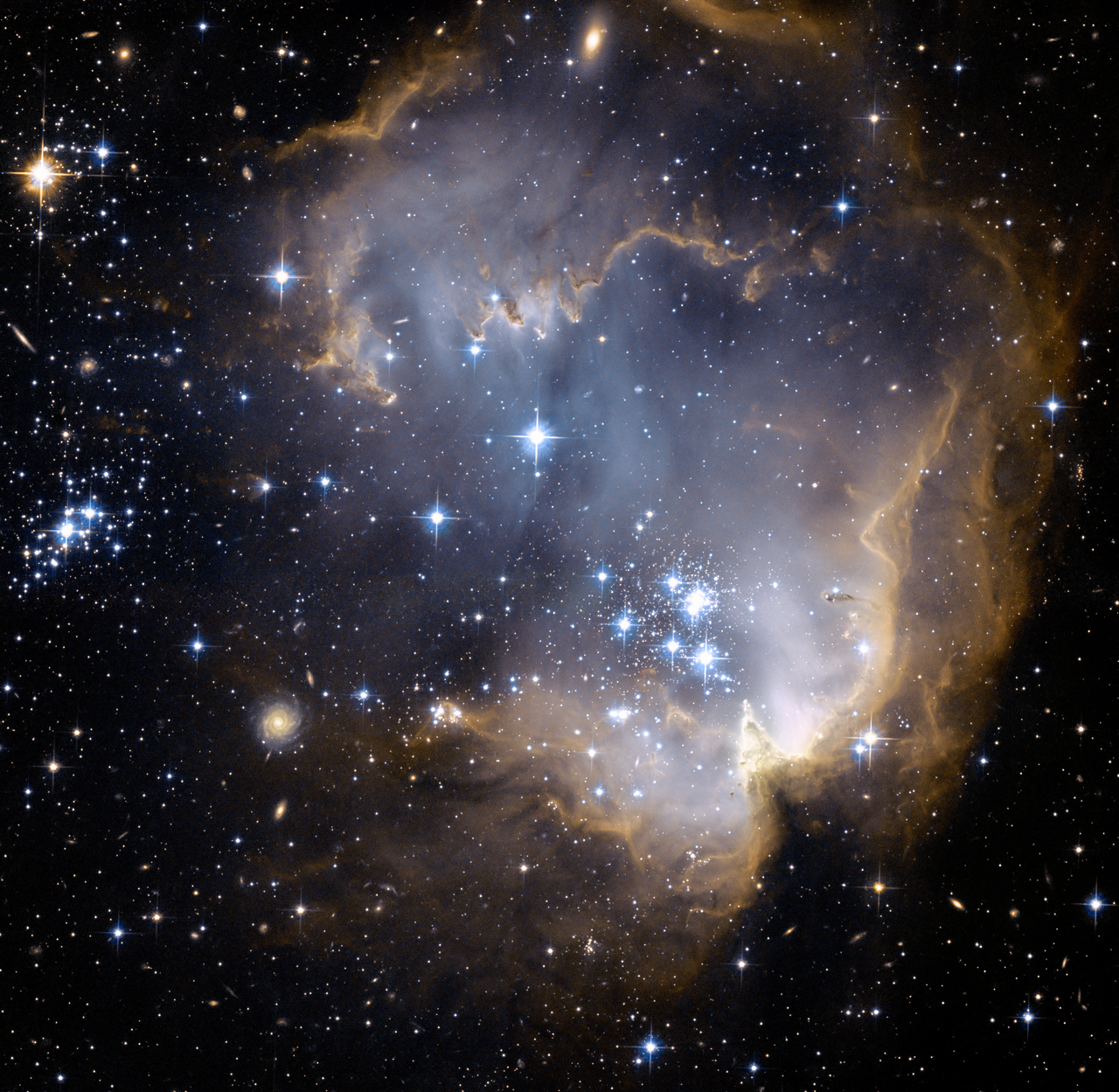
Atronomy pic of the day

Wednesday, June 18, 2008
David Hardy
Huh. The artist who did the two pictures I scanned and posted below: he's still kickin' around, apparently, and has a website with a lot of work on it. Some of them are from the book I just bought, but most of them are newer. Some of them are also unrepentantly retro, which I like.
Also, here's an unfortunately small image of an updated version of the Milky Way picture that I loved so much.

Also, here's an unfortunately small image of an updated version of the Milky Way picture that I loved so much.

Used books
While unsuccessful in my goal of finding used copies of Dresden Files novels, my search of the used bookstores in the area did allow me to find two things I wasn't looking for. The first was Leigh Brackett's Outlaw of Mars which is a reprint of two of her earlier very slim novels (probably more properly novellas) The Secret of Sinharat and People of the Talisman. Although I never had this particular printing of these under this particular title, I did have the two of them together as an "Ace Double Book"—although that has now been lost for some time, sadly.


The cover art on this book is really bad. It looks sorta like airbrushed van art with Eric John Stark as a vaguely humanoid creature sitting on the back of a dinosaur. He's pale and blonde with very stylish hair (for the late sixties or seventies); like some kind of Swedish ABBA groupie (nevermind that Brackett described as as extremely dark skinned; either an adaptation to or a consequence of a childhood spent on Mercury baking under the cruel sun.)
Despite the terrible cover art, I'm extremely gratified to replace my copy for only $2. The book is recently back in print again thanks to our friends at Paizo's Planet Stories line, but I haven't been to thrilled at buying a new trade paperback copy when I'd hoped I could find other copies used. An introduction by Michael Moorcock and better cover art aren't worth that much. As a testament to the quality of these two stories, this is at least the fourth time that they have been reprinted in book form. If you haven't ever read them before, buy the Paizo version, or trawl through Amazon for one of the older copies.
The other book I stumbled upon as a $6 well-maintained copy of The New Challenge of the Stars; a book that was quite formative to me as a child. The thrust of the book is that it attempts to apply science fact to science fiction about space travel. It does so in fairly non-technical terms (it was originally in the children's section of my public library as a kid). It was published in 1977 and at least some elements of this new (at the time) fangled hit movie called Star Wars can be found in it (Star Wars is mentioned two or three times in the text and the cover art is a not-so-subtle homage to the Death Star and Star Destroyers.)
Really, though, the book's easily worth more than the $6 I paid for it for the art alone. Every page has at least one—occasionally two—top class paintings on it. From scenes from H. G. Wells' War of the Worlds to pictures of pioneering lunar colonies, astronauts walking around on Mars, to planetscapes from worlds with closely paired binary twin suns and such sci-fi go-to concepts as generation ships made out of hollowed out asteroids.
Two paintings in particular stuck with me, and I've even mentioned them in posts here in the past. That surely merits me putting the book on a scanner and sharing a couple of the images. This lower painting is a night time landscape from a planet outside the Milky Way, and the top is a night time view from a planet inside a globular cluster.


Subscribe to:
Posts (Atom)