I've organized these posts so that each is more or less the same size, but the unfortunate side effect is that other equally (or maybe even more) sensible arrangements are not done. Ideally, I'd have done basal forms, sinraptors, allosaurids, carcharadontosaurids and neovenatorids in that order, because that's how they appear chronologically in the fossil record, more or less (with some overlap, of course.)
After the basal forms, which are all poorly known and their antecedents are also unclear, we get the sinraptors, mostly in China in the late Middle and earlier part of the Late Jurassic. The actual allosaurids are next, but seem to be a group lacking in much diversity, from North America and Portugal and (possibly) Africa at the end of the Jurassic, overlapping with later sinraptors.
During the earliest Cretaceous, we have only scanty remains and poorly researched formations that don't tell us much about the apex predators, but by the "middle" Cretaceous, carcharodontosaurs seem to have emerged as the dominant predators globally, with similar forms from Africa, North America, South America and even Asia. Then near the end of the period of carcharodontosaurid dominance, the neovenators take over for a time, although by now there is no longer a "global fauna" and tyrannosaurs and abelisaurs are starting to become more dominant in most regions. During the last 15-20 million years of the Cretaceous, there don't seem to be any carnosaurs left, with the possible exception of some poorly dated and controversial remains here and there (Orkoraptor was long held out as a Maastrichtian carnosaur, but it appears to have been earlier in time after all.)
The carnosaurs also appear somewhat ex nihilo; or rather, we don't have much to go on with basal forms, so we have little to no understanding of where they came from exactly. Although they are part of the avetherapods, and therefore sister group to the coelurosaurs (avetherapods are themselves the sister group to the megalosaurs... which I guess are "cousin" group to the carnosaurs, then?) this lack of early forms is difficult. In addition to that, as the neovenators replaced the carcharodontosaurs who replaced the allosaurs and sinraptors... well, none of these groups derives from within the other, so there are long ghost lineages somewhere that may yet throw our understanding of these animals and their relationships off considerably. There is in fact a fair bit of controversy already, although this mostly seems to come from South American paleontologists who make proposals that otherwise seem to be outside of the mainstream, i.e., that maybe carcharodontosaurs are closely related to abelisaurs and/or tyrannosaurs, for instance, or that megaraptors aren't actually neovenators at all, but are instead tyrannosauroids. The establishment of some specimens that fill in, even if just a bit, this ghost lineage will help to clarify considerably.
In any case, I'm ignoring these non-mainstream opinions for the most part, with the expectation that as we gradually find more specimens and start to close the gaps in some of those long ghost lineages, that the mainstream opinion will be proven correct after all. In doing so, well—we find that the carcharodontosaurs are a surprisingly successful group of carnosaurs; the earliest ones were found in the late Kimmeridgean (150 or so million years ago) and they stretch easily to the Turonian of the Late Cretaceous (89 million years ago) with their greatest extent of success ramping up in the Barremian (127 million years ago). Although keep in mind that the earliest Cretaceous periods are not well known and exactly what large predators dominated their ecosystems is unknown at this time. Some form of carnosaur—allosaurid or early carcharodontosaurid—seem likely for most regions. As with most carnosaurs, they seem to have dominated in ecosystems in which very large sauropods were the largest herbivore as well, and some thyreophorans, along with ornithopods, usually of the iguanodont grade. They are nowhere known in areas where ceratopsians and hadrosaurs make up the dominant herbivores, nor do they seem to be common during the ages when more modest sauropods lived among abelisaurs. Although this may, of course, be a preservational artifact; we never know for sure what we don't know about formations and time periods about which our evidence is poor. Some isolated teeth from Brazil may suggest that carcharodontosaurs lived on almost to the very end of the Cretaceous; they are found from the Campanian or maybe even Maastrichtian age rocks. But this evidence is dubious; they might well be something else entirely, or the dating may be off. As with the tyrannosaurs—even moreso, in fact—there are a lot of questions to be answered.
Another curious fact—not really very important, but one that gets lots of attention nonetheless—is that there are a number of quite large specimens here, including no less than four that are at least as big as T. rex if not larger. Of course, our sample sizes being what they are, this doesn't really mean much. But it does mean that the carcharodontosaurs, in spite of their jaw-cracker names and relatively recent vintage, are quite well known to the general public. Even if all they know of them is their name and the fact that they're so big.
Acrocanthosaurus atokensis. This quite large early carcharodontosaur lacks a number of features peculiar to the group. Before the carcharodontosaurs were defined in the later 90s, it was assumed to be a close relative of Allosaurus and some researchers continue to prefer putting it there rather than with the rest of the shark-teeth. Most phylogenies recover it as a primitive carcharodontosaur, however. It was found in at least three formations: the Twin Mountains of north Texas, the Antler Formation of southern Oklahoma and the Cloverly Formation of Wyoming's Bighorn Basin. None of these have been radiometrically dated, but appear to be entirely within the Aptian Stage; 112-125 million years ago. It is also believed to be present in the Glen Rose Formation of Texas that lies over top of the Twin Mountains rocks, so it may have been relatively long-lived as a taxon and crossed into the Albian stage as well.
Acrocanthosaurus may have also been found in Maryland and Florida, and elsewhere in North America, but this is based on teeth and other rather non-diagnostic remains, so that's not for sure. For much of its range, the environment was a coastal floodplain next to the epicontinental sea that would later expand and become the Niobrara Sea (or Western Interior Seaway) splitting North America into island continents Laramidia and Appalachia. All of the formations in which it is found are somewhat poorly known in terms of what the complete faunal assemblage was like, but all of them also feature, in addition to Acrocanthosaurus itself, Deinonychus, Tenontosaurus and either Astrodon or Sauroposeidon or both. Small hypsilophodonts are known in Cloverly, as are a few early nodosaurs. A few other small therapods, some titanosaur backbone, and a Psittacosaurus-grade ceratopsian are also known from the Cloverly, while the Glen Rose adds yet another sauropod. All in all, it would have still maintained a rather Morrison-like aspect, although less dry.
Some significant work has been done on Acrocanthosaurus systematics, including detailed CAT scans of its braincase (determining that it had a crocodile rather than avian style brain with a good sense of smell), fairly light, long and narrow head with huge antorbital fenestrae, and rather limited forearm movement. And of course, it's very famous for its tall neural spines, which were not nearly as dramatic as that of Spinosaurus, but which would have been unmistakable nonetheless. It was unlikely that it had a low sail, but it is believed to have been a "buffalo hump" type feature that ran the length of the animal's back.
Concavenator corcovatus. Another early (and basal) member of the shark-teeth is Concavenator from Barremian Spain (130 million years or so ago.) Much more modestly sized (about 20 feet long, compared to nearly 40 for Acrocanthosaurus) this guy is famous for having what may be quill nodes on its foresarms as well as a very odd structure on its lower back that would have appeared as a very short yet tall triangle over its hips. No other therapod has a similar structure, so nobody is quite sure what to make of it; although some kind of back adornment supported by neural spines on the vertebrae seems to be a feature of many of these basal carcharodontosaurs.
The La Hoya fossil site that it comes from is an inland lacustrine environment, and most of the fossils are beautifully preserved freshwater fish, worms, arthropods, molluscs and many crocodilians. Some early birds are also found at the site, and the basal ornithomimosaur Pelecanimimus.
Eocarcharia dinops. The "dawn shark" a reference to it being a relatively early member of the shark-tooth-saurs is not actually all that early appearing. Eocarcharia is from the Erlhaz Formation of Niger of the Albian-Aptian border (about 112 million years ago) which puts it smack dab in the center of the heyday of the carcharodontosaurs, in spite of its basal position in phylogenies. It was a more modest sized animal, about 26 feet long, without much in the way of distinguishing physical features. Its co-Formation inhabitants include Kryptops, an early abelisaur, and Suchimimus, a very large spinosaurid (Spinosaurus itself was from the formation over top of this one, so later in time), a rebbachisaurid sauropod (Nigersaurus), two large iguanodonts, both with unique features—Ouranosaurus with its large back sail and Lurdusaurus with its especially thick and robust skeletal build and extra long neck, and the dryosaur Elrhazosaurus.
Kelmayisaurus petrolicus. A formerly poorly known (well, it still is—some jaw fragments is all we've got) specimen from the Lianmuqin Formation somewhere between the Valangian and Albian stages (140-125 million years ago) of Cretaceous Chinese Turkestan, Kelmayisaurus was recently found to actually be diagnostic, and that it does nest as a basal carcharodontosaur. Everything in the Lianmuqin Formation is very poorly known, but it seems that Kelmayisaurus may have passed some basal coelurosaurs on its morning commute, as well as Psittacosaurus, some sauropods, and the latest known surviving stegosaur in the world.
Sauroniops pachytholus. Named to literally be "The Eye of Sauron" this somewhat primitive carcharodontosaurid, and a relatively large one over 30 feet long, was curiously found in the same time and place as Carcharodontosaurus itself; Cenomian Morocco (93-99 million years ago.) It's only known from a skull roof, but it differs substantially from Carcharodontosaurus. In fact, the rugose and extremely bumpy skull roof has really captivated the imagination of researchers, some of whom imagine it banging heads like mountain goats. From the Kem Kem Beds, its neighbors would have been, in addition to Carcharodontosaurus, a wide variety of predators: Deltadromeus, Elaphrosaurus, Majungasaurus and Spinosaurus, the largest and most famous of the spinosaurids. Lots of crocodylomorphs here as well, and several fishes; the Kem Kem beds are described as representing a former wide river delta environment that was in the process of shrinking and thus bringing together a number of animals that might otherwise have preferred different habitats and wider separation (it's also not clear that everything found in the Kem Kem beds is really from the same time period, and they may have been spread out in time.) I'm not sure exactly what all these predators would have hunted, as Rebbachisaurus is the only known herbivorous dinosaur, although ornithopod footprints have also been found.
Shaochilong maortuensis. A small (16-20 ft) found in the Turonian (89-93 million years ago) of Mongolia is interesting, in part because it's among the latest found carnosaurs in Laurasia (later even than Siats of the megaraptors—although plenty of late appearing megaraptors are found in Gondwana) suggesting that the dominance of tyrannosaurs in the north was really quite late. Chilantaisaurus is also found in the same formation, which is poorly known. It also has an ankylosaur, an ornithopod of some kind, and an ornithomimid. It's also one of only two Asian carcharodontosaurs known, which is unusual, because Asia is also the cradle of tyrannosaurs (although they also developed in parallel to a great degree in North America.)
Veterupristisaurus milneri. Another jaw-cracker name, which means "old shark lizard", Veterupristisaurus is the oldest known carcharodontosaurid, from the Tendaguru beds of late Kimmeridgian and early Tithonian (155-150 million years ago) Tanzania. This was often compared to the Morrison, and many of the species were believed to be the same as the Morrison, but further discoveries and further review have shown that it was not as clean-cut as it was once thought. Veterupristisaurus was about Allosaurus-sized and probably played its role in the fauna. It was originally thought to be a large local variant of Ceratosaurus. The African Brachiosaurus was also renamed as a different animal, Giraffatitan, the African Diplodocus was renamed Tornieria, etc. It was still a very similar faunal assemblage to that of the Morrison, or the Porto Novo of Portugal, but the differences are just enough to make it interesting.
Carcharodontosaurus saharicus. At this point, Carcharodontosauridae develops the more specialized node, Carcharodontosaurinae, which contains Carcharodontosaurus itself, plus the Giganotosaurini subfamily, which contains the large South American forms. Although named before WW2 by German paleontologists working in North Africa, the remains were lost and had to be rediscovered in the form of new specimens by Paul Sereno in the 1990s. When combined with the exciting finds coming out of South America, the Carcharodontosaurid family was finally recognized. Carcharodontosaurus probably had two species, both of them quite large, rivaling T. rex in size. I already described the environment in which he lived in the Sauroniops entry, so I won't repeat it here.
Carcharodontosaurus was pretty typical for the family; large sized, narrow but long snout, three-fingered relatively powerful (but somewhat inflexible) forearms, robust design that does not indicate a particularly fast animal (although with its stride length, that probably doesn't really matter too much. Plus, if these guys really did specialize in hunting large sauropods, as believed, then they probably didn't need to be super fast anyway.) It's also famous for, of course, it's shark-like teeth, which gave the animal and the entire family its name. Unlike the powerful robust teeth of the late appearing tyrannosaurs, they didn't allow for a particularly powerful bite, and presumably the carcharodontosaurs (and for that matter, most large dinosaurian predators) had teeth designed to slash flesh rather than puncture or crush bone. Many researchers have even proposed that they didn't have to kill their prey; if they just "snacked" on the flesh of sauropods, they probably could survive and even heal to a great degree from those kinds of injuries, and keep on going to be snacked on later. Otherwise, they probably dealt massive wounds that removed large chunks of flesh and then let shock and blood loss weaken its prey enough for it to continue attacking at its leisure and with less risk.
There is some evidence, mainly from the South American forms, that it may have hunted in packs as well.
Tyrannotitan chubutensis. This is one of the earlier carcharodontosaurids from the Aptian aged rocks; so about the same as Acrocanthosaurus. It's much more derived, though—nested well within Giganotosaurini, although at the base of that clade. Not much is known of it's environment other than it's been interpreted as a return to rather arid conditions after moister floodplain environments which preceded it. Large titanosaur Chubutisaurus was probable prey for Tyrannotitan. As the name implies, there were a number of features that somewhat superficially resembled tyrannosaurs, and which captivated some early researchers into proposing a link between carcharodontosaurs and tyrannosaurs. Sigh. Everyone wants to tie everyone to the tyrannosaurs. I prefer, obviously, the carnosaur interpretation as much more robust and well established for both carcharodontosaurs and megaraptors.
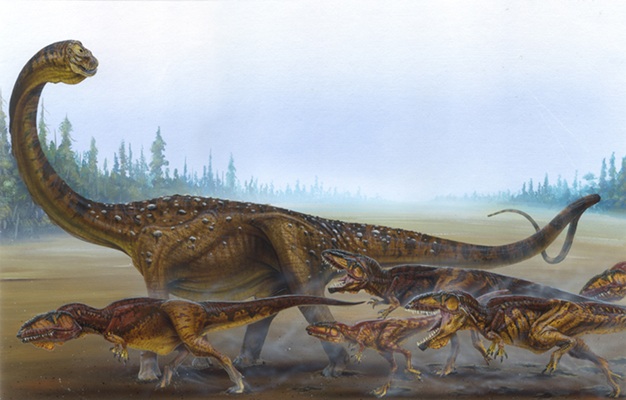
Giganotosaurus carolinii. The largest and first discovered of the South American carcharodontosaurs, Giganotosaurus has been rather famous. It appeared in the rather excellent Chased by Dinosaurs pseudo-documentary with Nigel Marvin, where it's hunting Argentinasaurus, the largest known sauropod. This isn't exactly accurate, as they are not from the same formation—but Giganotosaurus would no doubt have chased Andesaurus instead; another very large basal titanosaur from South America. It's curious that the basal titanosaurs are quite large; but later they were replaced in South America by much more modestly sized derived saltasaurs. This seems to have coincided with the end of the large carnosaurs as well.
Giganotosaurus also had iguanodonts, dromaeosaurs, smaller rebbachisaurid sauropods, and relatively large abelisaurids. It comes from the Cenomian age (same as Carcharodontosaurus 100-97 million years ago) Candeleros Formation of Neuquen, formerly called the Rio Limay Formation. It is overlaid by the Huincul Formation (which includes Argentinasaurus and Mapusaurus) which is in turn overlain by the Lisandro Formation which does not (at least so far) have any carnosaurs in it.
Mapusaurus roseae. The last appearing carcharodontosaur of the South American procession, Mapusaurus may also have been the largest, according to some fragmentary remains. It's also known from a bone-bed with several individuals of various age and size—which is always breathlessly held out by many as evidence of packing behavior, although it isn't really. At least not necessarily. It could also be mobbing, which is gregarious, but not cooperative exactly.
Mapusaurus was also found in a riparian depositional environment in what was otherwise determined to be a rather arid climate. Not terribly unlike the Morrison in that regard, curiously. Argentinasaurus was the large sauropod; the largest sauropod, or at least a credible contender for that title. The Huincul is otherwise not a very good depositional environment for fossil bones, actually, so it's rather poorly known. A study of the various individuals also determined that Mapusaurus displayed heterochrony; a condition in which ancestral conditions are present at one age stage but later go away. This is significant, because it means that it's not hard to think you're seeing more diversity in the fossil record than you actually are.
Pages
- Blog
- Links
- Darkness In the Hill Country
- Cult of Undeath
- Terror in Timischburg
- Freeport Trawl
- Eberron Trawl
- Forgotten Realms Trawl
- Pathfinder Adventure Path Trawl
- Pathfinder Modules Trawl
- Pathfinder Chronicles/Setting Trawl
- Pathfinder Companion Trawl
- Pathfinder Rules Trawl
- 3.5 Core Rules Trawl
- 3e Adventure Trawl
- 3e Web Adventure Trawl
- 5e Campaign Trawl
- 3PP Trawl
- 4e Trawl
Showing posts with label Meet the Carnosaurs. Show all posts
Friday, February 03, 2017
Thursday, February 02, 2017
Meet the Carnosaurs, Part II: Allosaurids and Neovenatorids
There are three families left within the carnosaurs; the allosaurids (the most famous and well-known group, although it's actually a very small one), the carcharodontosaurs (a large family of animals that have become increasingly famous because some of them are allegedly "bigger than T. rex") and the neovenators (an another interesting family that includes the megaraptors, and which has become increasingly interesting just in the last few years.)
At the next node beyond the sinraptors, the tree splits into the allosaurids and the carcharodontosaurians; the carcharodontosaurians then split into the carcharodontosaurids and the neovenatorids. For today, partly as a function the number of specimens that need to be described, I'm going to do the small allosaurid family and the medium sized neovenators. The carcharodontosaurs are such a large group that they need to be treated separately in the next (and last) post in this series.
Allosaurus fragilis. This is the really famous Allosaurus known from big quarries in Utah and Colorado at Dinosaur National Monument and the Cleveland-Lloyd Dinosaur Quarry—both of which are national monuments. Allosaurus is well-known from at least 60 excavated skeletons, of all ages and sizes. The average sized Allosaurus seems to be about 30 feet long (maybe a tiny bit less) and the largest was nearly T. rex sized at over 40 feet. In fact, this largest specimen is so large that its describers were enchanted by the size and gave it a new name; Epanterias amplexus, but most studies have suggested that at most it's a new species, and probably not even that.
Allosaurus has probably got a number of species and a nearly global distribution, although other than the Morrison Formation allosaurs from the American West they're not well known, and their remains are a bit scrappy, which makes determining exactly how they're all related a bit difficult to determine. The formal and then informal species A. lucasi and "A. jimmadseni" are both from a bit later than A. fragilis; above it in the later Morrison Formation from the very late Kimmeridgian and Tithonian (A. fragilis is more from earlier in the Kimmeridgian.) Like the rest of the Morrison fauna, as time passed and one species within a genus was replaced by another, in general they became somewhat larger. There's also a European species, although there's some doubt that it truly is a different species—in spite of the rather large geographical separation (which was admittedly less at the time) found in Portugal. There was an allosaur in the Tendaguru Formation of Tanzania, although subsequent analysis suggests that these poor remains might actually be carcharodontosaurian. And allosaurs have been reported from Siberia and Australia, although there are—again—serious doubts that they've been properly identified. Allosaurus also has swallowed up a rather large number of names that were applied to animals once thought to be something else but later determined to merely be specimens of Allosaurus: Creosaurus, Antrodemus, Labrosaurus, Epanterias.
Allosaurus is best known from the Morrison, of course, and the environment of the Morrison and the other animals that lived around it are interesting. While I've pointed out before that the environment in which many of the sinraptors lived was similar, including similar types of animals, this is even more true for the Lourinhã and Tendaguru Formations. Rather than describe them all, the Morrison can stand in for all of them. Allosaurus was surrounded by sauropods. So many varieties, in fact, that scientists are at a bit of a loss trying to explain how they all coexisted without competing head to head. There are several varieties of rather slim diplodocids (Diplodocus, Barosaurus, Supersaurus and a bewildering variety of many more dubious names), the more stout apatasaurines (Apatasaurus and now even the name Brontosaurus has been revived) dicraesaurs, haplocanthosaurs, and the future of sauropoda—macronarians come in a few varieties including Brachiosaurus, the largest of the sauropods of the Morrison (unless Amphocoelias turns out someday to be verified) and the more modestly size and apparently by far the most common, Camarasaurus. Stegosaurus and a few other stegosaurs are also well-known from the Morrison, and there's an also incredibly diverse array of ornithopods; many of them rather small and presumably fleet-flooted hypsilophodonts, but some of them nearing Iguanadon in size and evolutionary grade. These include (not comprehensively) Dryosaurus, Camptosaurus, Uteodon, Drinker, Othnielosaurus and Othnielia. There are two early ankylosaurs. There are many smaller therapods, like Ornitholestes and Coelurus (and others). There's an early tyrannosauroid. Curiously, there are also other larger therapods. Ceratosaurus was roughly half to two thirds the size of Allosaurus but had much more robust teeth and apparently a different hunting style. There are large megalosaurs—Marshosaurus and Torvosaurus (which includes the nearly T. rex-sized Edmarka rex). As an aside; both Torvosaurus and Ceratosaurus have also been found in the same formation as the Portuguese Allosaurus. The lower, thinner bodies of the other two predators has sometimes been interpreted to mean that they preferred hunting in the more overgrown lowlands, while Allosaurus preferred the higher, drier, and certainly more open floodplains.
The Morrison itself is semi-arid, on the shores of the Sundance Sea. Further to the south it starts to become actually desert-like, but more to the north it's got a strongly riparian flavor, with drier savanas separating the river valleys. It's often believed that many of the dinosaurs favored the gallery forests along the rivers to the floodplains, but adult sauropods and possibly Allosaurus himself may have preferred the open.
Saurophaganax maximus. Closely related to Allosaurus (there are still a few workers who refuse to recognize it as a valid, separate genus, although most do now, especially after the recent Brusatte, Carrano and Benson phylogeny) but fairly large—again, up to nearly T. rex sized, this guy appears to have appeared fairly late in the Morrison. Some studies even suggest that it may have replaced the megalosaurs like Torvosaurus as the "predator larger than Allosaurus" role. It's also better known from not only the latest Brushy Basin member of the Morrison, but also the southern range—finds have been in Oklahoma, New Mexico. This may suggest that it lived and hunted in a different environment than the other Morrison predators; one that was less conducive to preservation. Or, it may mean that it was simply rather rare and late-appearing compared to Allosaurus.
Datanglong guanxiensis. This is known from only a bit of backbone, hip and ribs from the Xinlong Formation in the Early Cretaceous. Not much is known about either the formation or the animal, but it appears to be a very basal carcharodontosaurian. Or, it may be a carcharodontosaurid or neovenatorid. We don't really know.
Chilantaisaurus tashuikouensis. Another poorly known critter from the Ulansuhai Formation of Inner Mongolia which appears to be from the Turonian period of the Cretaceous—rather late, actually. It was once thought to be Albian-Aptian due to faunal similarity, which suggests that the "Morrison pattern" of fauna (speaking very broadly—also called the "Jurassic aspect" when referred to some Cretaceous fauna that had broadly similar animals by Thomas Lehman) was more common and lasted longer than many thought. Chilantaisaurus does appear to be a "good" neovenator, which are the latest appearing family of carnosaurs, for the most part, and which seem to have prolonged the presence of carnosaurs, possibly all the way to the end of the dinosaur era.
Neovenator salerii. Known from the Isle of Wight, Neovenator was a modest-sized 25 feet or so long and rather gracile in build. The fossils are very fragmentary, and like many British fossils, exactly what it was and what environment it lived in is hard to determine. Neovenator is probably more famous for bouncing around a ton in various family trees than it is for anything else. It was from the Barremian (125 million years ago) and probably lived alongside Iguanadon, Baryonix, and Polacanthus.
Within Neovenatoridae we have the family Megaraptora. There are a few folks who are captivated by some similarities to the tyrannosauroids and believe Megaraptorans to be related to them, but the mainstream and most likely view is that they are a family of carnosaurs, nested within Carcharodontosauria (but not Carcharodontosauidae) and therefore most closely related to them (the phylogenies by Novas and Porfiri that recovers them as coelurosaurs close to the tyrannosaurs also recovers carcharodontosaurs there as well. It's not a very trustworthy result. Wikipedia seems to suggest that nesting with with the tyrants is the last word, but it isn't.) The interesting thing about them, of course, is also their temporal placement; they seem to start right about the time that the carcharodontosaurs are running out the clock, and the earliest one seems to be a specimen from Australia at about 110 million years ago. This suggests that that's where the family evolved from somewhere within Neovenatoridae and spread from there.
Fukuiraptor kitadaniensis. One of the few dinosaur fossils from Japan, Fukuiraptor is a modest-sized and slender animal. Although the type specimen is supposed to not be fully grown, it was found with some other individuals, all of whom were even smaller. From the Cretaceous Barremian (129-125 million years ago). It's about 16 feet long, and is known from mostly leg bones, a few arm, jaw and teeth fragments. Little is known about dinosaurs in Japan in general; needless to say volcanic islands are not super ideal for preservation of fossils for millions of years.
Siats meekorum. Found in the Mussentuchit Member of the Cedar Mountain Formation (Cenomian Late Cretaceous; about 98 million years ago) Siats is interesting for a number of reasons. The skeletal remains are a bit on the scanty side, but by using other neovenatorian specimens to scale up what we have, they suggest that Siats was already in the same ballpark as the biggest therapods, in spite of the fact that several features of the skeleton suggest it was not fully grown. It's also late appearing, at a time when it was thought that carnosaurs had abandoned North America in favor of early tyrannosauroids. Exactly what a megaraptoran was doing in North America at the time is unsure. It would have replaced Acrocanthosaurus (a carcharodontosaurid and apex predator of the earlier members of the Cedar Mountain Formation) and preceded the dominance of tyrants. Indeed; the upper Cedar Mountain is much more "Asian" in character than the earlier Cedar Mountain, which had a more traditional Gondwanan assemblage; or perhaps as Lehman calls it, they retained a "Jurassic aspect" well into the Cretaceous.
Siats lived alongside some early ankylosaurs (Animantarx, Cedarpelta, Peloroplites) some indeterminate neoceratopsian and pachycephalosaur remains, ornithopods like the iguanodont Eolambia, the medium-sized Tenontosaurus might still have survived that long, and the advanced hypsilophodont Zephyrosaurus, a brachiosaur (Abydosaurus), and of course the famous Deinonychus that is the specimen most responsible for launching the Dinosaur Revolution.
The whole Cedar Mountain formation is only recently described; it's only been known since the 90s, really. There's no doubt still much to be learned about it and the gap between the passing of the torch from the "Jurassic aspect" faunal assemblages and the "Asian Cretaceous aspect" faunal assemblages is poorly understood. The upper Cedar Mountain, and middle Cedar Mountain assemblages are probably the answer there, but we need to know more about them first.
Aerosteon riocoloradense. "Bird bone" was a medium-sized (about 30 foot) megaraptor from Argentina's Anacleto Formation; Santonian (84 million years ago) of the Late Cretaceous. Again; the remains are somewhat scrappy and may not represent a fully mature individual; and they were discovered before the existence of the megaraptoran clan was understood, so it was a bit of a mystery for some time, as it didn't fit into any of the known therapod families at the time in South America (spinosaurs, carcharodontosaurs, abelisaurs.) The faunal assemblage of the Anacleto formation is not super well-known; a small ornithopod, some titanosaurs, and abelisaurs are known, along with a few lizards and crocodylians.
Australovenator wintonensis. An Australian megaraptor (as you can probably guess by the name) from the latest Aptian (95 million years ago) from a site that tells us little about the faunal assemblage that it occupies other than that a sauropod lived there too. It was only about 20 feet long and relatively lightweight, and has been informally described as "the cheetah of its time.) It's very similar to the earlier appearing (Albian 105 million years ago) therapod Rapator and the two may be synonymous, or it may be a descendant of the latter.
Rapator ornitholestoides. Speaking of which, Rapator is known from very poor remains; only a few bones. In fact, it took the discover of Australovenator and some of the other megaraptors to make sense of Rapator's remains. If Rapator were built like Australovenator, then it would probably have been bigger; about Allosaurus sized. It comes from the Griman Creek Formation, as mentioned above, quite a bit earlier than Australovenator, and it's not really known what was in the Griman Creek formation other than some kind of sauropod, some small ornithopods, and the large iguanodont Muttaburrasauus.
Megaraptor namunhuaiquii. From the Turonian to Coniacian (somwhere between 93 to 86 million years ago) of Patagonia, Megaraptor is what started the journey of the neovenatorids. For a long time, it really confused paleontologists. It's large hand claw was interpreted as a dromaeosaur-like foot claw, then a spinosaur-like feature, and finally it was recognized as a defining feature of the megaraptorans themselves. A good 26 feet long, it was a decent-sized carnivore. A juvenile specimen is being used specifically to advance the tyrannosauroid claim. I'd like to see that go away—unless of course, I'm wrong and it turns out to be the correct interpretation after all. But I seriously doubt it. There's no explanation for a radiation of tyrannosauroids in Gondwana that are significantly disparate from what happened in Laurasia. And if they are tyrannosauroids, they still have some pretty amazing similarities to the carcharodontosaurs and even the spinosaurs, dromaeosaurs and abelisaurs. I think the real story here is how extraordinarily conservative the bauplan of therapods was that it remains so very difficult to classify them with confidence.
Orkoraptor burkei. Another South American animal, Orkoraptor was a rather late appearing megaraptoran from the Pari Aike Formation in very southern Patagonia. Initially believed to be from the Maastrichtian, that would have extended the carnosaurs (unless of course the megaraptors aren't carnosaurs at all) considerably. Actually, it still does, but it's now believed to be from the Cenomian from about 95 million years ago. Not much is known about this formation other than a few ornithopods and the giant titanosaur Puertosaurus are found here.
At the next node beyond the sinraptors, the tree splits into the allosaurids and the carcharodontosaurians; the carcharodontosaurians then split into the carcharodontosaurids and the neovenatorids. For today, partly as a function the number of specimens that need to be described, I'm going to do the small allosaurid family and the medium sized neovenators. The carcharodontosaurs are such a large group that they need to be treated separately in the next (and last) post in this series.
Allosaurus fragilis. This is the really famous Allosaurus known from big quarries in Utah and Colorado at Dinosaur National Monument and the Cleveland-Lloyd Dinosaur Quarry—both of which are national monuments. Allosaurus is well-known from at least 60 excavated skeletons, of all ages and sizes. The average sized Allosaurus seems to be about 30 feet long (maybe a tiny bit less) and the largest was nearly T. rex sized at over 40 feet. In fact, this largest specimen is so large that its describers were enchanted by the size and gave it a new name; Epanterias amplexus, but most studies have suggested that at most it's a new species, and probably not even that.
Allosaurus has probably got a number of species and a nearly global distribution, although other than the Morrison Formation allosaurs from the American West they're not well known, and their remains are a bit scrappy, which makes determining exactly how they're all related a bit difficult to determine. The formal and then informal species A. lucasi and "A. jimmadseni" are both from a bit later than A. fragilis; above it in the later Morrison Formation from the very late Kimmeridgian and Tithonian (A. fragilis is more from earlier in the Kimmeridgian.) Like the rest of the Morrison fauna, as time passed and one species within a genus was replaced by another, in general they became somewhat larger. There's also a European species, although there's some doubt that it truly is a different species—in spite of the rather large geographical separation (which was admittedly less at the time) found in Portugal. There was an allosaur in the Tendaguru Formation of Tanzania, although subsequent analysis suggests that these poor remains might actually be carcharodontosaurian. And allosaurs have been reported from Siberia and Australia, although there are—again—serious doubts that they've been properly identified. Allosaurus also has swallowed up a rather large number of names that were applied to animals once thought to be something else but later determined to merely be specimens of Allosaurus: Creosaurus, Antrodemus, Labrosaurus, Epanterias.
Allosaurus is best known from the Morrison, of course, and the environment of the Morrison and the other animals that lived around it are interesting. While I've pointed out before that the environment in which many of the sinraptors lived was similar, including similar types of animals, this is even more true for the Lourinhã and Tendaguru Formations. Rather than describe them all, the Morrison can stand in for all of them. Allosaurus was surrounded by sauropods. So many varieties, in fact, that scientists are at a bit of a loss trying to explain how they all coexisted without competing head to head. There are several varieties of rather slim diplodocids (Diplodocus, Barosaurus, Supersaurus and a bewildering variety of many more dubious names), the more stout apatasaurines (Apatasaurus and now even the name Brontosaurus has been revived) dicraesaurs, haplocanthosaurs, and the future of sauropoda—macronarians come in a few varieties including Brachiosaurus, the largest of the sauropods of the Morrison (unless Amphocoelias turns out someday to be verified) and the more modestly size and apparently by far the most common, Camarasaurus. Stegosaurus and a few other stegosaurs are also well-known from the Morrison, and there's an also incredibly diverse array of ornithopods; many of them rather small and presumably fleet-flooted hypsilophodonts, but some of them nearing Iguanadon in size and evolutionary grade. These include (not comprehensively) Dryosaurus, Camptosaurus, Uteodon, Drinker, Othnielosaurus and Othnielia. There are two early ankylosaurs. There are many smaller therapods, like Ornitholestes and Coelurus (and others). There's an early tyrannosauroid. Curiously, there are also other larger therapods. Ceratosaurus was roughly half to two thirds the size of Allosaurus but had much more robust teeth and apparently a different hunting style. There are large megalosaurs—Marshosaurus and Torvosaurus (which includes the nearly T. rex-sized Edmarka rex). As an aside; both Torvosaurus and Ceratosaurus have also been found in the same formation as the Portuguese Allosaurus. The lower, thinner bodies of the other two predators has sometimes been interpreted to mean that they preferred hunting in the more overgrown lowlands, while Allosaurus preferred the higher, drier, and certainly more open floodplains.
The Morrison itself is semi-arid, on the shores of the Sundance Sea. Further to the south it starts to become actually desert-like, but more to the north it's got a strongly riparian flavor, with drier savanas separating the river valleys. It's often believed that many of the dinosaurs favored the gallery forests along the rivers to the floodplains, but adult sauropods and possibly Allosaurus himself may have preferred the open.
Saurophaganax maximus. Closely related to Allosaurus (there are still a few workers who refuse to recognize it as a valid, separate genus, although most do now, especially after the recent Brusatte, Carrano and Benson phylogeny) but fairly large—again, up to nearly T. rex sized, this guy appears to have appeared fairly late in the Morrison. Some studies even suggest that it may have replaced the megalosaurs like Torvosaurus as the "predator larger than Allosaurus" role. It's also better known from not only the latest Brushy Basin member of the Morrison, but also the southern range—finds have been in Oklahoma, New Mexico. This may suggest that it lived and hunted in a different environment than the other Morrison predators; one that was less conducive to preservation. Or, it may mean that it was simply rather rare and late-appearing compared to Allosaurus.
Datanglong guanxiensis. This is known from only a bit of backbone, hip and ribs from the Xinlong Formation in the Early Cretaceous. Not much is known about either the formation or the animal, but it appears to be a very basal carcharodontosaurian. Or, it may be a carcharodontosaurid or neovenatorid. We don't really know.
Chilantaisaurus tashuikouensis. Another poorly known critter from the Ulansuhai Formation of Inner Mongolia which appears to be from the Turonian period of the Cretaceous—rather late, actually. It was once thought to be Albian-Aptian due to faunal similarity, which suggests that the "Morrison pattern" of fauna (speaking very broadly—also called the "Jurassic aspect" when referred to some Cretaceous fauna that had broadly similar animals by Thomas Lehman) was more common and lasted longer than many thought. Chilantaisaurus does appear to be a "good" neovenator, which are the latest appearing family of carnosaurs, for the most part, and which seem to have prolonged the presence of carnosaurs, possibly all the way to the end of the dinosaur era.
Neovenator salerii. Known from the Isle of Wight, Neovenator was a modest-sized 25 feet or so long and rather gracile in build. The fossils are very fragmentary, and like many British fossils, exactly what it was and what environment it lived in is hard to determine. Neovenator is probably more famous for bouncing around a ton in various family trees than it is for anything else. It was from the Barremian (125 million years ago) and probably lived alongside Iguanadon, Baryonix, and Polacanthus.
Fukuiraptor kitadaniensis. One of the few dinosaur fossils from Japan, Fukuiraptor is a modest-sized and slender animal. Although the type specimen is supposed to not be fully grown, it was found with some other individuals, all of whom were even smaller. From the Cretaceous Barremian (129-125 million years ago). It's about 16 feet long, and is known from mostly leg bones, a few arm, jaw and teeth fragments. Little is known about dinosaurs in Japan in general; needless to say volcanic islands are not super ideal for preservation of fossils for millions of years.
Siats meekorum. Found in the Mussentuchit Member of the Cedar Mountain Formation (Cenomian Late Cretaceous; about 98 million years ago) Siats is interesting for a number of reasons. The skeletal remains are a bit on the scanty side, but by using other neovenatorian specimens to scale up what we have, they suggest that Siats was already in the same ballpark as the biggest therapods, in spite of the fact that several features of the skeleton suggest it was not fully grown. It's also late appearing, at a time when it was thought that carnosaurs had abandoned North America in favor of early tyrannosauroids. Exactly what a megaraptoran was doing in North America at the time is unsure. It would have replaced Acrocanthosaurus (a carcharodontosaurid and apex predator of the earlier members of the Cedar Mountain Formation) and preceded the dominance of tyrants. Indeed; the upper Cedar Mountain is much more "Asian" in character than the earlier Cedar Mountain, which had a more traditional Gondwanan assemblage; or perhaps as Lehman calls it, they retained a "Jurassic aspect" well into the Cretaceous.
Siats lived alongside some early ankylosaurs (Animantarx, Cedarpelta, Peloroplites) some indeterminate neoceratopsian and pachycephalosaur remains, ornithopods like the iguanodont Eolambia, the medium-sized Tenontosaurus might still have survived that long, and the advanced hypsilophodont Zephyrosaurus, a brachiosaur (Abydosaurus), and of course the famous Deinonychus that is the specimen most responsible for launching the Dinosaur Revolution.
The whole Cedar Mountain formation is only recently described; it's only been known since the 90s, really. There's no doubt still much to be learned about it and the gap between the passing of the torch from the "Jurassic aspect" faunal assemblages and the "Asian Cretaceous aspect" faunal assemblages is poorly understood. The upper Cedar Mountain, and middle Cedar Mountain assemblages are probably the answer there, but we need to know more about them first.
Aerosteon riocoloradense. "Bird bone" was a medium-sized (about 30 foot) megaraptor from Argentina's Anacleto Formation; Santonian (84 million years ago) of the Late Cretaceous. Again; the remains are somewhat scrappy and may not represent a fully mature individual; and they were discovered before the existence of the megaraptoran clan was understood, so it was a bit of a mystery for some time, as it didn't fit into any of the known therapod families at the time in South America (spinosaurs, carcharodontosaurs, abelisaurs.) The faunal assemblage of the Anacleto formation is not super well-known; a small ornithopod, some titanosaurs, and abelisaurs are known, along with a few lizards and crocodylians.
![]() |
| Australovenator |
Rapator ornitholestoides. Speaking of which, Rapator is known from very poor remains; only a few bones. In fact, it took the discover of Australovenator and some of the other megaraptors to make sense of Rapator's remains. If Rapator were built like Australovenator, then it would probably have been bigger; about Allosaurus sized. It comes from the Griman Creek Formation, as mentioned above, quite a bit earlier than Australovenator, and it's not really known what was in the Griman Creek formation other than some kind of sauropod, some small ornithopods, and the large iguanodont Muttaburrasauus.
Megaraptor namunhuaiquii. From the Turonian to Coniacian (somwhere between 93 to 86 million years ago) of Patagonia, Megaraptor is what started the journey of the neovenatorids. For a long time, it really confused paleontologists. It's large hand claw was interpreted as a dromaeosaur-like foot claw, then a spinosaur-like feature, and finally it was recognized as a defining feature of the megaraptorans themselves. A good 26 feet long, it was a decent-sized carnivore. A juvenile specimen is being used specifically to advance the tyrannosauroid claim. I'd like to see that go away—unless of course, I'm wrong and it turns out to be the correct interpretation after all. But I seriously doubt it. There's no explanation for a radiation of tyrannosauroids in Gondwana that are significantly disparate from what happened in Laurasia. And if they are tyrannosauroids, they still have some pretty amazing similarities to the carcharodontosaurs and even the spinosaurs, dromaeosaurs and abelisaurs. I think the real story here is how extraordinarily conservative the bauplan of therapods was that it remains so very difficult to classify them with confidence.
Orkoraptor burkei. Another South American animal, Orkoraptor was a rather late appearing megaraptoran from the Pari Aike Formation in very southern Patagonia. Initially believed to be from the Maastrichtian, that would have extended the carnosaurs (unless of course the megaraptors aren't carnosaurs at all) considerably. Actually, it still does, but it's now believed to be from the Cenomian from about 95 million years ago. Not much is known about this formation other than a few ornithopods and the giant titanosaur Puertosaurus are found here.
Monday, January 30, 2017
Meet the Carnosaurs, Part I: Basal forms and Sinraptors
Following the 2010 Benson, Brusatte and Carrano cladogram, let's do for the carnosaurs what I did a month or two ago for the tyrannosaurs. Carnosaurs are an interesting family; for many years, it was a wastebasket, rather useless designation that merely meant "any therapod that was big." It even had a bunch of critters in it that ended up not being therapods at all (or even dinosaurs at all, in the case of Teratosaurus) but as it was eventually pared down to something that made some sense, a core Carnosauria did in fact emerge; one that is synonymous for all intents and purposes with Allosauroidea. As one can imagine, this means that the large, meat-slicing therapods related to Allosaurus which are famous for being the apex predators in environments with large sauropods are what we ended up left with. Allosaurus is, of course, probably the most famous and well-known, but some of the later groups, like Giganotosaurus and Carcharodontosaurus end up within the classification as well.
But before we can get to the famous species, let's have a quick look at some dubious specimens, which we're not quite sure where they fit, and then the earliest appearing group—the sinraptors, or metriacanthosaurs.
Becklespinax altispinax. This guy was a very early discovered dinosaur; known only from a few vertebrae, but described by Richard Owen himself, in 1856. Although originally referred to Megalosaurus (but seriously; what wasn't?) this confusion is what led to the hump on the back of the plodding Benjamin Waterhouse Hawkins sculpt of the animal that appeared famously in the Crystal Palace. Becklespinax had relatively tall neural spines on the vertebrae, which mesmerized later describers who have tried to refer it to Acrocanthosaurus as well. It comes from the Wealdon Group of the early Cretaceous Varanginian (about 130-140 million years ago) in southeastern England. His contemporaries would be a number of poorly known yet ironically very famous dinosaurs, who include most of the first dinosaurs named or described: Iguanodon, Hylaeosaurus, Cetiosaurus, etc.
It's probably not really very primitive, given the time frame in which it appears, but it's so poorly known that we can't really determine what Becklespinax is. It might not even be a carnosaur at all; it might be a "megalosaur" or other more primitive tetanuran.
Gasosaurus constructus. Another poorly known critter, Gasosaurus is known from the lower Shaximiao formation (164 million years ago) in Sichuan, and is poorly enough known that it's placement on the family tree is also uncertain. It was probably relatively small, and it may have been a basal tetanuran, basal carnosaur—related to the sinraptors (probably the most likely, given its temporal and geographical placement) or even a basal coelurosaur. In its environment there are a lot of stegosaurs, a number of basal ornithischians (like fabrosaurs) or early ornithopods (primitive hypsilophodonts) as well as sauropods like Shunosaurus and Omeisaurus.
Erectopus superbus. A young carnosaur, from the La Penthiève beds in France from the lower Cretaceous, the exact time and placement in the family tree of this guy is unknown. It is very late appearing for a carnosaur, and it does appear to be definitely a carnosaur, but other than that, very little is known of it. It appears to have been found in a formation that was semi-marine; either an island or because it washed out to sea; other fossils found with it include plesiosaurs, ichthyosaurs, and marine crocodiles. Like every other meat-eating dinosaur discovered within the 1800s, it was known as Megalosaurus for quite some time.
The first actual family within Carnosauria that we encounter are the sinraptors. Sinraptoridae has largely been ousted as the name Metriacanthosauridae appears to have precedence, but typing the informal "sinraptors" is a heckuva lot easier. As you can probably guess from the name, they are mostly found in China, and tend to be early to late Jurassic, making them the earliest appearing solid group of carnosaurs. If one can speak about the group generically, it would be fair to call them allosaur-like therapods, both in shape and in size, but with a tendency towards tall backbone spines. This tendency was repeated by some of the later appearing carcharodontosaurs, and was of course even more famous in the spinosaurs, which are not carnosaurs at all. Some of the ornithopods also tended towards this trait, which seems to have been one that appeared repeatedly and independently in various dinosaur families that were not related to each other.
Xuanhanosaurus qilixiaensis. Quite a mouthful, as are many of the Chinese dinosaurs. Known from some partial sub-cranial skeletal elements, this was originally believed to be a megalosaur, but more recently it has been recovered as a basal sinraptor; although it is a "wildcard" taxa that tends to make phylogenies unstable and weird. Found in the same formation as Gasosaurus (although their temporal relationship is not understood) it was a relatively smallish animal; maybe 15 feet long (which is actually slightly larger than the specimen of Gasosaurus known) and seems to have had an unusually large and strong forelimb. The describer, Dong Zhiming, even proposed that it might have been quadrupedal, although that idea, fanciful and interesting as it seemed, has not been accepted by anyone else. Although, if you look, you can find illustrations online of what some have thought that would look like—quite an interesting idea.
Yangchuanosaurus shangyouensis. Also, Y. magnus, which is no longer considered a separate species. From a little earlier than Allosaurus itself (although the exact timing of its formation is subject to some contradictory data), Yangchuanosaurus was not only very similar in size and shape to North American Allosaurus, but also appeared very close to it in time, and rambled through a faunal assemblage of similar creatures as the Morrison—the Shangshaximiao Formation has stegosaurs, ornithopods, large sauropods, crocodiles, small therapods, etc. The largest specimen was estimated to be about 35 feet long; fairly big, although the type specimen was only about 26 feet long.
A number of other dubious specimens, with various names, were determined just in the last few years by Carrano, Benson and Sampson to belong to a different species of the same genus, Y. zigongensis. This animal appears just a bit earlier than Y. shangyouensis and is likely ancestral to it. This makes it very close in time to Xuanhanosaurus and Gasosaurus, if not coterminous. Exactly why there were so many closely related (apparently) creatures in the same time and place is unclear. Sadly, the most likely interpretation is that the colorful names "Szechuanosaurus" and "Szechuanoraptor" are no good. Too bad.
All of the Yangchuanosaurus species appear to have had a highly ornamented head, with a bony ridge along the nose and multiple hornlets. This is often forgotten; most of the therapods have highly decorated heads, really, but the nose ridge was quite tall and almost Ceratosaurus-like; although of course those two are also not closely related.
But before we can get to the famous species, let's have a quick look at some dubious specimens, which we're not quite sure where they fit, and then the earliest appearing group—the sinraptors, or metriacanthosaurs.
Becklespinax altispinax. This guy was a very early discovered dinosaur; known only from a few vertebrae, but described by Richard Owen himself, in 1856. Although originally referred to Megalosaurus (but seriously; what wasn't?) this confusion is what led to the hump on the back of the plodding Benjamin Waterhouse Hawkins sculpt of the animal that appeared famously in the Crystal Palace. Becklespinax had relatively tall neural spines on the vertebrae, which mesmerized later describers who have tried to refer it to Acrocanthosaurus as well. It comes from the Wealdon Group of the early Cretaceous Varanginian (about 130-140 million years ago) in southeastern England. His contemporaries would be a number of poorly known yet ironically very famous dinosaurs, who include most of the first dinosaurs named or described: Iguanodon, Hylaeosaurus, Cetiosaurus, etc.
It's probably not really very primitive, given the time frame in which it appears, but it's so poorly known that we can't really determine what Becklespinax is. It might not even be a carnosaur at all; it might be a "megalosaur" or other more primitive tetanuran.
Gasosaurus constructus. Another poorly known critter, Gasosaurus is known from the lower Shaximiao formation (164 million years ago) in Sichuan, and is poorly enough known that it's placement on the family tree is also uncertain. It was probably relatively small, and it may have been a basal tetanuran, basal carnosaur—related to the sinraptors (probably the most likely, given its temporal and geographical placement) or even a basal coelurosaur. In its environment there are a lot of stegosaurs, a number of basal ornithischians (like fabrosaurs) or early ornithopods (primitive hypsilophodonts) as well as sauropods like Shunosaurus and Omeisaurus.
Erectopus superbus. A young carnosaur, from the La Penthiève beds in France from the lower Cretaceous, the exact time and placement in the family tree of this guy is unknown. It is very late appearing for a carnosaur, and it does appear to be definitely a carnosaur, but other than that, very little is known of it. It appears to have been found in a formation that was semi-marine; either an island or because it washed out to sea; other fossils found with it include plesiosaurs, ichthyosaurs, and marine crocodiles. Like every other meat-eating dinosaur discovered within the 1800s, it was known as Megalosaurus for quite some time.
The first actual family within Carnosauria that we encounter are the sinraptors. Sinraptoridae has largely been ousted as the name Metriacanthosauridae appears to have precedence, but typing the informal "sinraptors" is a heckuva lot easier. As you can probably guess from the name, they are mostly found in China, and tend to be early to late Jurassic, making them the earliest appearing solid group of carnosaurs. If one can speak about the group generically, it would be fair to call them allosaur-like therapods, both in shape and in size, but with a tendency towards tall backbone spines. This tendency was repeated by some of the later appearing carcharodontosaurs, and was of course even more famous in the spinosaurs, which are not carnosaurs at all. Some of the ornithopods also tended towards this trait, which seems to have been one that appeared repeatedly and independently in various dinosaur families that were not related to each other.
Xuanhanosaurus qilixiaensis. Quite a mouthful, as are many of the Chinese dinosaurs. Known from some partial sub-cranial skeletal elements, this was originally believed to be a megalosaur, but more recently it has been recovered as a basal sinraptor; although it is a "wildcard" taxa that tends to make phylogenies unstable and weird. Found in the same formation as Gasosaurus (although their temporal relationship is not understood) it was a relatively smallish animal; maybe 15 feet long (which is actually slightly larger than the specimen of Gasosaurus known) and seems to have had an unusually large and strong forelimb. The describer, Dong Zhiming, even proposed that it might have been quadrupedal, although that idea, fanciful and interesting as it seemed, has not been accepted by anyone else. Although, if you look, you can find illustrations online of what some have thought that would look like—quite an interesting idea.
Yangchuanosaurus shangyouensis. Also, Y. magnus, which is no longer considered a separate species. From a little earlier than Allosaurus itself (although the exact timing of its formation is subject to some contradictory data), Yangchuanosaurus was not only very similar in size and shape to North American Allosaurus, but also appeared very close to it in time, and rambled through a faunal assemblage of similar creatures as the Morrison—the Shangshaximiao Formation has stegosaurs, ornithopods, large sauropods, crocodiles, small therapods, etc. The largest specimen was estimated to be about 35 feet long; fairly big, although the type specimen was only about 26 feet long.
A number of other dubious specimens, with various names, were determined just in the last few years by Carrano, Benson and Sampson to belong to a different species of the same genus, Y. zigongensis. This animal appears just a bit earlier than Y. shangyouensis and is likely ancestral to it. This makes it very close in time to Xuanhanosaurus and Gasosaurus, if not coterminous. Exactly why there were so many closely related (apparently) creatures in the same time and place is unclear. Sadly, the most likely interpretation is that the colorful names "Szechuanosaurus" and "Szechuanoraptor" are no good. Too bad.
The rest of this group are all part of a subfamily within the sinraptors (Metriacanthosauridae) called Metriacanthosaurinae, which includes four genera. Three of them are Chinese.
Metriacanthosaurus parkeri. Of course, this was originally named Megalosaurus parkeri but was later renamed Altispinax. Although named for its neural spines, they are not really all that high compared to many other therapods, and are certainly much more modest than that of Acrocanthosaurus. Known only from a partial hip, leg and some vertebrae, Metriacanthosaurus is about the same size as an average Allosaurus specimen from the Morrison. It comes from the Oxford Clay Formation from the... wait for it... Oxfordian period, coterminous with the early Morrison. Although much of the material referred to this formation (dinosaur-wise, at least) is pretty scanty, it looks to be a typical late Jurassic fauna in most respects. Lots of fish and invertebrates, on the other hand, are known from the Oxford Clay.
Shidaisaurus jinae. Poorly known, and from a specimen that is probably sub-adult to boot, very little can be said about Shidaisaurus other than its clear familial relationship, modest size and that it comes from the Upper Lufeng in the early Jurassic—although various authors vary in how they characterize exactly when this means that it lived. Some papers refer to it as a basal tetanuran rather than a sinraptor, but the Carrano, Brusatte and Benson paper recovers it as a metriacanthosaurine.
Sinraptor dongi. Often given short shrift as a rather "boring" representative of the allosaur clade, Sinraptor appears to have been a medium sized therapod; a bit smaller than Yangchuanosaurus which was in turn a bit smaller than Allosaurus, lacking in head gear of any notable type, there's not a lot that really stands out, I admit. About 25 feet long (although if we had more samples, we may find that it could grow larger—there is a spectacularly large tooth that may belong to Sinraptor found in this area that would be considerably larger than the specimens we know, if so), and found in the Shishugou Formation (known to us already as the home of Guanlong the early tyrant) the most interesting thing about Sinraptor is really the environment that it is found in. Slightly earlier than the Morrison, although very broadly similar to it, we have a number of classic dinosaur elements here; Sinraptor as a carnosaur, large sauropods (Mamenchisaurus, a camarasaur), an ornithopod that little is known about, a medium sized stegosaur, early alvarezsaurs, a noasaur, a few other small therapods, etc. One of the earliest tyrannosaurs and the earliest ceratopsian are located here. Sinraptor may have replaced Monolophosaurus, a "megalosaur" with a large nose crest that appears in the earliest part of the formation.
There may have been more than one species as well; "Sinraptor" hepingensis is a specimen that's bounced around in various genera over the years, and appears to be closely related to Sinraptor although slightly more basal.
Sinraptor is also famous for some paleopathology, specifically some broken ribs and what appear to be bite marks on the skull. Some have argued for cannibalism based on these, but more likely it was intraspecific competition. It's well known that a number of therapods fought via face-biting, and most survived the combat to partially heal their wounds.
Siamotyrannus isanensis. One of the few dinosaurs known from Thailand (and named for Siam, the older kingdom of the Thai people, it is a modest-sized 20 or so foot carnosaur. We think. Some early analysis presumed it was actually a tyrannosauroid, and later a basal carnosaur. The phylogenies of Brusatte, Carrano and Benson seem confident in its placement as a metriacanthosaurine, however. Since it's only known from part of a hip and some back and tail vertebrae, in some ways, we don't have a ton to go on. A tibia and some teeth were also referred to the species, but I'm always skeptical that those are correct, since the only reason to believe so is there general spatial relationship. It comes from the Sao Khua formation; an early Cretaceous formation about 129 million years old—which would make this by far the latest appearing sinraptor. It's neighbors would be a spinosaurid (known only from some teeth), a titanosaurian and other incertae sedis sauropod remains, an ornithomimosaur, and other uncertain therapods.
Subscribe to:
Posts (Atom)


