Showing posts with label Extinct Animal of the Week. Show all posts

Monday, December 11, 2017

The Mysterious Morrison

I'm a huge fan of the Morrison Formation; the famous North American formation from which Brontosaurus and Allosaurus and Stegosaurus come.  Although it's very well known and kind of established what was once seen as a "standard" Jurassic fauna, there are actually some real questions if it is representative, or unusual.

In large part, this is because of the strange prevalence of diplodocid dinosaurs.  The Morrison is teeming with them.  It's got Diplodocus itself of course (two species, probably separated in time) plus Apatosaurus, Barosaurus, Supersaurus, Galeamopus, Kaatedocus, the newly re-split out Brontosaurus plus (probably) Amphicoelias

The most common sauropod was the macronarian Camarasaurus, however, and Brachiosaurus appeared rarely, probably living more in the highlands where it's remains were less likely to be fosssilized.  Nowhere else is this diversity represented, and even in contemporary faunas that are often compared to the Morrision, the diplodocids are much more rare and less diverse than they are in the Morrison.  In the Lourinha formation, for example, there's only Dinherirosaurus (which may be simply a different species of Supersaurus instead) and in the Tendaguru, there's only Tornieria.  Portugal's fossil needs more surveying (the same is true for Africa's) but in Tendaguru it seems abundantly clear that the analog to Brachiosaurus (Giraffatitan) is relatively much more common.

So the diplodocids are actually present in only a fairly narrow window of time, and really only had amazing diversity in one (albeit a large one) location; the Morrison itself.  Other than that, they don't really appear anywhere else, except in small numbers in some formations that are contemporary in time with them.  What does that mean?  Were they a briefly flourishing local family, or do we just need to find more of them in the rest of the world as more formations get to be better known?

It seems clear that the macronarians, especially the titanosaurs, are the most diverse and successful clade of sauropods; they lasted the longest, were by far the most widespread, and had by far the largest number of clades and specimens both.

But somehow, I can't get over the classic "Brontosaurus" and "Diplodocus" that I grew up with.  Along with "Brachiosaurus" (which was actually based on the African skeleton rather than the related but different North American one, so it isn't actually Brachiosaurus after all) they were the three sauropods that everyone knew; the most well-known, the longest and the biggest, respectively.  None of those is true anymore, but it's weird to think that the classic dinosaurs I knew... aren't.

Wednesday, December 06, 2017

African savannas

While reading a book on sauropods recently (which I really need to finish ASAP) I came across a section on predator/prey relationships.  It made the good point (this is not original to this book, but I can't remember where I saw it previously) as it described them.  The east African savanna is sometimes put forward as a mature, modern ecosystem, but there are a lot of reasons to believe that it is actually predator impoverished.  Namely:
  • The climate is particularly arid (I mean, not desert arid, but not super productive) and the large herbivores tend to migrate out during the dry season, providing a particularly lean maximum for predator numbers.
  • It's never been known without the specter of human interference, as Massai and other human tribes have been cattlemen in the area, hunting predators both as a demonstration of masculinity and as rivals for their food.
  • In the relatively recent past, it had actually several other large predators that are now extinct (Dinofelis and a species of Megantereon and Homotherium, among others).
Although the predator/prey ratio in the savanna is today less than 1%, it probably should be "stable"; i.e., in an ecosystem fully recovered after a mass extinction event, at 3-5% or so.

As an aside, it should be noted that the herbivore diversity isn't as high in Africa today as it was in the Pleistocene either.  There are only two proboscideans, when there were 4-5 in the past, for instance, at the top of the large herbivore guild.  This included not only the African elephant, but the "Asian" elephant, in the form of Elephas recki, which actually originated in Africa, mammoths in the form of the earliest known mammoths (so they're also originally an African only animal; like Elephas, Mammuthus is best known after it left Africa and was gradually replaced by Loxodonta), Stegodon and Deinotherium—many of which are contenders for the largest non-baluchatherium terrestrial mammal.  There are reports of remains referable to the mastodon (Mammut) genus from Africa from the Pliocene and early Pleistocene as well.

So for this week's (belated) extinct animal of the week, I offer up one of the aforementioned predators: the jaguar-sized Dinofelis.  It is famous for some fossils that are found in a predator trap with some baboons, where it was obviously eating them, as well as bipedal savanna apes like Australopithecus and Paranthropus.  It's also been suggested that they may have been (along with other saber-, knife-, dirk- and scimitar-toothed cats) have been capable and in fact specifically co-evolved to hunt proboscideans like the elephants, mammoths, mastodons and the like—at least young and old examples of them.  (Homotherium was particularly a hunter of them, it seems, based on bone isotope studies as well as the Friesenhahn cave finds in Texas.  Smilodon, on the other hand, seems not to have been—prefering bison and camels in California and peccaries and llamas in Florida, and toxodonts and litopterns in South America.  Given this, the evidence for Dinofelis having such a diet seems less strong than one would like for those who are making the claim.)

Still, although he's a little lost in the shuffle of bigger and more local saber-tooths, you gotta hand it to Dinofelis who is supposed to have eaten early hominids, assuming that the Out of Africa theory remains credible.

As an aside; this is an interesting point: some specialists have pointed out that the relatively "full" complement of megafauna in Africa is evidence precisely of the fact that it was the last colonized continent by humans; who hunted the megafaunas of every other continent to impoverishment.  Even the Out of Africa folks are now forced to admit that prehistoric DNA evidence suggests a reflux Out to the Middle East and then Back Into Africa as the more derived version of their model.  If you're interested in pursuing other alternatives to the Out of Africa model, there's an intriguing Out of America model, in three versions of progressively more radical bent, that I think is really fascinating.

While I admit to being an iconoclast, I don't want to accept iconoclast ideas simply because they buck the accepted notions, however.  They actually have to be better models than the status quo.  Out of America may yet end up qualifying, if more work is done into promoting and describing it.


Monday, November 27, 2017

Smilodon


The saber-tooth, or Smilodon has always been one of my absolute favorite extinct animals—and one that we likely just missed in North America by a small window.  The image above is Smilodon fatalis, the species from North America and the northern part of South America.  The larger species, Smilodon populator seems to be only found in the trans-Andean part of South America (which is admittedly, most of the continent.)

Their are a lot of potential explanations for their extinction, but probably one of the most significant contributors was the climate change as the interglacial that we currently are living in started.  Much of the available land, which was admittedly more square mileage, also became more arid.  Pluvial lakes dried up.  Forests turned to savanna and savanna turned into open prairie.  This significant ecological shift may have been supplemented by other problems; competition from human hunters being one that's frequently mentioned.  Ultimately, this is all somewhat speculative, however, and may require further revision.  For example, the extinction of prey is often given as a reason for the extinction of predators that in the past had been able to exploit plenty of different environments, but is this really true?  In spite of the dramatic image above of Smilodon preying on a young mammoth, bone isotopes suggest that in the La Brea region, the most common prey was bison and Camelops.  Sure; American camels went extinct (with the exception of the llama group in South America) but bison didn't.  If Smilodon could hunt Bison antiquus, why not Bison bison?  They weren't that different, and up to the historical period, woodland bison (as opposed to the plains bison that are more familiar) are known from as far east as the Eastern Seaboard.  Although habitants did change, and the Great Plains would have been a more savanna like environment rather than open grasslands, with an open forest feel, and relatively more trees and brush than today, such environments certainly exist in plenty of large areas of both North and South America; it's not true to suggest that everything became drier and more open, obviously. The whole of two continents hardly turned into wide-open prairie and pampas.

I'm also personally skeptical that the Quaternary extinction event was as sudden and dramatic as is often presented; in which absence of evidence is given as if it were evidence of absence.  There are a lot of fragmentary fossils here and there of supposedly extinct megafauna that post-dates the main period of extinction, and I'm less inclined to be dismissive of old injun lore that "grandpa hunted a mammoth" or " we had our own native breeds of horses all along" and whatnot than most.  While I agree that the preponderance of such stories isn't strictly speaking a fait accompli in the world of logic and scientific conclusions, it does get to be a little hard to ignore and yet still be taken seriously.  Not that they don't anyway, but as I read more and more of these anecdotes and more and more samples of animals that aren't supposed to have been there start to turn up, I wonder why that's not really being addressed.

Anyway, yeah—Smilodon; the saber-toothed tiger.  I always laugh when people feel inclined to point out that it's not an actual tiger, or even a pantherine cat at all, but part of the machairodont line; a subfamily with Felidae that split early on.  So what?  There's a lot of what appears to be spergy autism in pop science books and pop science discussion (this is especially prevalent in cladistics discussions and taxonomy); as near as I can tell, literally nobody ever actually thought that saber-toothed tigers were actual Panthera tigris tigers with big teeth; they were always recognized as just big cats.  Most people probably believe that they looked more like lions with big teeth anyway, given that that's the coloring Charles Knight gave them.

Monday, November 20, 2017

Extinct Animal of the Week: Fruitadens and Yinlong

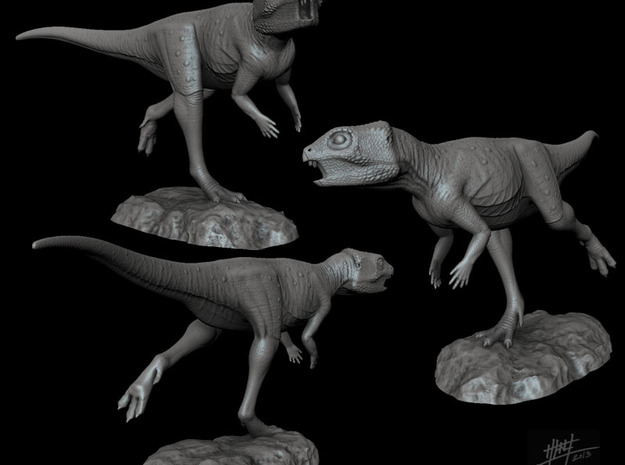
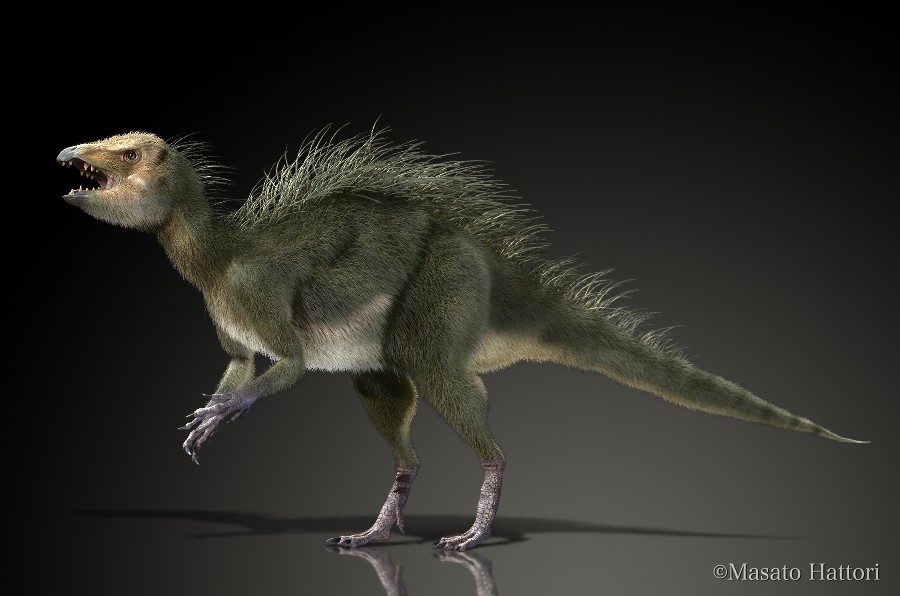
A double entry!  Yinlong is one of the most interesting dinosaurs of recent years to be discovered—a tiny basal ceratopsian; even more basal and older than Psittacosaurus, although somewhat similar on the ouside.  Yinlong also has some unusual synapomorphies with pachycephalosaurs that other more derived ceratopsians do not, although that's not surprising.  It also recovers surprisingly close to the heterodontosaurs, which was more surprising.  In fact, it's sufficiently similar and comes out in cladograms such that it makes significant changes to the cladograms of ornithischians overall.  Heterodontosaurs are now shown to be very closely related to marginoceratopsians, and together they form a sister-clade to ornithopods called heterodontosauriformes.  Curiously, all of our feathery ornithischians are in this group.  Previously, I have suggested that because of where heterodontosaurs were located, it was the best proof that feathers (or filamentous protofeathers of some kind, at least) were ancestral to dinosaurs because they were in the second most basal position in ornithischia as well as in therapoda.  That's not quite as true now, but still—with several ceratopsians and heterodontosaurs showing evidence of filaments along with therapods, we're covered pretty well.  About the only thing that would do to improve the picture (although I don't know that it's precisely necessary) would be to have evidence for feathers show up in a prosauropod and small ornithopod or something like that.  Maybe even a fabrosaur. (Maybe Kulindadromeus will pan out here.)

Anyhoo—the other interesting thing about Yinlong is that it comes from the same Chinese formation that has Mamenchisaurus, Yangchuanosaurus and Guanlong—a kind of analog to the Morrison, if you will, but a little bit earlier.  We already suspected that ceratopsians originated in Asia because of Psittacosaurus and Protoceratops, but this is much earlier than we thought.  Curiously, the greatest diversity of the clade is, of course, in North America, and at the end of the Cretaceous, they seem to have been extinct in Asia.  In fact, the big, rhino and elephant sized classic horned dinosaurs all seem to come from North America (with the probable exception of Turanoceratops.)


And if Yinlong is a surprisingly early ceratopsian that proves—surprisingly—that they were relatively closely related to the heterodontosaurs, well Fruitadens is a surprisingly late heterodontosaur; from the Morrison quarries near Fruita Colorado.  Probably the smallest ornithischian found, and one of the very latest of the heterodontosaurs, these two animals show, among other things, that there very very long ghost lineages (quite possibly in both directions; younger and older) have to exist, meaning that there is a lot we still don't know about dinosaur ecosystems.


As an aside; with these models and those faces, it's not at all hard to see the relationship, is it?

Tuesday, November 14, 2017

(Belated) Extinct Animal of the Week: Panphagia

From Infogalactic:  Panphagia is a genus of sauropodomorph dinosaur described in 2009. It lived around 231 million years ago, during the Carnian age of the Late Triassic period in what is now northwestern Argentina. The name Panphagia comes from the Greek words pan, meaning "all", and phagein, meaning "to eat", in reference to its inferred omnivorous diet. Panphagia is one of the earliest known dinosaurs, and is an important find which may mark the transition of diet in early sauropodomorph dinosaurs.

My first thought was; hey; 231 million years ago isn't in the Carnian, its in the Ladinian!  But I notice that in 2012, the IUGS seems to have updated the dates. My chart is now out of date! My second thought was that while I don't know of anyone who disagrees that Panphagia protos was probably a basal sauropodomorph, at the same time, the position of the Basals is really ugly and subject to a lot of uncertainty and disagreement.  Wedel and Hallet's new sauropod book, for instance, claims Eoraptor is such a basal, while Nesbitt et al.'s big definitive cladogram has it as a basal therapod.  It's also been called a basal saurischian, a basal dinosaur, and even a non-dinosaurian sister group.  As Wedel and Hallett point out, the whole assumption that carnivory is ancestral to Dinosauria comes into question now that we know that the silesaurs are a closer sister group to the dinosaurs than little Lagosuchus after all.  This suggests that herbivory could easily be the ancestral condition for dinosaurs instead of carnivory—or at least omnivory.  This would also help explain why it's so hard to sort out who belongs where at the base of the dinosaur (or at least saurischian) family tree.
In any case, Panphagia is an interesting little character; not much larger than a chicken, and apparently biologically adapted to an omnivorous diet—we think (although studies of iguanas and other animals with similar teeth show us that maybe that's not quite as cut and dried as we've tended to think in the past.  The same is true for almost all of the dinosaurs coming out of the Ischigualasto Formation in La Rioja and San Juan Argentina; it's the same formation as the original herrerasaurs (which come in more genus names than are valid, no doubt), Edodromeus, Eoraptor, and some slightly more defined animals, like Pisanosaurus and Chromogisaurus.  Of these, Panphagia's position as a sauropodomorph seems fairly secure compared to some of the alternatives, which have bounced around all over the place.  Whether or not Eoraptor turns out to be even more basal, or part of some other group, Panphagia seems fairly secure, as does our interpretation of its likely omnivorous diet. 


In any case, Panphagia would have closely resembled several other non-dinosaurian relatives from the same time and area, roughly.  Lagerpetids and silesaurs are also in the formation, as well as aetosaurs, rauisuchians, ornithosuchians, poposaurs, proterochampsians, rhynochosaurs, etc.  Cynodonts and dicynodonts with a fair degree of diversity are also found here, as are temnospondyl amphibians.  Rhyncosaurs and herbivorous cynodonts are the most common fossils found here, and herrerasaurs seem to be the most common carnivores.  The Ischigualasto area was a volcanically active floodplain with plenty of rivers and monsoon-style seasonal rains.  At the time, of course, it was part of the supercontinent of Pangaea, and it would have been located fairly close to the western Panthalassic Oceanic coastline—close to the back of the "pac-man" shape that Pangaea had.

Wednesday, November 08, 2017

The North Horn Formation


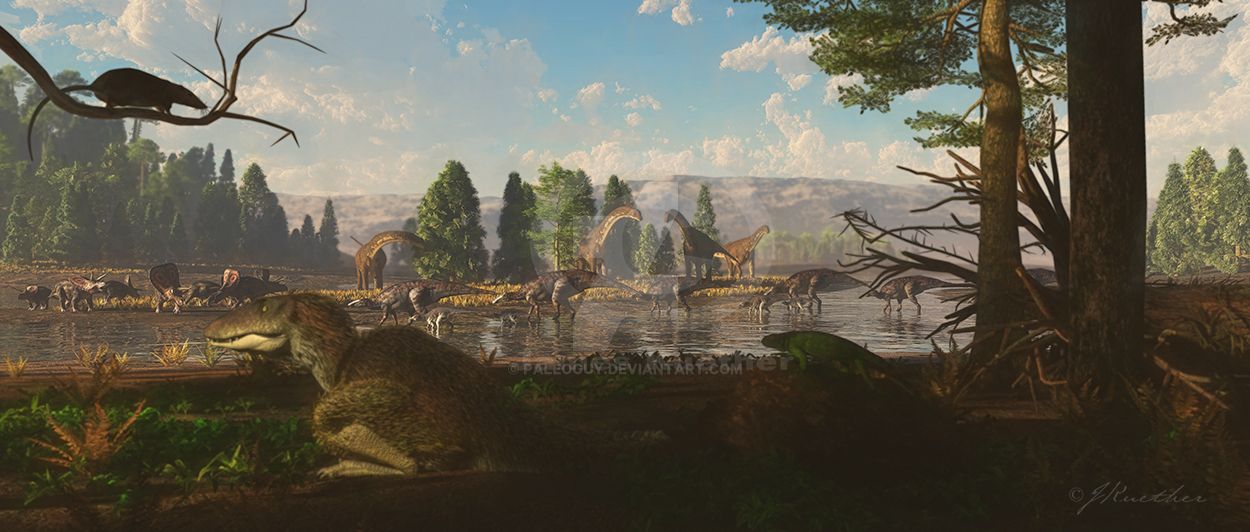
This is an illustration of the Alamosaurus Faunal Assemblage of the North Horn Formation of Utah, a latest Cretaceous Formation that is a bit different from the Lancian assemblages a little further north in Montana and Wyoming with the Hell Creek and Lance Formations.  As most fossil assemblages are, it's a relatively flat area, with rivers and lakes that represents a rather high energy depositional environment.  (This is because these conditions are the best to preserve fossils.  This certainly isn't to imply that dinosaurs didn't live in other environments.)  Because of the lakes, rivers, and probably wetlands that made up the plains of the Maastrichtian North Horn, there are lots of fossils of fish, amphibians, crocodiles, and champsosaurs.  There are also fossils from a large variety lizards (and snakes), turtles and mammals.  Both bird and dinosaur egg fragments have been found, and pterosaur footprints in the mud.

Of course, in dinosaur-bearing formations, what most people are most interested in are the dinosaurs.  Naturally.

However, there isn't a ton to go on, really.  Alamosaurus has been found there, as well as Torosaurus and Tyrannosaurus rex (represented by juveniles in the picture above.)  Some indeterminate hadrosaur fossils have been found.  Based on fossils found both to the north and to the South of North Horn, I'd expect ornithomimosaurs, troodontids, dromeaosaurs (maybe even quite large ones, like Dakotaraptor), oviraptors, ankylosaurs, another big ceratopsid (Triceratops or Ojoceratops), smaller leptoceratopsids, hypsilophodonts of some sort, maybe a pachycephalosaur or two.

Of course, we don't know what kind of animals we have there exactly, just that it's likely that representatives of those groups are probably mixed in there somehow, since they appear both to the north of the formation and to the south of it.

This makes something like the North Horn Formation my #1 destination if there were ever a Terra Nova project in real life to go colonize the Cretaceous.  It's got big sauropods (in fact, some Alamosaurus specimens suggest it's a contender for "the biggest"), it's got big therapods—T. rex even!—and all kinds of other stuff.  It's as if the Morrison had less diversity in its sauropods, but upgraded Allosaurus to T. rex and swapped out Stegosaurus for Triceratops (or at least a close relative.)  There's also probably less small ornithopods, because ornithomimosaurs and oviraptors replaced them.  And the flora is more modern—angiosperms (even grasses) are around.  Mammals are more diverse.  Pterosaurs are considerably less diverse, but toothed (and sometimes claw-winged) birds are plentiful.

All in all, it's a strange hybrid of all kinds of classical dinosaur action—the biggest, most iconic therapod, a really big sauropod, big ceratopsians, big hadrosaurs, all kinds of small dinosaurs, potentially big raptors, big pterosaurs (Quetzalcoatlus is present in the Ojo Alamo formation to the south.) The rice family is estimated to have appeared a good 40-50 million years earlier; there might even be native crops that are edible.  And smaller ornithopods and herbivorous (or at least omnivorous) therapods would probably be good eating for the likes of you and me. The weather probably isn't so miserably hot as it is to the south, but it's still tropical, or at least subtropical.  And although it's a floodplain with rivers and lakes and probably wetlands obviously present, it's not just pure marsh either—probably more fun for the likes of you and me to explore without getting wet, muddy, killed by crocodiles or mosquitoes, etc.  The highlands making up the mountains at Laramidia's western edge aren't too far away, although we know nothing whatsoever about the fauna that lives there.  All in all, this would be a great place to visit.  Maybe even to settle.

Speaking of the highlands and drylands; I wonder if they resemble contemporary (or nearly so, anyway) Mongolia-Chinese fossil assemblages a bit?  By which I mean: therizinsaurs were present in North America earlier, although none are known from these formations, but they continue and in fact are quite diverse in Asia.  There are also really weird animals like super-sized ovirpaptors (Gigantoraptor) and the bizarre Deinocheirus—but then there are very close relatives to T. rex and Edmontosaurus present as well.  Much of the smaller dinosaur fauna is also referable as closely related to North American faunas. 

By the way, the Nemegt would be a fun one to visit as well.  Maybe it'd be interesting to see the latest Maastrichtian of the Nemegt area to see what (if anything) changed in the NALMA.

Monday, October 30, 2017

A quiet tribute to dinosaurs of yore

I'm not going to pick a single Extinct Animal of the Week this week, and I'm not going to (yet) do the second half of MEET THE MEGALOSAURS either.  Rather, I'm going to do a nostalgic trip through the kinds of dinosaur stuff that I used to read as a kid.  The whole "gigantic lizards, living in the swamps and lakes" business, with names that I saw in practically every dinosaur book that nobody ever uses anymore.  Scientifically, we find that most of these names were assigned to dubious, scrappy, incomplete, or non-diagnostic remains, and then the name was used normally to describe remains that should have been assigned other names.  Today, of course, we 1) use different names to describe the animals that used to have the names listed below, mostly, and 2) know that most of what we thought we knew about them was wrong anyway.  Given 2, then maybe it doesn't mean that 1 didn't get renamed; it means that they simply never existed at all.  The whole aquatic Trachodon, for instance—one could say that they were renamed Anatosaurus, then Anatotitan, then Edmontosaurus.  But although the remains of Edmontosaurus are those that used to have the name Trachodon, the two animals are really quite different.  Edmontosaurus is a terrestrial, pine-needle eating Late Cretaceous buffalo, if you will, while Trachodon was a lake-dwelling, two-legged, tall, buck-billed herbivorous crocodile.  So, without further ado...

Trachodon—well, I was just talking about it, so let's start there.  In every old dinosaur book I ever read as a kid, Trachodon was the "boring" duck-bill, and he'd be sitting there on the lakeshore along with Lambeosaurus, Corythosaurus and Parasaurolophus.  They always hung out together on the beach.  And whenever Tyrannosaurus rex came along, they'd make a scramble for the water, which T. rex was so afraid of that he wouldn't even let his feet get a tiny bit wet in a few inches of water, it seems.

This is of course nonsense, as only Edmontosaurus lived at the same as as T. rex; the other three were all part of Judithian or Edmontonian faunas.  None of them lived at the same time as each other either.  And while it's true that these hadrosaurs all seem to have favored wetlands as habitat, they weren't lake-dwellers, and T. rex hunted those same terrains without worrying too much about it.  There is also a theory that the transition from the Judithian to the Lancian fauna came as sea levels decreased and generalists from the more arid uplands flourished, while wetlands specialists declined.  This is more marked in the south, with the Alamosaurus-Quetzalcoatlus guys.  Migration from Asia and possibly South America as sea levels fell is another theory.  In any case, nothing about the environment or habits of Trachodon turns out to be true, so maybe it's not such a bad idea that the name is closely associated with the debunked paradigm of dinosaurs anyway.


Fabrosaurus—This one, on the other hand, is just unfortunate.  Fabrosaurs were long listed as these really primitive, early Ornithischian from the Early Jurassic of South Africa.  They were presumed to have had wide-spread, probably even global distribution.  (This in spite of the fact that almost all of what we've found for them is in South Africa, and maybe some very recent findings now from China.)  No doubt, there were some interesting, early Ornithischians that were more or less similar to what we long thought Fabrosaurus looked like—Pisanosaurus from South America is even earlier and isn't all that different than what we would expect from Fabrosaurus.  But fabrosaurs themselves are no longer believed to be a group; they're just a bunch of stuff "on it's way" to becoming another, more advanced ornithopod group, or something like that.  And the specific animal on which most restorations of Fabrosaurus were based is now called Lesothosaurus instead.

Monoclonius—While some still say that this might be a valid animal, most think that Monoclonius was actually a fragmentary juvenile Centrosaurus these days.  As with the duckbills, horned dinosaurs in old books were often thrown together regardless of whether they were from Judithian, Edmontonian or Lancian faunas—although at least they were more or less geographically close (much of the fossils of the southern province of Laramidia hadn't been found yet, with names like Bravoceratops, Eotriceratops, Arrhinoceratops, etc.)  In those old books, a hungry T. rex almost always found the duckbills—who ran into the lakes, thus frustrating him, then he stumbled across an Ankylosaurus, which he couldn't do anything with because of its armor, and then he went looking for the horned dinosaurs, which oddly enough were always believed to be out on the plains like scaly buffalo.  Monoclonius and Styracosaurus were usually pictured together, but for whatever reason, T. rex didn't try to eat them, always looking instead for the Triceratops.  Often these other two were pictured forming musk-ox like circles around the young.  Triceratops, on the other hand, were always the big bad loners.

Complete with Triceratops in the distance
Brontosaurus—This is a real crime, in my opinion.  Brontosaurus was the most famous dinosaur ever, and a bunch of nerdy, nebbish paleontologists made a gamma male play to be self-righteous and self-important and tell everyone in the whole world that no, we need to call it Apatosaurus.  At around the same time that the name was disappearing from popular literature, we also found out that it had been given the wrong skull, and the boxy, squared-nose skull associated with Brontosaurus should have been replaced with one more like Diplodocus, making the newly christened (at least in popular literature) Apatosaurus a very different animal than Brontosaurus that was.  At about the same time, the whole snorkeling lake-dwelling sauropods was replaced; we now believe that there's actually a strong correlation between sauropods and drier climates, if anything.  Granted; what we've learned about sauropods is much more interesting than what we used to think.  Most old dinosaur books associated the sauropods very distinctly with the Jurassic, and we were often only shown three of them; Diplodocus (the longest), Brachiosaurus (the biggest) and Brontosaurus (the most famous) while the much more common (yet fairly boring) Camarasaurus and the rare Haplocanthosaurus plus the European (yet poorly known) Cetiosaurus.  Maybe if you were really lucky, you heard of Barosaurus somewhere.  But those three were all we talked about.

Curiously, Brontosaurus has made a return; some specialists now believe that Apatosaurus deserves to be split into two genera, and Brontosaurus was the obvious choice.  There are now two to three species of both Apatosaurus and Brontosaurus specifically (probably separated in time, so that there was only one of each in the Morrison at a time, most of the time.)

Classic square-headed Brontosaurus trying to escape by going to the lake.
http://fistfullofpodcasts.com/?powerpress_pinw=1117-podcast

Very interesting.  Listening to the stuff about halfway through (a few minutes after one hour) they talk about sauropods being really big all of the time; that clearly isn't true, though.  He does talk about island dwarfs briefly, but the fact is, there really are a number of modest sized sauropods, and much of the latest Cretaceous sauropods are modestly sized.

He also talks about the polyphyly of Sauropoda.  This is not something that he really believes (in fact, he specifically says that) but it's still an interesting idea.


Thursday, October 26, 2017

Meet the Megalosaurs, Part I

I never did an Extinct Animal of the Week on Monday!  I noticed this on Tuesday, of course, but I was busy on Tuesday and even Wednesday and still didn't get around to it.  So my Extinct Animal of the week is extraordinarily late this week. In fact, it's so late, that I think I'm going to expand it into another "Meet the ...." series, in this case, Meet the Megalosaurs.  This is an odd one, because I'm not as familiar with the megalosaurs as I am with the carnosaurs or tyrannosaurs... so I'll get to learn along with the reader, to some degree!

Megalosauroidia, as defined by Carrano, Benson and Sampson (2012) is the sister-group to Avetherapoda, which includes both carnosaurs and coelurosaurs.  I've already talked a great deal about both the carnosaurs, and one branch of the coelurosaurs (the tyrannosauroids.)  Of course, the coelurosaurs also give us, for instance, the oviraptors, the "raptors" (dromeosaurs), the ostrich-dinosaurs (ornithomimosaurs), the therizonsaurs, the compsognathids, and of course, the birds themselves.  There are several posts worth of exploration within coelurosauria, but I'm not feeling very inclined to do it, because I think many of those animals are weird and less interesting to me personally than some other dinosaur groups.

I'll do the megalosaurs, and maybe the ceratosaurs (someday), including abelisaurs, and I'll be done with meat-eaters.  I may yet explore some of the plant-eating lineages, like the ceratopsians or the sauropods, but we'll see.

The megalosauroids consist, at a high level, of three groups: the piatnitzkysaurs, the spinosaurs, and the megalosaurs proper (which also has the spin-off group of afrovenators.)  The earliest known examples come from the Middle Jurassic, and this seems to be their period of greatest diversity.  Their larger and more famous examples include Late Jurassic forms (like Torvosaurus), but the spinosaur radiation is more of a "mid" Cretaceous phenomena.  (Keep in mind, there is no official Middle Cretaceous; just Early and Late.  "Mid" Cretaceous is therefore a convenient informality.)

The Piatitzkysaur family is united by five synapomorphies, and is usually the "first" encountered on the megalosaur family tree.  It consists of only three animals; two Middle Jurassic therapods from South America and Marshosaurus bicentesimus from the Cleveland-Lloyd quarry of Utah.

If you recall, Cleveland-Lloyd is from the Brushy Basin member, and is therefore the later part of the Morrison.  There were other large megalosaurs in the Morrison; mainly Torvosaurus, but Marshosaurus was a more modestly sized animal, maybe the size of a grizzly.  Known from not a lot of remains, and have some tail fragments from Colorado provisionally referred to it as well, we don't know a lot about Marshosaurus.  It would have been, curiously about the same size as the holotype of Ceratosaurus, but a large individual of the latter was also found in the Cleveland-Lloyd.  Altogether, there seem to be more predators in the Morrison than we'd expect, and exactly how they evaded competing directly with each other is unclear—but the Morrison area was large and spread over many millions of years; maybe they didn't all exist in the same time and place at the same time as much as it seems that they did.

The other two piatnitzkysaurs are Condorraptor currumili and Piatnitzkysaurus floresi itself; both from the Cañadon Asfalto Formation of central Patagonia.  Both are known from pretty scanty material, so I'm not sure exactly how to describe them as different from each other—but both are medium-sized therapods (similar in size to Marshosaurus) from a lacustrine floodplain environment from the Middle Jurassic about 165-160 million years ago.  Not a lot is known about not only these two animals, but also their environment.  Some frogs and turtles, a couple of primitive sauropods, a primitive heterodontosaur, and even a primitive abelisaur have all been found in the formation, as well as many plants and a few few mammal bones, but not necessarily all from the same stratigraphic position within the formation.  Which means to say that we can only infer a relatively small amount of information about its environment at all, really—what it hunted, how it lived, and what it competed with.  As is the case with some other environments, there seem to be two many therapod species that are all about the same size for the area, making one wonder how they avoided competing with each other exactly.

Leaving the piatnitzkysaurs and entering megalosauria proper, before we get to any of the groupings within it, we have to deal with Streptospondylus altdorfensis, a French animal of (again) medium size, known from some vertebrae and limb elements.  Although it was one of the very first dinosaurs identified, it was actually known and misidentified as crocodylian for quite some time prior to that.  The remains are too fragmentary for a really confident placement of its relation to the rest of its family.  It was found in rocks that are about 161 million years old, and like many megalosaurs known from fragmentary remains, has bounced all over the therapod family tree for many years, and has seen a bizarre split into numerous proposed species, almost all of which are dubious.  Although within Megalosauria, it is not within Megalosauridae, which means that it's not really all that closely related to Eustreptospondylus oxoniensis, which is within the Megalosauridae proper.  Eustreptospondylus is sometimes placed within its own subfamily.  Like everyone else in the family we've looked at so far, it was about 20 feet long and maybe half a ton in weight.  Also from the Middle Jurassic around 162 million years ago, it is one of the most complete largish therapods discovered in Europe, and certainly that was true when it was unearthed in 1870.

Europe during this period was an East Indies-style archipelago, with relatively large islands, but nowhere near the landmass of a continent, because high sea levels flooded much of the epicontinental areas with shallow, tropical seas.  It makes an appearance in Walking With Dinosaurs which, although pretty dates, is probably more or less accurate enough.

It's funny that the megalosaurs have been an infamous trashcan taxon for decades when in reality not a ton is known about megalosaurs, because they've been found most frequently in formations that are poorly known, or they've been relatively rare in the formations in which they are found.  There are really on three genuine megalosaurs, by which I mean members of the Megalosaurinae subfamily.  The most primitive and oldest is Duriavenator hesperis from 170 million years ago in England; one of the earliest of all tetanuran therapods, actually.  Of course, it was originally referred as a new species of Megalosaurus itself, but it's fairly closely related, at least.  Known only from some jaw fragments, it was... probably about the same 20-25 foot or so size as everything else we've looked at so far.  Very little is known about it or its environment, except that it had more teeth in its jaws than Megalosaurus itself.

Which, after all that, only has one valid species left after all, Megalosaurus bucklandii.  From the same time period, the Bathonian of about 166 million years ago, in Oxford.  Amusingly, its famous for having the knob end of a leg bone named Scrotum humanum, the first scientifically named dinosaur remains, although they were assumed to have been the fossilized testicles of a giant at the time.  Although among the largest animals known of those we've reviewed so far, it still wasn't all that big; less than 25 feet long—this seems to have been an upper limit for Middle Jurassic finds so far.  A hip and sacrum is known, some leg bones and plenty of vertebrae, and some jaw bones, but nothing like a complete skeleton has ever emerged, and its exact proportions and details remain fairly speculative.  A bit of skull (although no nose elements) suggests that it might have been an unusually large-headed therapod.

Megalosaurus lived alongside primitive cetiosaur-grade sauropods (including Cetiosaurus itself), some other smaller therapods and primitive ornithopods.  By inference, some stegosaurs are believed to have lived in its habitat as well, and it's believed to be the apex predator of its ecosystem.  As described elsewhere, including earlier in this post, it is part of the island Europe environment.

The final megalosaur (before I do afrovenators and spinosaurs tomorrow) is Torvosaurus, which comes in two species, tanneri from the late and northern Morrison and gurneyi from Portugal.  There may be another specimen (or closely related animal) found in Germany as well, and as at least a few already collected but not prepared or properly described bones lurking in museums have been referred to it, there may yet be more to come that's already been unearthed.

Torvosaurus, compared to, say, Allosaurus, which appeared in the same time and place (more or less) seems to have been quite large; from nearly 35 feet long to nearly 40—possibly—with a heavy body, kinda short legs, and a long snout.  It is presumed that Torvosaurus (and Ceratosaurus) may have preferred the more thickly vegetated gallery forests, and the allosaurs may have preferred the drier plains, but this is an inference based on pretty circumstantial evidence.


Tomorrow (or Monday) I'll turn to the spinosaurs and afrovenators.  In general, the megalosaurs have not been among my favorite predators (which are the predictable tyrannosaurs and the less predictable carnosaurs) but the last two; particularly Torvosaurus is a kind of favorite of sorts of mine.  As a contemporary of Allosaurus and the possible king of my favorite dinosaur faunal assemblage from the Morrison, I've got to give Torvosaurus his due.  I'm also a bit fascinated by Megalosaurus himself and his environment.  I've long been interested in the immediate predecessors of my Morrison-aspect faunas (and by Morrison aspect faunas, I mean Lourinha and Tendaguru too); i.e., where did they come from, and what were the more primitive Middle Jurassic faunas that led to them come from and what did they look like?  In general, the early Jurassic is very poorly known and the Middle Jurassic could use a lot more exploration.  It's a bit of a blank spot on our paleontology map that I'd love to see filled.

Monday, October 16, 2017

Estemmenosuchus


Estemmenosuchus is likely one of the ugliest land-creatures that ever lived.  Coming to us from the Permian fossils of... the Perm, actually (Cis-Ural Russia) in the Wordian age of about 267 million years ago, it predated the great die-off at the end of the Permian by about 15 million years, and followed Olson's Gap by only about three million years.  Olson's Gap, previously thought to be an actual gap in the fossil record, is now sometimes called Olson's Extinction, and is meant to show how the primitive pelycosaur and reptilomorphs faunas dominated by animals like Dimetrodon, Edaphosaurus and Diadectes and the caesids were replaced by more advanced therapsids.  Bob Bakker, in his famous pop-science book The Dinosaur Heresies, published in the 80s, called this event "the Kazanian Revolution" and proposes that this is when warm-bloodedness took over the megafauna of the world permanently.  Prior to this "Kazanian revolution" (Kazanian is a regional stratigraphic term, which corresponds to the upper Guadalupean, which is when the Wordian is placed.  It gets little use today except in older Russian paleontological papers) the fauna was "cold-blooded."  (Although the book is old, much of it is out-dated, and it was kind of old news even when it was published, that particular chapter is still worth a read.  See if you can score a copy at your local public library.)

Although the words aren't very popular anymore with working scientists, who have embraced the cladistic terminology like a bad fad, it represents the turnover from pelycosaurs to early therapsids, and was a revolutionary thing to have happened, even if Bakker is wrong and the early therapsids weren't warm-blooded (although they probably were.)  It was a major shift in the fauna towards the development of mammals, and would be followed by further shifts into more advanced therapsid groups until true mammals finally appeared—right about the same time true dinosaurs appeared in a rival lineage—in the Middle to Late Triassic many millions of years ahead of Estemmenosuchus.  But our buddy for this week was an important goal-post to be crossed on the way there.

Estemmenosuchus was a relatively large animal; the largest of the two species could reach lengths of nearly 15 feet, even though it was a sprawl-legged, short-tailed critter.  It was probably fairly bulky, and would have weighed nearly as much as a hippo or rhino. The smaller species is more like the size of a large pig or tapir.  It's believed to be a herbivore that lived in the floodplains drained by rivers running from the relatively newly raised (and therefore sharper and taller) Ural Mountains.  Estemmenosuchus is famous for it's moose antler-like headgear, as shown in the pictures attached, but it's also famous because good skin impressions are found associated with it.  This means that it provides evidence of a kind that even other, more primitive therapsids do not (for that matter, we rarely have this kind of evidence for more advanced therapsids either.)  Curiously, this skin is not scaled at all, nor is it hairy, but evidence shows that the skin was highly glandularized.  This would suggest that its lack of hair might be an adaptation to its relatively large size and warm climate (i.e., rhinos, hippos and elephants are all almost completely hairless today too) but that it is skin that is already prepared to deal with hair and warm-bloodedness.

If this is all actually true, which it appears circumstantially that it well may be, then Estemmenosuchus is part of one of the very first terrestrial faunal assemblages that could be called truly "modern", albeit extremely primitive for a modern assemblage.


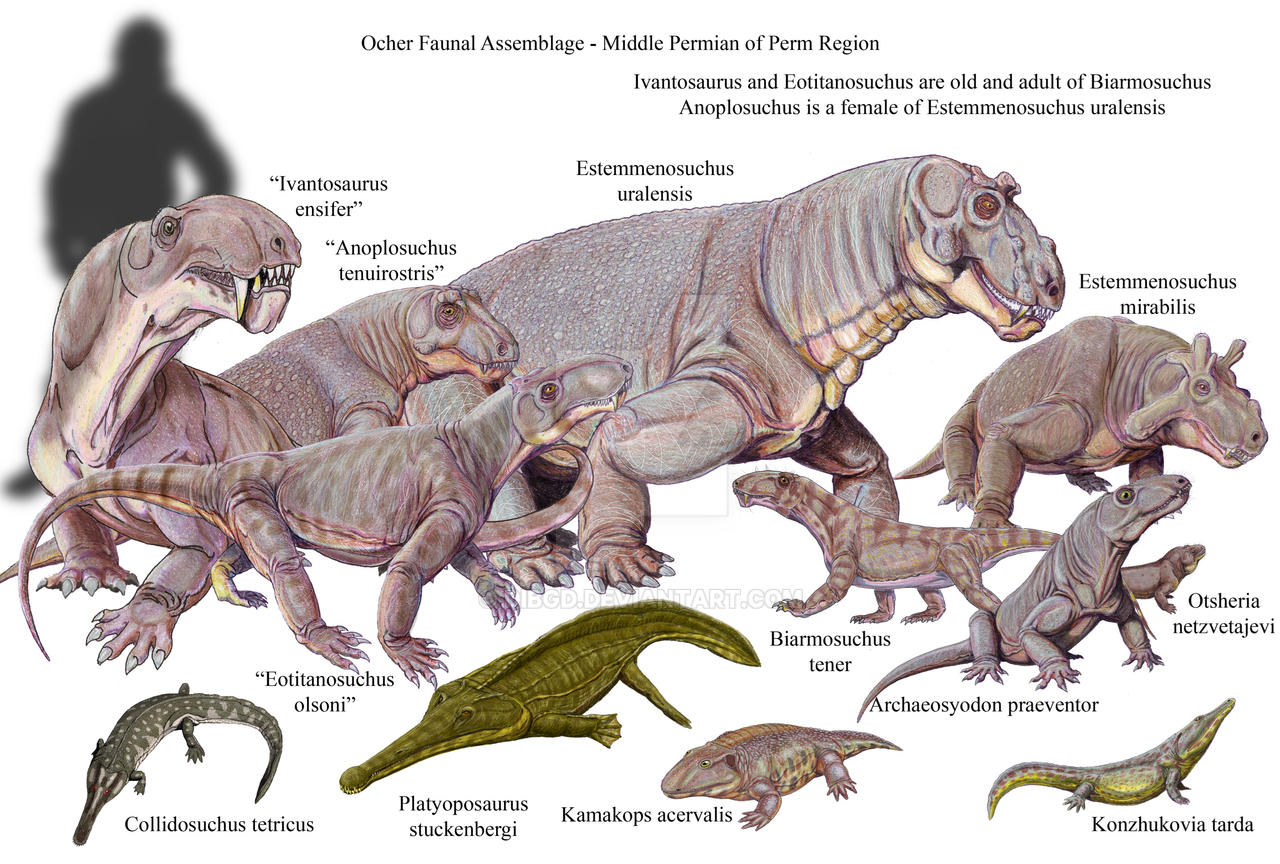
Estemmenosuchus was associated with Eotitanosuchus and may in fact have been frequent prey of that animal as well as the myserious "Ivantosaurus ensifer"—a very large carnivorous primitive therapsid who is believed to be a large representative of either Eotitanosuchus or maybe Biarmosuchus tener.    The whole faunal assemblage, as illustrated by a Russian paleoartist, is shown below:


As you can clearly see, the smaller Estemmenosuchus species has by far the more elaborate headgear.  These animals were replaced as large herbivores in the next faunal assemblages by tapinocephalians such as Ulemosaurus and the South African Karoo version, Moschops.  

Although these large-bodied sprawling therapsids, living among primitive archosaurian fake crocodiles and gigantic amphibians and primitive tree ferns, club mosses and other strange plants are, as I said, a "modern" fauna in the sense that it represents probably warm-blooded megafauna, it is still extremely primitive; only one faunal assemblage is more primitive in the Russian fossil record; and it has a close relative, Parabradysaurus present therein.