Showing posts with label DnD Next. Show all posts

Wednesday, April 09, 2025

Dragonborn, tieflings, and what is D&D?

Couple of things percolating in my head like a hot drink. First thing; I finished reading last night a pdf that I got as part of a DCC humble bundle a little while ago. The pdf was the Gazetteer of the Known Realms, and is basically a 120 or so page campaign setting for the DCC adventures. It was written before the DCC game, but it is part of the 3.5 OGL releases, and if you recall, the first DCC adventures were all 3.5 adventures. There's also a second part, another pdf that's part of the same "boxed set", which is Gamemaster's Guide. This was an interesting setting, to me at least. Not because it necessarily did anything that I really thought was exciting, or that I wanted to borrow or use, but because of what it represents. While a number of "3e-isms" were pretty obvious, especially with regards to psionics whenever they were mentioned, it was obviously and deliberately written to be a very "proto-OSR" setting, and I've heard it described online as what a Mystara boxed set would have looked like had the old D&D line ever released one (apparently, they didn't. Just the gazetteers. No doubt why they also used that name.) This is both its strength and its weakness; it's cool that it's such an old-school campaign setting, that it fits nicely next to Greyhawk or Mystara and even feels very similar in most respects to those settings. But it curiously is very, very D&Dish in the old school way; the way the setting is set up, the races and their arrangement and relationships, etc. As cool as that is, it doesn't do much that hasn't already been done many times, and as such, it hurts it as a product; it simply doesn't offer anything that we don't already have, therefore, it becomes completely superfluous and unnecessary. I'm still trying to decide if I think it was a waste of my time to have read it (and to turn to the second book in the boxed set) or not. 


One way in which it was just a little different than older settings like gray box Forgotten Realms, or the older Greyhawk gazetteers, or whatever—it has some proto-wokeness. The whole white colonialism bad vibe, which is understated but present, is one that we probably wouldn't even have thought of at all in the 80s, so I'm not sure that that can count, but the presence of all kinds of female knights and heroes is something that's always jarring to me; I've known too many women and I've known to many men to think of them as interchangeable widgets. The people who push that kind of nonsense come across as very bizarre to me. Like they don't know enough real people to understand human behavior, or something. I don't mine female characters, especially when played by women. But acting like women who act like men is common across the history of the campaign setting, and common across the setting overall is weird. DCC's setting Aereth, or whatever exactly it's called, does this.

That said, I came across this old post by Rob Schwalb from the lead-up to 5e. I think it's interesting, so I'll quote it (mostly) in full.

A few years ago, I woke up and realized what I thought was fantasy wasn't the same for everyone else. Sure, people have had worlds with winged cats that could talk, elves with red cloaks, and all sorts of tweaks and twists to the basic fantasy tropes for years. And I've always known that things such as the Empire of the Petal Throne and Jorune lurked on the fringes, but they were strange things wholly alien to my sensibilities. You see I cut my teeth on Tolkien, Homer, Mallory, Howard, Alexander, and the rest. The old red box D&D let me play in a version of fantasy with which I was most familiar. It let me tell my own stories set in Middle-Earth or wherever because the fundamental concepts about fantasy ranged from "one ring to rule them all" to forbidden dealings with Arioch to scaling the Tower of the Elephant. I knew elves didn't hang out in Hyborian Age and you would never find dwarves drinking with Gawaine, but in my youthful mind I could reconcile these differences because it was all fantasy to me.

By the time 2nd Edition D&D hit the shelves, I had already solidified my views and, with the frustrating absence of assassins, half-orcs, and monks aside, the game remained true to that vision. But over the next few years, the game began to change. TSR published settings that presented different ways to play D&D. Some, such as Birthright and Mystara, weren't that far from my tastes, while others challenged what I believed was true about D&D, notably Spelljammer, Red Steel, and Dark Sun. In some cases I embraced these visions; in others I rejected them. Thinking back, we never said we were playing D&D when we played Dark Sun. Instead, we said we were playing Dark Sun. (The same was true for Ravenloft now that I think on it.) I enjoyed those settings as games in themselves—games that just so happened to use the rules I knew so well. They weren't D&D; to me, but that was okay because they never spilled too far into the core (though the MC Appendixes would eventually chunk together all sorts of monsters from across a wide range of worlds).

The weird psychological game I played continued into 3rd Edition. The racial assortment stayed more or less the same as it had in previous editions. The game retained the core tone I had embraced years ago. Things would change. Supplements introduced new races, some expected (half-ogres and minotaurs) and some completely unexpected such as dusklings (Magic of Incarnum), illumians (Races of Destiny), and the hadozee (Stormwrack). Since these races lived in supplements, I could ignore them or use them at my discretion.

Fourth Edition, however, shocked me. I never imagined I would find dragonborn and tieflings in the Player’s Handbook. What about the gnome? Where did the half-orc go? D&D had gone and reinvented itself without consulting me! Imagine my horror. Why did the marshal deserve to be in the Player's Handbook in place of the druid or the bard? Everything I knew to be true about D&D had been shaken up, and I was left puzzled and a bit upset—not enough to explode in nerdrage, but enough that I was uneasy.

I was so certain and so confident the dragonborn didn't belong in D&D, I figured my players would reject the race as I did and choose something more in line with the D&D we'd always played. Imagine my surprise when one of my younger players, who was 19 at the time, immediately latched onto the dragonborn and warlord. Imagine my continued surprise when game after game my players ventured further afield than the classic array of classes and races. What I realized was that although dragonborn seemed ridiculous to me, the race had a great deal of appeal to my gaming group—the cantankerous, vulgar, twinkie group of players that they are. And if these old dudes could climb on board the tiefling, drow, dragonborn, wilden, shardmind train, then there must be people for whom these elements are fantasy for them. In the end, I made my peace with the weirder races and classes that have snuck into the game and broadened my horizons to at least not be offended that they exist. (I would use an emoticon to soften the last sentence but I won't stoop to that sort of nonsense here.)

We've talked a lot about what races and classes we would include in the next core player book. I've argued at great length about how editions never fall at break points in people's campaigns and that often an edition change means invalidating a choice a player has made about the character he or she is playing. I can imagine some folks were upset not to have a monk class when 1st Edition shifted to 2nd, just as I'm pretty sure some folks were upset when they couldn't play a barbarian right out of the gate when 4E landed. We've tentatively agreed that D&D; is big enough to accommodate the various Player's Handbook classes and races, and we want to make sure these options are available when the next version comes out. Although this move will certainly appeal to the audience who think dragonborn and tieflings kick ass, I wonder if their inclusion will offend people with opinions that matched mine a few years ago. I'd love to say that we're all reasonable people and finding a tiefling in the next version of the game doesn't mean they have to appear in every world or campaign, but, being an unreasonable person myself, I can understand how such a thing might be upsetting to people who have a clear vision of what D&D ought to be. Likewise, I think people who dig the Nentir Vale and the 4E cosmology would be livid if we ripped out the dragonborn and tieflings, whose fallen empires are so important to shaping the land. Is this a no-win situation?

I mean, he's not wrong, necessarily. D&D isn't just whatever the owner of the brand says that it is. At some point, it's not recognizable to people who played D&D in the past. People who don't seem to get that, and tell "conservative" gamers to suck it up because claiming that sexually ambiguous bird, rabbit or turtle people running bakeries is what D&D is are wrong; that's not D&D to me, or anyone my age, and arguably its so far away from what D&D was that even people who play 5e and have only played 5e, in a neo-trad playstyle, have got to see that as something severely removed from what D&D was. 

Of course, my perspective is that I don't also care very much what D&D is, because I've always been somewhat ambivalent to exactly what D&D is. My own perspective has changed away from the more "vanilla" approach of what fantasy is, from the mostly high fantasy stuff like Tolkien, Alexander, and even Salvatore and Weiss/Hickman of my teenaged years to something a bit different, and more weird tales (not that I didn't read pulp stories in my teenage years too, but at the time, I was more likely to read Tarzan and John Carter than Conan, honestly.)

UPDATE: Spotted on ENWorld. Why am I still going there? Anyway...


Sadly, it wouldn't be appropriate in that venue for me to respond "It's still super gay." Well, maybe appropriate isn't the right word. But it wouldn't be seen as funny. ENWorld is super woke. They make reddit seem sane.

Wednesday, May 13, 2015

Year of the RPG

To show how out of touch with the hobby mainstream I have been, it literally never occurred to me throughout the entirety of 2014 that it was the 40th anniversary of D&D and therefore of the hobby itself.  D'oh!  And this as I had a friend named Dave who always signed off internet posts, on hobby related topics, with a tagline proclaiming that OD&D (1974) is the One True Game.  All others are a pale imitation.  For years, I saw that, and yet it still never occurred to me that naturally 2014-1974 is 40 years.  Man.  Facepalm, and all that.

However, considering that my attachment to D&D specifically is rather tenuous--I'm playing, on the very rare occasions when we do play (I think it's well over six months since a session has been held) a home-brewed d20 Star Wars, and my own efforts in design and general tom-foolery with RPGs have been focused on Microlite for some time now--maybe it's not terribly surprising that the whole year came and went without me thinking about it.

That said, even I'm not immune from the occasional trip into sentimentality and nostalgia.  I've had a lot of fun with D&D over the years, and would not at all be averse to playing it again with a good group, especially if it's one of the rulesets that's either flexible or light or both.  Which ones would I be willing to play?  Interesting question.
  • Some time ago, I proposed to my gaming group a one-shot--or at least few-shots game of B/X D&D--the original Basic/Expert Moldvay series from 1981, which was based on the earlier Holmes Basic set.  The Holmes set was meant to be a revision and clean-up of the original OD&D rules, while the Moldvay set reflected a schism at TSR over the direction of D&D as a whole; the Basic set, while substantially revised and changed by Moldvay meant to emulate the original "spirit" of the game, if you will, while Gygax himself went on to AD&D which was an increasingly arcane and complicated ruleset with a much greater preponderance of rules to follow.  I have no interest in playing AD&D (1st or 2nd edition) but I could go for some B/X D&D.  Especially if we played the original modules that came with the game--B2 Keep on the Borderlands and X1 Isle of Dread as a prelude to doing something original.  Actually, come to think of it, I'd probably prefer this ruleset to be used almost exclusively to be used in a retrospective of classic modules.
  • I'd still play some Third Edition.  Or more likely, 3.5.  It's more rules than I want anymore, but I know the system well, and I know how to get the experience I want out of it.  I've had tons of fun playing this, and am sure that I could do so again.  It's not my first choice anymore, since discovering Microlite, but I wouldn't complain if this is what ended up in front of me.  If I were to run it myself, I'd incorporate a few houserules, many of which I've talked about ad nauseum  on this blog already, a few of which are from Pathfinder, but in general I think Pathfinder took the parts of 3rd Edition that weren't good an amplified them rather than fixing them.  I'd much rather play 3rd Edition than Pathfinder.  If I were running, I'd even consider a pared down and heavily edited (and somewhat redacted) Pathfinder Adventure Path.
  • Although I have no interest whatsoever in 4th edition, 5th Edition seems to be a well-designed game that purports to play more like what I want D&D to play like.  Does it really?  I have no idea!  I've never played it; I've never even read it.  But I'd be willing to give it a go.
  • Although not technically D&D per se, I'd be willing--surprise, surprise--to play one of the Microlite games that's specifically set up to play like D&D, such as regular ole original Microlite, or some variation on the Microlite74 family.
Any version of AD&D is right out; not interested, and the same is true for 4th Edition.  I got bronchitis, ain't nobody got time for dat. Now get me a cold pop!

Wednesday, February 19, 2014

XP and levels... again

http://www.wizards.com/DnD/Article.aspx?x=dnd/4ll/20140217

I know, I know... D&D 5e is about being the "big tent" that brings all of the D&D players who were lost in the diaspora back home again.  But is that maybe a pipe dream?  Are the playstyle assumptions of the various "factions"--to say nothing of the mechanics preferences--simply too disparate to ever be able to be on the same page again?

Mearls' post mentions trying to design adventures with a pace and flow of leveling that matches a more "story first" paradigm of the game.  He mentions the XP model as being more appropriate for a wandering hexcrawl or other "sandbox" style game. (For now, I'll reserve judgement on those two proclamations.)  Essentially, he's saying that adventure writers are working in the "story first" paradigm, but hang on to the hex and dungeoncrawl paradigm of rewards.  Why they would do this is unclear--unwilling to buck tradition, maybe?  Hope that hexcrawlers or dungeoncrawlers will still see enough value in their Story First module to buy it anyway due to the rewards?  None of these motivations are clear.

But if--and I say this for the sake of argument, because I'm not at all certain that I believe in this if--XP rewards are best suited for a hexcrawl or dungeoncrawl, and story milestone leveling up is best suited for a Story First paradigm, then wouldn't it be better for module designers to just pick a playtsyle that they're trying to accomodate and go all out to be the best module to accomodate that playstyle that they can?  Trying to appeal to both playstyles seems like an exercise in pleasing no one very much.  Why even go through the motions of appealing to XP progression, if it's inherent in the design of the module that the PCs are X level when they start it, and level up at Y position in the module, and are therefore at level Z for the remainder of the module?  Just tell GMs that that is the assumption, and let them figure it out.  If Mearls' column linked above is correct, that's what many DM's are already doing anyway.

I think the problem here is the commercial imperative that 5e gather in as many players as possible, combined with the psychological imperative some people have that wants everyone to be on the same page.  That just simply is not a realistic goal.  One side effect--whether intentional or not is up for debate--of the OGL was that gaming became micro-sourceable, in order to reach increasingly smaller niches.  Actually, this was exactly what Ryan Dancey hoped it would do, but he thought it would do so under the rubric of d20 D&D, and I don't think he foresaw a Hasbro-compelled business desire to move to 4e, and then 5e in relatively quick order.  Nor did he foresee the use of the OGL to create completely different games, like OSRIC and the rest of the OSR, and more particularly, Pathfinder.  He certainly didn't foresee that Pathfinder would actually overtake D&D (as a brand name).  Micro-sourcing to niche preferences is all well and good when we're talking about modules, but the actual game itself?  Well, the OGL was supposed to drive sales of the PHB, right?

Then again, maybe he did.  There were also a lot of comments from guys like Peter Adkinson and Ryan Dancey and the like about "saving" D&D from the poor decisions of corporate suits who didn't understand the hobby at all, and making sure that it stayed saved in the future, by creating an evergreen version of the game that could never be revoked.  In that sense, Pathfinder is D&D; D&D as envisioned by the WotC team that saved it from the folly of TSR's mistakes, at least.  In that sense, maybe it's more D&D than D&D is.

Now, I don't really have a dog in that particular fight.  I don't really play Pathfinder, 4e, nor am I likely to play 5e. My group is quite happy continuing with 3.5, I think, and my own personal favorite is Microlite.  I'm academically curious about stuff that happens in the OSR and in the "official" D&D space, but it's not likely to impact me or my own personal gaming very much no matter what happens.

Wednesday, February 05, 2014

Tiers of play

http://www.wizards.com/dnd/Article.aspx?x=dnd/4wand/20140205

I've said many times that as the game advances through the levels, it literally changes genre before your eyes.  This, of course, wouldn't have been surprising at all if I'd remembered and connected the dots that it used to be much more explicit.  My first game of D&D was with OD&D, but I didn't really "get it" for some time.  It wasn't until sometime in the 1981-3 window that the Moldvay B/X sets of D&D were out that I really got into the game.

And within relatively short order, Moldvay was replaced with the Mentzer boxed sets (y'know, with the awesome Larry Elmore dragon art.)  This version of D&D is usually "acronymed" out as BECMI--Basic (levels 1-3), Expert (4-14), Companion (15-25), Master (26-36), and Immortals (transcended levels altogether and advanced by divine rank.)  And each of the boxed sets indicated by a letter in the acronym represented a specific tier, if you will, of gameplay.

And although my memory of those boxed sets is pretty hazy (besides, by then most of my friends had made the switch to AD&D anyway, and I don't recall that I ever exactly saw all of the BECMI run or read through them myself) it seems that each tier focused on a different type of adventure.  BECMI moved you from some apprentice dungeongcrawling, to wilderness exploration, to kingdom building, to plane-hopping, to mingling with the gods.  Later editions collapsed the tiers somewhat, and also erased their distinctiveness as exppressed through modules.  Basically, they were all stuck in the Basic mode, even if you were actually fighting Orcus in the dungeon instead of orcs.

These are, as I've said, fundamentally different play paradigms, different genres; almost entirely different games.  But that was also kind of explicit, given that they came in separate boxed sets that you had to buy separately.

Although my own interest is specifically rooted in the basic and expert tiers (hence my preference, if I were to ever revisit an older edition of D&D, for the B/X version) I don't begrudge the other tiers their existance, and I can imagine wanting to play in any of them from time to time.

But the tiers got kind of muddled during the d20 days, and while 4e had tiers, they seemed kind of arbitrary, and there wasn't anything specific about belonging to one tier vs. the other.  This isn't necessarily a horrible thing (I'd hate to think that wilderness exploration could only be done during the Expert tier, for example) I also think that focusing on tiers, instead of having the entire panoply of D&D spread out in one volume that's trying to do it all at once, isn't necessarily a bad idea.

I wonder, though, if keeping the tiers more sharply defined, and more "separate" feeling, that there can again be a sense that levels aren't a drain on the system; a sacred cow that is dubious in today's world, where level-less systems are otherwise more or less the norm.

Otherwise, the concept of Bounded Accuracy, which I described earlier (and which is also the subject of a developer post) keeps the tiers from being as noticable, because it makes the power curve of D&D significantly flatter.  I'm not sure which is "better" except from the standpoint that I recognize my own tastes aren't necessarily exclusive to the market, and even if they were, even I don't want to feel like the first two tiers are my only options all of the time.

Tuesday, February 04, 2014

5e "Hat Trick"

Another D&D related topic.  Actually, this is from a guy who's excited about 5e.  Or D&D Next, or whatever they're officially trying to call it.

He says that what it does is a "hat trick"--three things it delivers that speak to those especially who are fatigued with 3e, Pathfinder and 4e grind.  The three things are,
  1. Speed of play
  2. Bounded accuracy
  3. Theater of the Mind
Nos. 1 and 3 I parsed easily enough.  I had to ask what #2 was.  Speed of play; well, clearly.  3e and even moreso 4e got bogged down in really grindy, slow, combat.  Sometimes it was because the rules were too cumbersome and had to be referenced a lot (especially with regards to some of the details of 3e), sometimes it was just because the tactical game was designed specifically to be that way (more a 4e problem.)  5e then, supposedly is much faster to play.  Is it faster than pre-5e?  How does it compare to the B/X pairing?  How does it compare to Microlite20?  Well, Speed of Play doesn't have to approach an absolute to be good--some depth is good, after all.  But keep in mind that this guy admits that he's only familiar with iterations of D&D.  He's never played any other game.  But nobody argued with him here either.  Certainly, speed of play is something that I want from my systems these days.  Grindy higher level 3e combat has soured me quite a bit on detailed rule systems.

Theater of the mind is a fancy term, but all it really refers to (at least his usage of it) is the ability to play the game without needing battlemats, miniatures, and other physical representations because of tactical positioning.  In this regard, the guy who made this claim got some more flack from folks with more depth to their roleplaying experience.  Sure, 5e may have more theater of the mind friendliness than 4e or even 3e, but not as much as earlier editions of D&D, and certainly not as much as other games like, say, Feng Shui.

I also highly desire mechanics that don't hinder theater of the mind style play.  But I admit that I'm a little bit suspicious of mechanics that specifically enable and encourage it.  I'd rather just have mechanics that easily allow it. 

Bounded Accuracy is a notion--a paradigm on how to flatten the power curve of heroes.  Allow them to level without allowing that to break the verisimilitude of the game, or otherwise cause all of the problems that levels can bring.  Considering that I just posted about levels a few days ago, I thought this was kind of interesting.

Anyway, here's the link to the design diary that specifically points out Wizards of the Coast's philosophy of bounded accuracy.

All in all, this "hat trick" is encouraging to me.  It indicates that I'd probably like 5e.

Doesn't, though, at all make any promises about my ability to prefer it to what I already have.  Going back to my idea of the Great Schism; I think one after-affect is a diaspora of D&D players.  Getting us all back under the big tent again is probably impossible.  I'm happy with what I have, and I don't feel any need to go look for something else just because it's "official."  I am, however, encouraged by what I see so far.  It looks like a good direction for D&D to me.

Wednesday, January 22, 2014

The Great D&D Schism

In spite of my better judgement, I've been posting a bit the last few weeks over on ENWorld again.  I may quit soon; I'm running into a number of the same issues that caused me to leave in the first place all over again, but in the meantime, I'm also coming up on a handful of interesting discussion topics.  My own interest in D&D is a bit low at the moment, since I'm using a house-ruled m20 ruleset to represent a setting that is avowedly non-D&D-like in a number of ways, and I'm also totally OK with that.  But as D&D Next, or 5e, or whatever they're calling it these days, approaches, I admit to an at least academic curiousity about the whole affair. 

One topic that came up, which I thought was kind of interesting, was the notion of "The Great Schism" of D&D players.  The assertion here is multipronged.  To wit:
  • At one point, almost all gamers played D&D, and the game was very similar--either OD&D, BD&D or AD&D, but the differences between them were more subtle than not, and the vast majority settled on AD&D anyway.  The 2e revision rankled a few people, but as compatability remained high, it wasn't a big deal, and most people played it anyway.
  • Late in 2e's life-cycle, a number of folks had left the D&D fold, and either weren't gaming anymore at all, or were playing other games (World of Darkness, for instance, or something else.)
  • In 2000, when 3e came out, everyone was again pulled up into the same big tent, and 3e was, again, an edition that everyone had in common, and was at least somewhat fluent in talking about, if not actively playing.
  • A combination of factors, most of which had to do with the bungling of PR at the 4e launch, dissatisfaction with 4e and all of the many changes it made to the system, and the fact that the OGL enabled the flowering of both the OSR and Pathfinder led to a schism of D&D players.  Due to the rancor and factionalism of the time, many players were drawn more or less permanently into their camps, and no longer had any significant common ground with the other factions.
  • D&D Next is meant to be another big tent unifier, but the factionalism is now so firmly entrenched that the notion of pulling OSRians, or Pathfinder players back to D&D is dubious at best.
  • This is a sad state of affairs, and we should all be one community and one game to rule them all, or some such.  Blah-blah-blah.
You can (and probably should) quibble with many of the points in this thesis (I'm paraphrasing it; it's not my thesis, certainly) but I do think the notion that the D&D player base is somewhat factionalized, and well-served by existing product, and therefore unwilling or unlikely to reassemble back into a common big tent game again is--I believe--more or less true.

Of course, where I disagree most ardently with this thesis is in the notion that this is a bad thing!  Frankly, I don't care about "the community" and I derive no satisfaction from knowing that some guy in Seattle and some guy in Germany and some guy in Uruguay are all playing the same game that I'm playing.  I don't care about that; the factionalist and relative freedom with which strikingly narrow niche products can be developed, produced, sold, or simply house-ruled is much more valuable to me than a vague sense of satisfaction that I'm doing the same thing as everyone else.  Where's the tradition of the Rugged Individualist who goes off and does his own thing?  I'd much rather be very specifically served exactly to my tastes than have to compromise just for the same of community.

Plus, this diversity means that I have a lot of rules and paradigms to draw from.  I've been well served by adopting the concept of mooks and healing surges into d20 games, for instance.  I've been well-served by attempts to streamline d20--either to appeal to OSR-themed tastes, or simply streamlining for its own sake.

There are, however, a few drawbacks to this new state of affairs.
  • If  you're Wizards of the Coast, your ability to market your products to the entire market of D&D gamers is significantly reduced.  Therefore less revenue.  Oh, well.
  • Recruiting new gamers into the fold is no longer quite as simple; which version of D&D (if any) are you playing, and if your new players are also D&D players, they may well have their own tastes and quirks and desires.  This means that finding new players might be harder.
  • Although, I'll point out that the ones you do find are much more likely to be on the same page as you in terms of what the game should be like.
All in all, I found the complaint a little hollow.  So what if we're not all playing the same thing, and aren't exactly speaking the "same language" about the same shared experience?  How was that a good and desirable thing anyway?

Wednesday, January 23, 2013

A few generic RPG and D&D related thoughts

Today, I'm going to punt and just "react" to some posts on some other blogs.  These posts are old, so this is probably a completely meaningless exercise, but that's what I feel up to today.  I've got a very busy afternoon--after a relatively busy morning, so I'm just going to spend a few minutes of my "lunch" creating a post that's relatively low effort, but which documents my approach to a few "important" facets of gaming and life in general.  This also, as it turns out, is very specific to my attitudes towards D&D.  I'm not particularly interested in D&D Next, or whatever they call it these days (clearly, I haven't been following the news with baited breath.)  I'm not particularly interested in the OSR.  Both, however, are post tags I have that are as close to discussing D&D specifically as I can think of.

http://bxblackrazor.blogspot.com/2012/01/ranting-in-new-year.html

BAM!  I disagree with some of his details: for one thing, I think the D&D system--regardless of edition--has only ever been mediocre at best at replicating anything familiar from the fantasy genre.  And I think he vastly overstates the complexity of skill systems, which don't just cater to a niche of hyper-minutia-enthused hardcore gamers.  In fact, quite the opposite; the skill system is a fairly quick and dirty approach to make gaming significantly easier.  But I'm not here to talk about where I disagree; I'm here to talk about where I completely agree with the premise of this rant.  Which is that the premise of D&D is stupid.  It's really quite dumb.  Going into holes in the ground--repeatedly--for treasure and XP.  Boring.  Tedious.  And just plain silly.  I also think it's actually been significantly counter-productive to the growth of the hobby, since it doesn't really highlight the potential of the game.  In fact, that's exactly the kind of thing that is better replicated by computer games.  It's the more open type of environment; intrigue, character development and relationships, action scenes that are a bit less predictable, organically developing plots, etc. that are the real potential of the RPG medium to "beat" their competitors in the computer gaming, or fiction-reading media--it offers an experience that is recognizably similar, but also recognizably different and expansive relative to those.  A novel where you direct the actions of the main characters in a semi-authorial stance--but without all of the hard work and tedium that actual writing gives you.  A computer game where you aren't constantly frustrated by the constraints that the system gives you; by default, a computer game has to give you only predefined options; you can't just "do anything" you want to. 

This, then, is the promise and potential of the RPG hobby.  And the D&D premise not only does not cater to that promise and potential, but it purposefully undercuts it.  Silly.

http://bxblackrazor.blogspot.com/2012/01/nothing-magical-in-d.html

BAM again!  I agree with the basic premise.  However... I don't think that's D&D's fault.  At least, not completely.  They have to have mechanics to represent the in-game properties of magic.  If that makes the magical seem mundane, that's by and large the player and GM's collective fault.  The game can add all kinds of "fluff text" around a +1 sword, but at the end of the day, if the player and GM treat a +1 sword like a +1 sword, that's all it will be. 

Since my tastes run a little more to the dark fantasy rather than the high fantasy--secondary fantasy worlds heavily influenced by horror and sword & sorcery--I've actually blogged before about making monsters monstrous.  You can easily swap out monsters with anything magical, and swap out scary/monstrous with the adjective "magical" and that blog post will apply nearly 100%.  In other words, both the culprit and the solution to the problem of making D&D magical lie at the table, not with the developers and not in the books.

Although that's not to say that the books couldn't do a much  better job of supporting and exemplifying those traits.

http://adept-press.com/ideas-and-discourse/other-essays/naked-went-the-gamer/

This one I agree with a whole lot less.  I mean, I kinda sorta do... but the "side show" commentary that Edwards adds doesn't help.  See; a lot of that is what I've called before the "pulp aesthetic"--it's often lurid and sensational in a gratuitous sense.  Edwards seems to exult in the gratuity--while simultaneously bend over backwards to deny that it is in fact gratuitous, making the case that he thinks its integral to the artistic vision of 70s fantasy that was "hallucinatory", "phantasmagorical" and other adjectives that imply a hippyish, drug-addled, counter-culture mentality.  He then makes the completely straw man argument that his "collective flinch" was somehow dishonest, juvenile, and morally reprehensible, and that it was the victory of a small niche that somehow infected and took over mainstream society.

He then includes another blatant logical fallacy by implying that there is no middle ground (the excluded middle, or false dilemma fallacy)--he seems to ignore or be ignorant of the probable (in my experience) vast majority of gamers who don't necessarily desire vulgarity, nor attempt to use it gratuitously or "because they can" but who still desire more than the pendulum swing towards self-censorship that happened in the mid-80s and which often threw out the baby with the bathwater.

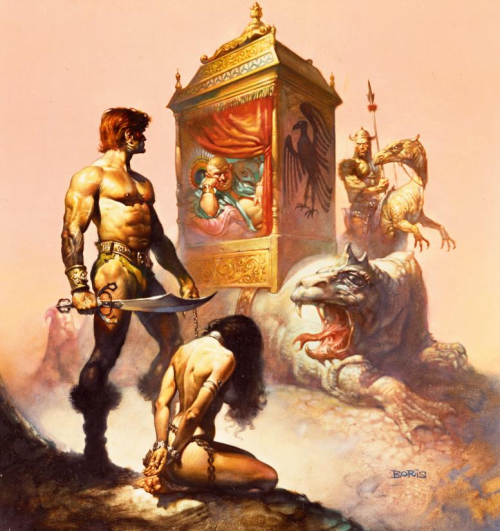
So, in that sense, I do agree with him.  That "collective flinch" he references did, in fact, throw out the baby with the bathwater.  But as a mature gamer (or at least one who's in early middle age; if the Wikipedia definition of middle-aged is to be accepted) I find the hullabaloo about the issue to be extremely over-wrought.  Again; the solution is to be had at your table.  You don't need lurid art of naked breasts or whatever to have a "mature" game--in fact, I'd argue that that's hardly a very mature thing to include, regardless of whether or not you're in denial about it and trying to pass it off as "naturalistic" (save it, Ron.  I've seen most of the same art you're specifically referring to--and I'm not that much younger than you anyway.  I lived through the age that directly followed that, before the "collective flinch's" impact was felt.  Plus, the books and whatnot that he refers to were commonplace in used bookstores during my real age of fantasy, which postdates his by a few years.  It was soft-core semi-porn cheesecake in most cases.  Not in the least mature.  Especially Boris Vallejo's work.  It was no accident that he did the covers for most of the mass market paperback versions of the Gor novels that were big in print at the time.  See below for a pretty tame example--there were a lot that were worse.)


If questions related to sex come up--and I don't mean "heaving bosoms" described at the table; I mean more things like bastard children to lords pressing their claims, and stuff like that--the more ancillary rather than direct references to sexuality--how is that really something that the content of the game books can really do much to encourage or discourage either one?  That's totally a local, game-group specific type of question.  The same is true of the monstrous, the horrific, or whatever other elements he claims were "neutered" during the 80s.

And regardless; if they were neutered during the 80s, they've certainly swung the other way since in  mainstream society; to the point of complete denial of everything he's railing against.  If Ron Edwards is still hacked off by Tipper Gore's warning labels on gangsta rap CDs or the Meese Commission's data-driven report that pornography is harmful to society (or the inadvertent side effects of that report in which not-exactly pornography like boobies in D&D books was--again, sometimes thrown out with the bathwater on occasion) then he really has nothing to complain about, given the complete mainstreamization today of pornographic content, profanity, and violence.  If anything the complaint should and could be made that we've gone way too far in the other direction.

Edwards' rant comes across as a frustrated bohemian who--having won the culture war, at least across the specific points on which he's ranting in this essay--doesn't know what to do but keep fighting anyway vainly.  That tone greatly reduces the utility of his essay.  But in my attempt to not throw out the baby with the bathwater, I'll certainly acknowledge that D&D--and other RPGs too, for that matter--benefit from being associated with mature topics.  This doesn't really mean mature in the sense that Ron Edwards seems to be using that word, which comes across to me as more "puerile" or "lurid" or "sordid" or "gratuitous"--but rather honest to goodness maturity.  A commodity that is in short supply in today's society (and my observation of that most definitely marks me as middle-aged mentally--if not actively old.)  But counter-culture fantasy fans in the late 70s (and shortly beyond, when the same works were still commonplace) wasn't exactly mature; and Ron Edwards' implication that it was means that you have to glean the point of his essay in spite of the specific arguments he makes, rather than because of them.

Friday, August 17, 2012

New WotC announcement

Well, in the wake of the ongoing GenCon and other things, a lot of news is coming out of WotC about stuff happening in the next little bit.  One of them is that, as of September 18th, the 3.5 core books are going to be reprinted with new cover art in a premium format--which I think just means that they'll be really expensive like the 1e reprints were, and otherwise be very similar to what they would have been in an "original" format.  This is curious, and has sparked more than a few debates.  I've even been a little bit involved in one such.  Hence my lack of an update to my A to Z series.  Sorry, folks!  D for House Dracul is coming soon, I promise!

So, here's the sitch, along with some commentary by me.  1e reprints have been out for... what, a couple of months now?  3.5 reprints will be out within about a month.  5e, or DnD Next, or whatever they're calling it, is about two years away is what official scuttlebutt is saying.  4e continues to be out, but with 5e prominantly announced, will probably have reduced sales on its titles as folks hunker down in anticipation of switching over.  This means that, other than 2e which was already quite close to 1e in terms of core books at least anyway, every edition of AD&D or its successors ever published will be in print at the same time!   In addition to this, most of the other stuff that's not in print will still be available via PDF again.  Why in the world would WotC do this?

Here's where I meander into pure speculation and make crap up.  But allow me to iterate some assumptions, and you can tell me how wrong I am afterwards...

  • First, WotC has an imperative to generate revenue to pay for development of DnD Next.  I think the reprints do a nice job of creating a probably reasonably high margin revenue stream in the meantime while 4e sales will (presumably) be lower than they would be because of the impending new edition.  It's a nice move for the fans, it's a nice move towards "healing" the fractured player base somewhat, generates some customer goodwill, and hey, brings in some money at the same time.  Win/win for customers and WotC both.
  • Second, lots of people theorize based on some sketchy and circumstantial data that Pathfinder might actually be outselling D&D these days.  If it isn't, it's at least got to be making a noticeable bite out of their market share.
  • Third, on Amazon, the used market for out of print 3.5 edition books has prices still as high or higher than new for many, if not most books.  Even in mediocre condition, in some cases.  This suggests, although it certainly doesn't prove, that there's still a robust demand for 3.5 edition books.  Which in turn suggests that many groups are quietly still going about their business playing 3.5.  Maybe even in really pretty big numbers.  Maybe, and this is where I get really speculative, in numbers rivaling that of groups playing Pathfinder or 4e.  
  • This in turn means that the D&D market is more or less fractured into four significant chunks, the OSR guys, the 3.5 guys, the Pathfinder guys, and the 4e guys.  I hesitate to say that they're roughly equivalent in size, but I bet they're at least on the same order of magnitude.  By reprinting the 1e core books and the 3.5 core books, WotC are making a direct warning shot against two of the three non-4e market segments that they are interested in getting their attention again.  I don't know how they directly address the Pathfinder guys, but then again, Pathfinder was supposed to be an iterative improvement on 3.5.  A 3.75, if you will.  
  • Speaking of which, what's the relationship between lingering 3.5 groups and Pathfinder groups and whatnot anyway?  Here, I hesitate to even speculate on the market at large, but I can at least offer my perspective.  Keep in mind that I rather reluctantly migrated from 3e to 3.5 in the first place.  In fact, because of the SRD being freely available, I never even bought the 3.5 core books (although I did buy the Monster Manual--that one I at least thought would be more convenient to have in book format rather than as a webpage.)  I don't think that 3.5 as a core ruleset necessarily improved on 3e.  For everything it fixed, there was something else that it broke and half a dozen other things that changed just for the sake of change, being neither better nor worse, but sadly being different, meaning that it became difficult to remember exactly how it was supposed to work properly (although to be fair, I remember this being an issue back in the day when people migrated freely and openly from the B/X or RC line into AD&D and back.)  With Pathfinder, the situation was very much the same, although because of the way in which it was done, Paizo managed to generate a fair bit of customer goodwill rather than cynicism with the move.  But from a purely systemic standpoint, it's not at clear to me (or to a number of other players I've spoken to) that Pathfinder is actually an improvement in 3.5.  Sure, some things are better--archetypes are great, for instance, and the skill list consolidation was a good thing.  CMB/CMD was a nice clean-up of a perennially ugly part of the mechanics.  But they did absolutely nothing to address what seem to be the two most common complaints about 3.5--that it breaks down at higher level, and that it's too complex and fiddly.  In fact, in the latter case, it gets qualitatively worse.  Their solution the first problem seems to have been elegant yet also pretty dubious; in their flagship product, the Adventure Paths, they simply started having them end earlier instead of going all the way up to 20th level.  And plenty of other things are just different for the sake of being different again.  Long and short of it, it's not really clear that it's universally accepted that Pathfinder is an improvement on 3.5.  I'm certainly not sure that I think so, and I don't think that I'm alone.
  • All of this means that there is circumstantial evidence of WotC acting somewhat strategically, without being arrogant or tone-deaf either one, in terms of trying to woo some of the big blocks of "lapsed" players; by which I mean players who don't buy anything from them because they don't play the current edition of the rules.  No matter what else you might think of WotC or DnD Next either one, that's still a pretty good thing, right?

Tuesday, March 27, 2012

D&D Next commentary

http://www.wizards.com/DnD/Article.aspx?x=dnd/4ll/20120326

A couple of points:

"I am going to 100% promise you that, especially if you are a veteran player or DM, we will include stuff in the next iteration of the game that you will ignore. In fact, I'm going to come out and say that we want you to ignore parts of the game." [snip] "Stuff such as XP budgets, treasure tables, encounter charts, and so on are there to make it easier to create adventures and build your campaign. If you are a veteran DM, it's quite likely you won't use any of this stuff.

 I'll let you in on a secret. I DM'ed a year-long Eberron campaign in 3E and I never once used the rules for treasure or wealth by level. I gave out stuff that seemed cool and appropriate, and the game worked fine. I used the challenge rating system as a starting point, but modified stuff to fit my group."

Again; I find myself somewhat surprised at what needs to be said.  I guess I shouldn't be anymore.  After all, how many times did I see gamers I know complaining about rules bloat in the d20 family of games?  How many times did I hear the (patently false) notion that the rules were a tightly interlinked 'system' and you couldn't remove one element of it without throwing the whole thing out of whack?

The paradigm presented here is hardly a secret.  I've been playing that way since about 1981 or so.  And I was still doing so last time I ran--a D&D 3e with extensive houserules and, curiously, a fair bit of ignoring wealth per levels, "correct" XP calculation, CRs (except in the vaguest sense) and all that.

It's a curious notion to me that so many gamers saw the presence of those rules as "mandatory" despite the history of our hobby being one that grew up in a crucible of DIY.  It's also a curious notion to me that so many gamers saw the only solution to that to switch to rules systems that were "lighter" and didn't have so many rules, rather than the immediately obvious and simple solution of just ignoring complexity that you didn't need or enjoy.  And finally, it's a curious notion to me that in the design of D&D Next, rather than removing all those rules, the presentation of them in the rulebooks and elsewhere (I presume, based on this post by Mike Mearls) will be to overtly encourage the ignoring of rules that you don't want.  To my perspective, this doesn't really need to be said, because it was always an available option anyway, and I found that doing so made d20 work quite well for me (I enjoyed the complexity for character definition and refinement, but disliked much of it during the actual running of a game.)  And since it doesn't need to be said, this doesn't actually represent any kind of meaningful change in direction to me at all.

But clearly, I'm not on the same page as a large chunk of gamers out there.  But it does seem that WotC could save themselves a lot of time and resources (as well as gamers a bunch of money--which is no doubt why it won't be done) by just saying that this advice--naturally--already applies to your existing 3e and/or 4e rules.  Or any other RPG rules of any other system you may be playing, for that matter.

If this is the vaunted "appealing to all kinds of fans" direction of the game--telling people that they are free to houserule (uh... no kidding!) then I'm somewhat less than impressed.

"This one is bound to be controversial, but I don't think roles belong in D&D as specific, mechanical elements that we design toward. Instead, I think roles are a great tool to help players focus on how they want to play a character. Veteran players should be free to create the character they want, however they want, instead of feeling that they must take on a job to "help" the party."

I agree 100%, but I do also agree that that's probably controversial.  I've very often talked to people who feel that role protection is very important, and I don't know how many times I've seen people take on a role that they didn't necessary want, but felt like it was necessary to take one for the team, because the game can't operate correctly without the proper roles all being represented.

My approach to GMing a game is to encourage everyone to make the characters that they are interested in playing... and if that means even going so far as not telling the other players what your specific class is, to encourage them to not try and fill out the corners of the party with what they think is missing.  And then, one of my #1 rules for good GMing is:
  • Run a game for the characters you get, rather than expect characters to be optimized for some predetermined notion of what the game will be.
If I end up (in D&D, for example) getting a party with nothing but fighters, or rogues, or magic-users, then I come up with challenges that will challenge the players I have, and not "punish" them for not picking something else.  Isn't that just common sense?  You do want your players to enjoy your game and invite you to run for them again, right?