Showing posts with label d20. Show all posts

Wednesday, March 08, 2017

d20 Soulknife base class, based on Jedi

I don't do this kind of stuff very often, but what the heck—here's an actual alt.soulknife, based on a d20 Jedi class.  This is actually, in my opinion a fairly poor representation of the Jedi archetype anyway, and d20 is a poor representation of the free-wheeling swashbuckling style of Star Wars.

But if you're playing d20, and want a soulknife that doesn't suck, this is, in my humble opinion, a pretty good alternative.

SOULKNIFE

Alignment: Any.

Hit Die: d10.

Class Skills
The soulknife’s class skills (and the key ability for each skill) are Climb (Str), Concentration* (Con), Craft (Int), Hide (Dex), Jump (Str), Knowledge (psionics)* (Int), Listen (Wis), Move Silently (Dex), Profession (Wis), Spot (Wis), and Tumble (Dex).

*New skill or expanded use of existing skill.

Skill Points at 1st Level
(4 + Int modifier) ×4.

Skill Points at Each Additional Level
4 + Int modifier.

Level BAB Fort Ref Will Special
1 +1 +0 +2 +2 Mindblade, Mindblade finesse, AC Bonus
2 +2 +0 +3 +3 Weapon focus (mindblade), Mage Hand
3 +3 +1 +3 +3 Suggestion, Mindblade enchancement +1
4 +4 +1 +4 +4 Uncanny dodge, Endurance
5 +5 +1 +4 +4 Weapon specialization (mindblade)
6 +6/+1 +2 +5 +5 Soulknife reflexes, Mindblade enhancement +2
7 +7/+2 +2 +5 +5 Throw mindblade, Great Leap
8 +8/+3 +2 +6 +6 Greater weapon focus (mindblade)
9 +9/+4 +3 +6 +6 Telekinesis, Mindblade enhancement +3
10 +10/+5 +3 +7 +7 Evasion, Deflection
11 +11/+6/+1 +3 +7 +7 Psionic morale
12 +12/+7/+2 +4 +8 +8 Improved uncanny dodge, mindblade enhancement +4
13 +13/+8/+3 +4 +8 +8 Greater weapon specialization (mindblade), Wholeness of body
14 +14/+9/+4 +4 +9 +9 Improved throw mindblade
15 +15/+10/+5 +5 +9 +9 Mind clarity, Mindblade enhancement +5
16 +16/+11/+6/+1 +5 +10 +10 Psionic resistance
17 +17/+12/+7/+2 +5 +10 +10 Improved telekinesis
18 +18/+13/+8/+3 +6 +11 +11 Mindblade mastery, Mindblade enhancement +6
19 +19/+14/+9/+4 +6 +11 +11 Freedom of Movement
20 +20/+15/+10/+5 +7 +12 +12 Psionic oneness

Class Features
Mindblade (Su): As a move action, a soulknife can create a semisolid blade composed of psychic energy distilled from his own mind. The blade is identical in all ways (except visually) to a one-handed weapon of the soulknife's choice.  It may represent a simple, martial or even exotic melee weapon, but has no other special properties. The wielder of a mind blade gains the usual benefits to his attack roll and damage roll from a high Strength bonus.

The blade can be broken (it has hardness 10 and 10 hit points); however, a soulknife can simply create another on his next move action. The moment he relinquishes his grip on his blade, it dissipates (unless he intends to throw it; see below). A mind blade is considered a magic weapon for the purpose of overcoming damage reduction.

A soulknife can use feats such as Power Attack or Combat Expertise in conjunction with the mind blade just as if it were a normal weapon. Powers or spells that upgrade weapons can be used on a mind blade.

A soulknife’s mind blade improves as the character gains higher levels. At 3th level and every three levels thereafter, the mind blade gains a cumulative +1 enhancement bonus on attack rolls and damage rolls.  Instead of this bonus, the soulknife can embue his mindblade with any number of other special abilities worth the same amount as this bonus, as per magical abilities listed in the magic items section of the SRD.  This is not "locked in" once chosen; the soulknife can distribute these bonuses at will each and every time that he manifests the mindblade.

Even in places where psionic effects do not normally function (such as within a null psionics field), a soulknife can attempt to sustain his mind blade by making a DC 20 Will save. On a successful save, the soulknife maintains his mind blade for a number of rounds equal to his class level before he needs to check again. On an unsuccessful attempt, the mind blade vanishes. As a move action on his turn, the soulknife can attempt a new Will save to rematerialize his mind blade while he remains within the psionics negating effect.

Mindblade finesse: At 1st level, the soulknife gains the effects of weapon finesse, when applied to his mindblade, and may use his Dexterity modifier instead of Strength modifier as the bonus to his melee attacks.

AC Bonus: A soulknife is highly trained in mental and psionic combat arts granting him a sixth sense that lets him avoid even unanticipated attacks. When unarmored and unencumbered,a soulknife adds his Wisdom bonus (if any) to his Armor Class. This ability does not stack with the monk or ninja AC bonus ability (a soulknife with levels of monk or ninja do not add the bonus twice). In addition, a soulknife gains a +1 bonus to AC at 5th level. This bonus increases by 1 for every five soulknife levels thereafter (+2 at 10th, +3 at 15th, and +4 at 20th level). These bonuses to AC apply even against touch attacks or when a soulknife is flat-footed. The character loses these bonuses when he is immobilized or helpless, when he wears any armor, when he carries a shield, or when he carries a medium or heavy load.

Weapon focus (mindblade): At 2nd level, the soulknife gains the benefit of the Weapon focus feat applied to his mindblade.

Mage Hand (Sp): The soulknife gains the ability to use the spell Mage Hand once per soulknife level + Wisdom modifier per day.

Suggestion (Sp): Once per day, per point of wisdom bonus, the soulknife can cast the Suggestion spell.

Uncanny dodge: At 4th level, a soulknife gains the ability to react to danger before his senses would normally allow him to do so. He retains his Dexterity bonus to AC (if any) even if he is caught flat-footed or struck by an invisible attacker. However, he still loses his Dexterity bonus to AC if immobilized.

Endurance: At 4th level, the soulknife gains the Endurance feat.

Weapon specialization (mindblade: At 5th level, the soulknife gains the benefit of the Weapon specialization feat applied to his mindblade.

Soulknife reflexes (Ex):  The soulknife gains the effect of the Lightning Reflexes feat, even if he does not normally qualify.

Throw mindblade (Su): At 7th level, a soulknife as a full-round action may throw his mindblade 10 ft + 10 ft per 2 Wis bonus modifiers. The mindblade is treated as having the "Returning" special ability.

Great leap (Ex): At 7th level and higher, a soulknife always makes Jump checks as if he were running and had the Run feat, enabling him to make long jumps without a running start and granting a +4 bonus on the jump (see the skill description, page 77 of the Player’s Handbook). This ability can be used only if he is wearing no armor and is carrying no more than a light load.

Greater weapon focus (mindblade): At 8th level, the soulknife gains the benefit of the Greater weapon focus feat applied to his mindblade.

Telekinesis (Sp): At 9th level, a soulknife gains the use of the spell telekinesis as a spell-like ability once every soulknife level per day.

Evasion (Ex): A soulknife of 10th level or higher can avoid even magical and unusual attacks with great agility. If he makes a successful Reflex saving throw against an attack that normally deals half damage on a successful save (such as a red dragon’s fiery breath or a fireball), he instead takes no damage. Evasion can be used only if a soulknife is wearing no armor.

Deflection (Ex): A 10th level Soulknife gains Deflection. Through the use of his mindblade, a soulknife may deflect one projectile per round that would have hit him otherwise, but only if he was not flat-footed.

Psionic morale (Su): At 11th level, a soulknife gains the ability to meditate during a battle. This meditation sends out waves of positive energy to allies, and negative energy to enemies. Allies get a +2 morale bonus to attacks, damage, armor class, and saves. Enemies with a hit dice lower than the soulknife's must run away. Enemies with equal or greater hit dice than the soulknife's get a -2 to attacks, damage, armor class, and saves. The save DC (Will based) is 10+1/2 the soulknife's level + his Wisdom modifier.

Improved uncanny dodge (Ex): At 12th level, a soulknife gains the use of the Improved Uncanny Dodge ability, as the barbarian.

Greater weapon specialization (mindblade): At 13th level, the soulknife gains the benefit of the Greater weapon specialization feat applied to his mindblade.

Wholeness of Body (Su): At 13th level, a soulknife can heal his own wounds. He can heal a number of hit points of damage equal to twice his current soulknife level each day, and he can spread this healing out among several uses.

Improved throw mindblade (Su): At 14th level, a soulknife can now throw his mindblade as a standard action instead of a full-round action.

Mind clarity (Su): At 15th level, a soulknife mind is so psionically honed that he becomes immune to mind affecting spells.

Psionic resistance (Su): At 16th level, a soulknife gains spell resistance equal to 10 + 1/2 soulknife level + wisdom modifier.

Improved telekineses (Su): At 17th level, the soulknife may now manipulate double the amount of weight that can normally be manipulated.

Mindblade mastery (Ex): At 18th level soulknife gains an additional +2 attack and +2 damage with his mindblade.

Freedom of Movement (Ex): When soulknives reach level 19, they attain the ability to have the spell Freedom of Movement perpetually on.

Psionic oneness (Su): Upon reaching 20th level, a soulknife has grown so attuned to his psionic powers that they can fashion it into a probe into the minds of others. The soulknife gains the ability to use Detect Thoughts and Clairaudience/Clairvoyance at will.

Monday, March 06, 2017

The Soulknife

One of the biggest FAILS of the d20 era was the soulknife class, which debuted in the Third Edition era—although I can't remember now offhand if it was part of the original 2000 3e Psionics Handbook or if it didn't debut until the 3.5 Expanded Psionics Handbook in 2004.  I admit to not being very well-versed in 2e, but I don't believe that there were any soulknives in 2e.

The reason that the soulknife is such a FAIL is not just because it sucked so badly (although it did) but rather because the concept was so intriguing, interesting, and popular.  It's a class that people wanted to play—but which was saddled with just about the worst mechanics that they ever came up with—and let's face it; during this era, they released a lot of bad ones.  Although they didn't normally illustrate it exactly this way, it was immediately obvious to anyone familiar with comic books that the X-men character Psylocke and her "psychic knife" were the immediate inspiration.  Most soulknife blades that I've seen illustrated still look like early Psylocke era psychic knife incarnations than they do any other kind of weapon.

So, the soulknife can form weapons out of raw psionic ability, and supposedly fight kind of like ninjas or something.  Again—not at all a bad concept, but just a terrible execution.  The soulknife blade doesn't keep up with a normal character's weapons, the BAB was mediocre (extremely curious for a supposed melee class) and it was a bit on the mobile side, but less so than even the monk.  It couldn't wear much in the way of armor, so it was beat up a lot, although it did have at least decent hit points.  And it had no real psionic powers to speak of other than the blade itself.

Like many, I liked the concept, but wanted to "fix" it.  My first efforts were pretty modest—just changing the BAB to full fighter-style BAB, and leaving everything else as is.  I eventually, however, saw the class as pretty much the same archetype as the Jedi—except that instead of a lightsaber that was mechanical hilt with an energy blade, it had weapon of psionic energy that it could call and banish at will.  Future efforts to "fix" the soulknife therefore actually started with various d20 Jedi classes rather than with the actual soulknife itself.  Of course, to do this properly, I'd have to have had a para-psionic magic system, giving the soulknife psychic abilities like the Jedi powers, or else somehow adopt d20 psionic powers to the class somehow, which always seemed like more work than I was interested in.

When I migrated from d20 to m20, I initially gave no thought to any kind of psionics or anything like it at all—however, I did create a Jedi class for my m20 Star Wars conversion.  When I eventually decided to raid my m20 Star Wars conversion for my m20 fantasy games, making the Jedi into some kind of soulknife analog seemed not only easy, but potentially kind of cool.  Thus was born the Shadow Sword, where I take the Jedi mechanics, get rid of the Force Powers and instead give it some mystic ninja-like powers, etc. and off we go.  I've got the soulknife I want, finally—converted from a totally different base into a totally different system.

As Pulp Revolution as a movement continues to get off the ground, I'm even more inclined rather than less—and I'll admit that at various times in my life, my tastes have been all over the map on this question—to look for nominally science fiction conventions to loot into my fantasy, or vice versa.  So, in AD ASTRA I expect sword fighting on space ships (and to be fair, it's not like this isn't pretty common already.  If Star Wars wasn't enough, Guardians of the Galaxy certainly added even more of it to the canon of mainstream space opera.)  And in FANTASY HACK and even DARK•HERITAGE itself, I've got Psylocke/Jedi.

Monday, September 05, 2016

Fantasy Hack m20

Well, after much delay, my complete "My D&D": Fantasy Hack m20, is complete.

How does this differ from other versions of D&D?
  • Mostly in that it's an m20 game, and therefore is build on the m20 chassis, which is a stripped down and greatly simplified rules-lite iteration of d20.  This is extremely rules-lite, even with artwork, some "administrative" pages, examples, and appendices with hex-crawl rules, optional rules, and GMing advice, its still only 48 pages long.  The actual number of pages of actual rules is probably only half of the document total.
  • It's got "Lovecraftian" rather than "Vancian" magic.
  • It's structured more like the B/X game; very specifically the Expert set, but with m20 rules.  This even includes a sample setting, or the seeds of one, not unlike "The Grand Duchy of Karameikos" from the Expert set, hex-crawl rules and tables, etc.
  • The tone is overall a bit more "dark fantasy"—Lovecraftian monsters make the cut as basic monsters, as do Gothic horror items and more.  Think Dracula meets Lord of the Rings in terms of basic setting assumptions.
  • I've also added some stuff from DARK•HERITAGE; mostly because, "why not?" I already had m20 rules in place for them after all.  This is more setting specific, but much of it is really only to be found in the Appendices.  I should point out that some of the race mechanics are updated here from what they are in DARK•HERITAGE or even CULT OF UNDEATH, which I did not expect to do... but I found that it was necessary to harmonize some stuff that I was mashing together.
While it could be used to play hex-crawls and dungeon-crawls (the former is more explicitly supported than the latter) it's not really designed for such.  In fact, the handwavey rules-lite approach that I prefer has much more to do with a rejection of the overly tactical and resource-management heavy aspects of the game that D&D naturally comes with as an extension of its past as a war-game.  What its explicitly designed for is to be a swashbucklery, fast-paced game that simulates, to some degree, the types of stories that are foundational to the genre (and even more explicitly to my specific tastes.)

Unlike some of my earlier ventures into m20 house-rules, this one is more specifically meant to emulate D&D, though—and what I would do if I were asked to run D&D for a group of complete neophytes who wanted to know what the hobby was all about; or if I were to run for long-standing players who shared some of my particular aesthetic tastes with regard to the game, rather than a more "derived" setting with more derived setting assumptions.  

Anyway, here's the document, in Google docs.  It should be readable without being editable.


And although it comes with a Character Sheet embedded in the document, here's another one that I actually like better.  For whatever reason, I couldn't seem to copy and paste into the document without screwing up the formatting, so I just made an alternate, and am keeping this one separate.

https://drive.google.com/file/d/0B9AcFlIn8HsEYlY4YTJLWW8wQ2c/view?usp=sharing

Is it a "fantasy heartbreaker?"  Absolutely.  In my case, though—it's a self-aware one that's only published online as a free Google doc rather than something that I've actually spent any money on thinking that I was doing something extraordinary.  No, I'm doing something that simply gratifies my own vanity and taste, and creates what I consider the ideal D&D game for me personally.  Thanks to the internet, the OGL, and years of designers; both professional and amateur, who've come before me, it's actually really easy to do so.

Tuesday, January 06, 2015

Star Wars gaming

Last night I watched a bit more Clone Wars Season 1.  I saw the episodes "Jedi Crash" and "Keepers of the Peace" which have the insanely stupid and annoying Lurman people.  This was interesting to watch again, after a year or two, because in the meantime I've discovered--or rather, more properly digested--the r/K theory of evolutionary psychology as applied to political and social issues, and it's easy now to see the Lurman as a fictional representation of bizarre yet somewhat commonplace r-selected delusions.  In any case, the ideological bent of the Lurman was somewhat deflated by the end of the second episode, so that was at least a satisfying conclusion when it's shown to be insufficient to deal with the real world, even if all things considered, the characters feel like they wish that it wasn't.  But that's neither here nor there: I should finish the third disk of season 1 tonight, I hope, and will be on towards finishing the season and moving into season 2.  Like I said earlier, while there are good (and mediocre) episodes in every season, I do strongly believe that in general the quality across the board improves as the show progresses, so I'll be anxious to move forward.

Another thing I noticed was how "cool" the Jedi were in that episode.  There's a lot of inconsistency in terms of how combat capable they are; three Jedi and two clones successfully take on a virtual army of droids in "Keepers of the Peace" whereas in Attack of the Clones itself a similar sized force of droids and Geonoshians kill and essentially defeat dozens of Jedi, and the survivors only have their bacon pulled out of the fire at the last minute by the arrival of the clone army.  If the Jedi are so cool in "Keepers of the Peace" why are they (relatively) so vulnerable in Attack of the Clones?  The real answer, I suspect, is that the two are simply inconsistent, and they strike a different tone and reflect the priorities of different writers and directors, etc.

For my money, I prefer a paradigm more like the scene mentioned above from the movies themselves.  Jedi are pretty cool; but they're not that cool.  Battle droids can certainly still threaten them in numbers, and other more capable soldiers--such as hot-shot mercenaries or Mandaloreans, can do so even more easily.  The rules for my m20 Star Wars should reflect that, I think--as do most of the other Star Wars rulesets.  This is based more around keeping the various classes balanced with each other, which is a game design goal that doesn't necessarily line up with a comparable in-fiction setting design goal, but for what it's worth, it does better reflect the fiction of the movies most of the time, at least.  With the exception that cool personalized antagonists seem to always go down like chumps in the movies, due to really bad writing (Boba Fett, the Emperor himself, Jango Fett, Darth Maul, General Grievous, etc.)

Speaking of my m20 ruleset, I'm going to make a few adjustments, thus moving the revision to 1.1.1 (from 1.1.)  Mostly, it occurred to me that with my new a la carte classes, which moved the doc from 1.0 to 1.1, I didn't think of going and correcting some references to the old classes in the equipment section, specifically with regards to armor.  Rather than simply edit the references a bit, though, I gave some thought to whether or not I even wanted armor to restrict class abilities so punitively, and decided that I don't.  But I do want there to be some incentive to not necessarily just always go for the heaviest armor you can afford, since that's not really in the swashbuckling vein of Star Wars to have everyone wearing heavy armor all the time.  What I've come up with somewhat based on Kirin Robinson's Old School Hack, actually, which awards Action points (or whatever exactly he calls them; there's a lot of labels out there for the same concept and I often forget which each particular game uses) and awards more in particular for using less armor.  This of course reminded me that while my m20 DARK•HERITAGE ruleset uses them, my m20 Star Wars does not.  It was always my intention to incorporate them, but I never got around to it, I think.  I'd give everyone two Action points per session (that don't carry over from session to session, to encourage you to use them and be more swashbucklery.)  They can be used to add a 1d10 to any d20 roll; an attack, a save, a check, etc.  It can also be used as a "healing surge"--i.e., you burn the action point and get an immediate 1d6 hit points healed back.  If a character is using heavy armor, he gets no additional action points per session beyond these two, but if he uses medium armor, he gets one additional action point.  If he uses light armor, he gets two additional action points, and if he uses no armor at all, he gets three additional action points.  GMs are, of course, encouraged to make sure that players don't abuse this by trying to put on armor right before a fight after already cashing in action points, or any nonsense like that.  I tend to think of Star Wars characters as having a signature set of gear rather with other stuff only picked up as occasions require rather than the D&D paradigm of carrying a caddie with a golf bag full of weapons that can be customized to whatever enemy you're fighting.

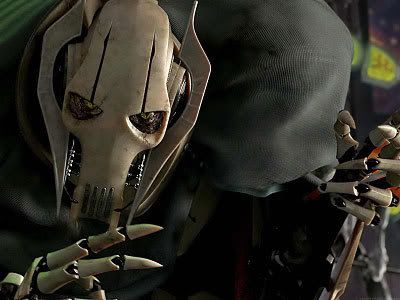
I'll also add a bit of minor text about cybernetic enhancements a la Darth Vader or General Grievous, but mostly I think I'll just treat it as if it were armor.  General Grievous would, then, have class features of Combat Bonus (not Lightsaber Training, since he can't use his lightsabers to deflect blaster shots, and has no force ability) and maybe sneak attack, since he's a coward who fights without honor, for the most part, as well as heavy armor to represent his cyborg body.  Jack him up to fairly high level--7 or 8, at least, and you've got a decent representation of him as depicted in the Clone Wars, who would be a major threat to most Jedi and certainly to most other characters and any mooks.

All of that will get us to 1.1.1--this is mostly fixing a few cascading effects of the change made in 1.1, plus a few other things that I thought of.  Not significant enough, in my opinion, to justify a change to 1.2.

The final thought I had was actually orthogonal to Star Wars, and might be relevant to my DARK•HERITAGE ruleset; or would be, anyway, if I used d20 still to represent it.  I use magic rules that are designed to make magic less ubiquitous than in D&D, but it's not really my intention to make it punitive per se, just rarer and as having less of an impact on the game itself.  I've often given some thought to making the concept of the soulknife integral to the setting, although again, they'd be extremely rare in actuality.  However... the rules for the soulknife really kind of suck.

But if you think a little bit outside of the box, it may occur to you to use the d20 Jedi Guardian from one of the d20 editions of Star Wars--probably not the SAGA edition, because it changed the rules more, but the Revised one (or the original) would work quite well.  It is balanced, theoretically, to work with the D&D classes (or at least, the Soldier Star Wars class is identical to the Fighter D&D class, so assuming that the Jedi Guardian is balanced for the game that it's in, it should also be balanced for D&D.)  If you assume that the lightsaber is, instead of being a piece of equipment but rather a class feature like the soulknife's namesake class feature, then you're all set to go.  You also need to remove the class Defense bonus (since D&D doesn't have anything comparable, although you could make a case that you'd be better off adding that feature to your other D&D classes instead) and do just a minor bit of work to harmonize the skill list, and you're all set.

Like the soulknife, the Jedi Guardian is basically a swashbuckling, lightly armored fighting class (although a much better one than the soulknife, actually) with a minor (relative to a wizard or sorcerer) ability to use some unusual magic that feels different than that of the standard D&D spellcasters.

Of course, if I want to adapt this archetype into my m20 ruleset, I'd have to do it a little bit differently, but it helps that I already have a Jedi archetype via my m20 Star Wars rules that I could add in with basically no effort at all.  And I really like the idea as an unusual class choice in a D&D game, especially since I like to focus on the non-standard when I'm in D&D anyway.

Tuesday, February 11, 2014

m20/d20 and stats

Just noodling around a little bit.  I recently picked up the Moldvay book (on pdf) from http://www.dndclassics.com and have been rereading it (I also picked up the companion piece, the Cook Expert set, as well as "Keep on the Borderlands" and "The Isle of Dread"--the two companion modules that initially sold with the boxed sets.  I've been rereading them (although I admit that I haven't gotten very far.)

One thing that I had forgotten was the flatter bonus curve for ability scores.  Let me highlight--this little "chart" will have the ability score, the bonus in a Moldvay environment, and the bonus in a d20 environment.  m20, for what it's worth, tends to follow the d20, not the Moldvay, paradigm.
3
-3
-4
4
-2
-3
5
-2
-3
6
-1
-2
7
-1
-2
8
-1
-1
9
0
-1
10
0
0
11
0
0
12
0
+1
13
+1
+1
14
+1
+2
15
+1
+2
16
+2
+3
17
+2
+3
18
+3
+4
My goal in looking at this was actually to investigate the notion of doing away with the ability scores altogether and migrating to an ability bonus only as the ability score, i.e., your score would range from -4 to +4 (or maybe -3 to +3 if I used a Moldvay paradigm) instead of ranging from 3-18.  It looks like there are only three things that I'd need to address if so: 1) ability score generation, 2) attacks like poison, for instance, that do ability score damage, and 3) hit point generation at 1st level.  Of those, the third is really easy to come up with an alternative, but I'm struggling just a bit to find a solution to #s 1 and 2 that I like.

I also have to think about the range and distribution I prefer, since seeing the Moldvay range and distribution, and realizing that it makes a much better bell curve, has got me second-guessing what I've done with d20 and m20 for the last fourteen years.  And finally, I'll have to think about how racial stats interact with any choice I make. 

For those who care about the details of my m20 system (that is, just me) stay tuned here... as I noodle around these issues, there may be minor updates in the document.

Tuesday, January 21, 2014

House rules redux

This last weekend, we had one of the last sessions of our d20 Homebrew Star Wars campaign, which has graced the "what I'm playing" sidebar over there for many months.  It's always a little tricky to estimate exactly, but there are probably two or three more sessions before we're done.  We have, in fact, already agreed to revisit Cthulhu next, a somewhat surprising turn of events given the failure of our last Cthulhoid venture, so I'm excited to once again play one of my favorite games.  Even if we do have to use the BRP ruleset.  Then again, it's probably not likely that I'd expect everyone (or even anyone) in my group to fall in love with m20 like I have.  We'll see what, if anything, I do with my m20 in the next few months or so.

Be that as it may, I've adapted my Star Wars m20 wiki into a pdf document, which is available right here for you to download.  It's marginally more convenient than in wiki form, at least for some purposes, and I fixed a few typos.  Embarrassingly, I'd mispelled Millennium Falcon repeatedly--I was only using one 'n' in millennium!  I have high hopes of running a game, albeit probably a shortish one rather than an extended campaign, for my younger boys using that system.  I actually think an adaptation of Star Wars, even a fan adaptation, as in my case, is probably a better gateway than anything in the D&D idiom. 

I've also had reaffirmed my repeated frustration--although it's a mild one that I can certainly live with--of trying to adapt d20, D&D paradigm and all, to the Star Wars idiom.  I've had further issues with trying to do some basic Jedi-ish, should be non-challenging stuff, and had it totally not really work as advertised.  Again--I think part of it, a big part even, is my GM's inability to wrap his head around a different interpretation of the rules than he grew up with playing D&D (which is somewhat ironic, given that it's basically his own alternate adaptation of the OGL to Star Wars which he wrote himself).  But an also not insignificant part of the problem is the ruleset itself.  m20 manages to mostly sidestep these issues, and certainly the specifically Star Wars interpretation of them that I've got here will do so.

Don't forget; two versions of the character sheet are also available, and include details for your characters ship (if he has one.)  The big version is here, which serves as a slightly clunkier first draft.  I actually prefer the slimmed-down alternative here instead.

I've also made some minor modifications to my DARK•HERITAGE ruleset while I was at it, available here.  I was quite happy with the result of what I had, but I had forgotten to add a minor detail to magic use, actually, in which sorcerers can use sacrifices and covens (or whatever plural group word best applies to sorcerers--I kinda like murder myself, although I'm sure I'm alone in that regard) to mitigate somewhat the cost in hit points and sanity that they would otherwise endure to work their craft.  If my "gating" of my kids into gaming via Star Wars is successful, I might also consider trying to do something with this system for them as well. 

Tuesday, November 05, 2013

Star Wars d20

We had another session of our much delayed Star Wars campaign this past weekend.  To the uninitiated, it's worth pointing out that we're not actually using the Star Wars d20 rules--any of the three options--we are actually using a house-ruled D&D 3.5.  Realistically, it's not substantively different from playing one of the first two Star Wars d20 iterations, to be honest with you.  I think the GM was simply more interested in house-ruling a game he already had and liked than in buying someone else's interpration of said houserules.

My character right now
Because our game is fairly heavily weighted towards Jedi-like operations, we have a lot of Jedi characters (four of six, as I recall.)  And by Jedi, I really mean Jedi as a character class, not necessarily Jedi as an in-game organization.  My character is an 8th level Jedi... but is not a member of the Jedi order, nor is he likely to be.  In fact, my character is a Sith acolyte defector; he's disillusioned by the Sith order and wants to bring them harm (hence his alliance with the Jedi) but he has not shed much of the baggage of his Sith training.

We're finally at high enough levels that our Jedi characters can finally feel like Jedi.  One of my early complaints about the rules is that things that even very young padawans (i.e. Ahsoka) seem to take for granted were out of our league even after being granted full Knight status (for all Jedi characters except myself, of course.)  This, naturally, impinged on the ability of the game to feel like Star Wars.  So the good news is, that we feel like Star Wars more now, in at least that respect.

I also think our DM has an unfortunate tendency to be a bit more punitive and difficult in terms of his rulings and DCs and whatnot that he assigns to tasks.  This, again, may be great in some games (including many games of D&D) but interferes with the game feeling like Star Wars.

In any case, because we played again--for the first time in a few months, I was reminded that I had been house-ruling m20 to run Star Wars the way I think it should be run; a way that focuses on the canonical source material (and here, I mostly mean the movies and the Clone Wars tv show--Old Republic games also get a pass.  Much of the rest of the EU is otherwise explicitly ignored.)  And looking back over those rules, I was reminded that I never did actually get spaceships done, so I'm missing a major hole in the ruleset!  This is not good, and therefore is something that needs to be addressed ASAP!  As I mentioned over on my Star Wars m20 wiki, I have two drafts--two other interpretations of Star Wars into m20 to work from to borrow my starship rules from, but neither one of them did everything completely right, so I'm hybridizing the two and additionally modifying it into the perfect "my Star Wars" ruleset.  I recall being a bit unimpressed with the spaceship rules in both iterations, which is probably why I never really got around to completing that section of the rules.

I'd also like to add a bit more; so I've got the rules, I've even got some setting background--moving the game forward to 1,000 years after Jedi so I have plenty of freedom to do things my own way.  Given that in 2015, we'll see new Star Wars movies (plus new material of other types--the Clone Wars TV show is ending, but Rebels is ramping up to replace it) I better either play this sooner rather than later, or be stuck later modifying setting information to fit new canon.  This means that I need to also start looking at some specifics--i.e., if I run a game of this, what will the players actually do?  And then I need to recruit some players and have at it.

Friday, February 01, 2013

M is for Magic

I had earlier indicated my desire to discuss/share my Map for the letter M, and discuss magic under S for Sorcery.  I'm updating my plan, because the map is taking much longer to get done than I hoped, and I don't want this series to languish without updates for that long.  I'll get the map out there soon--I am working on it already--although it might not end up being part of the A TO Z challenge after all.

The mundane, regular world is the natural world. Things that happen here tend to happen for natural reasons. In this regard, the world of the DARK•HERITAGE campaign setting is very much like the mundane, scientifically understood world in which we live in as well. However, the world of the DARK•HERITAGE setting also intersects on occasion with many other worlds, and when energies, spirits, demons, or entities of unknown type cross over through these intersections into the mundane world, it is called supernatural rather than natural. Unlike some fantasy settings, such as those served by the DUNGEONS & DRAGONS® game, the supernatural in this setting is rare, poorly understood, and often dangerous to encounter in any form whatsoever. Most people have never witnessed anything supernatural, and some few don't even believe in it. Most others do, but it is similar to how many people in our world are religious or superstitious; it is not because they have direct evidence that is convincing for its existance, it is because they have faith and/or fear in the potential power of the supernatural to disrupt their lives.

Because the supernatural seems to maintain a discrete stance on this setting, it is most often referred to as the Shadow; a force that can only be percieved indirectly, and only rudimentarily understood, and which stays out of the glare of knowledge and enlightenment. Mankind is simply not equipped to know and understand the supernatural, so to him, it will always be merely the Shadow; lurking in the darkness just out of sight, haunting his footsteps, waiting for an unwary moment. As H. P. Lovecraft said, "The most merciful thing in the world, I think, is the inability of the human mind to correlate all its contents. We live on a placid island of ignorance in the midst of black seas of infinity, and it was not meant that we should voyage far. The sciences, each straining in its own direction, have hitherto harmed us little; but some day the piecing together of dissociated knowledge will open up such terrifying vistas of reality, and of our frightful position therein, that we shall either go mad from the revelation or flee from the light into the peace and safety of a new dark age."

But occasionally the Shadow does, indeed, intrude into the lives of mankind. Some have learned to control or harness a portion of the Shadow to increase their own power. These sorcerers and witches may wield power which is a trifle to the Old Ones, or the demons and spirits of Beyond, but they are perilous to mortals. Monsters and strange, alien creatures occasionally can breach the Gate and walk through the intersections into our world. The entire, dire location of Leng is one such intersection, and the slow seeping of Shadow out of that area has created the entire cursed and shunned region called the Forbidden Lands. In the distant past, an ancient god or demon named Tarush fell from the sky and was buried where he fell in the nation that became Tarush Noptii. While he is now perhaps dead or dreaming, his influence has spread, infecting some of those in the region with the curse of vampirism. The hellkin and the jann also claim to have ancestors amongst them who come from the Shadow; although that is as much legend as fact. And in some way poorly understood, the curse of lycanthropy infected those who lived in the Shifting Forest anciently. While the curse is now believed to be greatly diluted, and the great and terrible werewolves of old no longer exist, their descendents in the form of the changeling race still bear the mark of the Shadow on them.

While many people remain largely ignorant of the Shadow--even changelings, hellkin and jann give it little thought, for the most part--still it lurks, just out of sight, a secret world which surrounds and infiltrates the more mundane world. While most people in this setting have few encounters with the Shadow, player characters (PCs) and others are exceptional; and as such, are much more likely to encounter the Shadow in the course of their travels. For the most part, this will come in a few categories:

• Monsters of the Shadow may be discrete, and some may doubt their existence, but they are all too real. Vampires really do roam the streets and rule the kindgom of Tarush Noptii. Dog may be torpid and asleep for years at a time, but he really does come out and eat sacrifices on the edge of Porto Liure. Strange creatures like the river gods or the thurses lurk in the wild places of the world. Unscrupulous sorcerers summon creatures through the Gate into the world from Places Beyond. Alien creatures wander from Leng, or other places of natural weakness in the Gate, and find their way to places they do not belong.

• Any character can learn to cast an Incantation or Ritual, assuming he can read and speak the language that the ritual is in. The rules for doing so are found in the Arcana section of the MSRD right here. In theory, I (as GM) should provide you with Incantations that are available; you mostly have to find them in forbidden tomes like The Prophecies of the Daemon-sultan, or The Book of Eibon or somesuch. The rules for creating incantations are for GMs, not for players. Eventually I'll get around to it, but the urgency is not there at present, so look at the examples in the Arcana section of the MSRD to see how they work and what a typical Incantation looks like.

• There are two advanced classes that provide some access to the Shadow--as well as some that are focusd on hunting and rooting out its influence. The Occultist and the Soulknife have very different approaches to dealing with the Shadow; the Occultist advanced class being much closer to the traditional archetype of a sorcerer or witch.

• There are a few feats that can give access to any character to a few minor spells and a familiar--most "world class" sorcerers start here while learning as many Incantations as they can get their hands on, before advancing into levels of the Occultist advanced class.

Thursday, October 11, 2012

On the importance of being E6 (apologies to Oscar Wilde)

Although I've long been a fan of the E6 tophat, I was reluctant to advise using it specifically with any d20 game except D&D itself (with or without other houserules.)  Looking back at it now, I'm not sure what the source of this reluctance was.  I've now decided that any d20 game--from D&D to d20 Modern to Pathfinder to d20 Star Wars to... well, like I said: any d20 game at all, can benefit from being played with E6.

Here's why.

The D&D game--and the rest of it's d20 derivatives by default, can be divided (by design, in fact, according to Ryan Dancy) into four quartiles, each corresponding roughly to five levels of play.  You can break down, if you like, the "genres" which each quartile best serves as follows:
  1. Levels 1-5: Grittier, low fantasy
  2. Levels 6-10: Classical sword & sorcery or high fantasy
  3. Levels 11-15: Much larger than life heroes; Achilles, Gilgamesh, Sigurd, or wuxia characters
  4. Levels 16+: The Justice League or The Avengers in fantasy drag
Think of things this way.  Most of the regular people in your average setting will have a level or two of an NPC class, right?  Mostly 1st level commoners, with fewer 1st level experts and warriors.  Only a rare few will have a second level, and an even rarer few--typically--have any levels in a PC class at all.  From the perspective of a 1st level commoner or expert, any character of even 1st level in a PC class is already pretty cool.  A character of 5th or 6th level is a hero of nearly legendary prowess.  Using standard D&D to illustrate:
  • A 6th level wizard can incinerate your entire house and most of the villagers too (if they're packed closely together) with a gesture and a few mumbled words (fireball spell).  He can summon horrors that can kill you and most of the villagers you know easily (summon monster III).  He is an epic character to be feared and respected.
  • A 6th level fighter can fight with preternatural skill.  His ability to hit and damage opponents in melee (or ranged) combat is unparalled (total to hit modifier of close to +10, probably doing damage enough to kill a 1st level NPC twice over regularly--three or four times over with a good, critical hit.)  He can roll with hits that would kill an entire platoon of lesser soldiers (hit points probably in the 50-60 range, compared to a 1st level commoner's hit point total of... 3 or so.)  In fact, he can be expected to take on an entire platoon of well-trained soldiers (1st level warriors) and kill them all, and at the end of it, still barely be breathing hard.  He is an epic character to be feared and respected.
  • A 6th level cleric can commune with deity.  He is a being of unbelievable holiness, who can heal the sick and afflicted, bringing them back even from the brink of death, curing them of diseases (or inflicting them,) create food and drink to sustain himself from nothing, cure blindness, deafness, and literally walk on water.  He is an epic character to be feared and respected.
I could do more, but surely you see the point.  You don't need to be really all that high level in D&D to be a thoroughly intimidating and larger-than-life character compared to the masses of characters that are out there.  The spiritual ancestor to E6 was an article published in Dragon back in 1977 that posited that Gandalf was only a 5th level magic-user.  In context, it kinda punctured the bubble that a lot of power-gaming folks had made prevalent in the days in which it was written.  Curiously, the power-gamers seem to have won that in the long-term, so if anything, that sentiment is even more relevant now then when it was originally written.  Although I'm not certain that the original author of the piece was really trying to make that point specifically.  E6, by playing with only the first six levels and then having feat-based continuous (but much more modest) advancement keeps the game firmly in the first two quartiles of play.  It can approach the 3rd quartile in power and efficacy levels of the PCs, but never really cross into it.

Mostly I like E6 because it keeps the game much more firmly in line with the fiction that we read.  The higher level D&D type stuff doesn't feel like anything other than itself.  To me, that's a major bonus.  I'm always a bit non-plussed when I hear D&D players who seem unable to grasp the concept of fantasy that little resembles D&D.  Especially given that such players are at least sometimes, maybe even often, fans of fantasy literature.  Although I can think of plenty of reasons why people may prefer a more superheroic fantasy game than that offered by Tolkien, Leiber or Howard, I can't think of any reasons why anyone would dismiss the notion of gaming in that vein out of hand.  It is, after all, the exact same foundation on which D&D was supposedly built in the first place.  But if you need some other reasons to take a look at E6, here's a few from the designer and author who came up with the concept--paraphrased and added to by me:
  • System never gets "big" or complex enough to bog down play.
  • Focus on planning, not levelling. To take on really monstrous monster, like a CR 10 beastie, the PCs will need help, special resources, and/or inside information.
  • A low magic game that everyone feels comfortable playing without lots of reference to rules.  This also leads to much quicker prep for GMs, who also can find it much easier to run on the fly with less prep, for that matter.
  • Encounters are rarely if ever meaningless. Nor do they drag out to consume an entire session (or more.)
  • Classic monsters stay classic throughout the campaign; even wild animals are dangerous.  Creatures like chimeras or vampires will always be challenging, even to higher level characters.
  • Even legendary heroes remain mortal; sure they're tougher than the NPCs around them, but they can't act with impunity and expect to pull that off for long.  Large groups of even weak minions will always a a threat that can't be ignored.
  • Market research Wizards of the Coast did back to support the design of 4e suggested that most people played shorter-lived campaigns that focused on these levels (and a little above them) anyway, and rarely played in the higher levels.  Possibly because they didn't have good options to do otherwise, rather than continue playing as the game got higher in level, they started over.
  • That same research suggested that many people preferred those levels anyway, and that it was commonly believed that the higher levels of play didn't work all that well, and never have in any edition of D&D.  Plus, they were widely considered very difficult to run effectively, because the game just got too darn complex at higher level.

Monday, October 01, 2012

Houserules doc

Although my houserules can be referred to easily on a single sheet of paper (i.e., use d20 Modern, "Shadow Stalkers" campaign model, reference to my gun rules, my chase rules, the Madness rules, Incantations. and E6) my houserules aren't really that short of a document if I actually put all of the texts of most of those modules in one place.  I recently did so, referencing all of the text of all of the rules except those that are specifically part of the MSRD.  I thought this was a more convenient place to house them.

I still think it's more to swallow at one time than many gamers would prefer, but for that, I've got the summary above.  This is the more inclusive document that, along with your copy of d20 Modern, and your character sheet, I'd expect most gamers would actually bring to the table with them.

Anyway... for the heckuvit... here it is.

http://users.wowway.com/~jdyal/Houserules.pdf

EDIT: Link got moved.  The wowway service was cancelled.

http://jdyal.webs.com/Houserules.pdf

Wednesday, September 26, 2012

Dark fantasy gaming

As I reminded myself in my last post, my tagline is "d20 rules, Call of Cthullhu paradigm."  The only reason I didn't use D&D rules is because I've focused my efforts on d20 Modern, but realistically, d20 Modern uses the D&D rules too, after all.  It's not a really significant change to the "engine" of the system.

It's been a while since I talked specifically about how to incorporate that "Call of Cthulhu" paradigm to the D&D rules.  I've blogged a bit here and there about how to limit power and magic, but that's only one part of the whole.  Coincidentally, I found myself thumbing through my copy of Darkness & Dread, a Legends & Lore series entry from Fantasy Flight Games written by Mike Mearls back in 2004.  I bought it when it was still fairly new, read through it, and then haven't looked at it much again.  Much of this is because what it offered I already have solutions for in other formats.  And the GMing advice, which was reasonably nice, paled next to the GMing advice by John Tynes in the d20 Call of Cthulhu game itself.  But, like I said, I was recently re-reading it, and because it's focus is specifically on modifying D&D to provide a dark fantasy or horror fantasy approach, I found that it was fun to refresh my memory on it.  In particular, I think its organization is well done, and making a "checklist" on how things work in a horror d20 game led me to believe that I might actually have left out a hole or two that needs patching.  So let me get to it: what things do you need to do to make D&D (or another d20 game, like d20 Modern in my case) work as a horror fantasy game?

Characters
Something needs to be done about characters; specifically the classes that they can pick.  D&D characters are designed to be heroic, competent, and basically to "win".  From a flavor perspective, some of them don't fit into a dark fantasy tone either, because they're basically superheroes.  My solution to this was to leave the D&D classes behind.  By using the d20 Modern/Past approach with the "Shadow Stalkers" campaign model, I have characters who are arguably fairly swash-bucklery and competent (for their level) but who are also designed specifically for a low-magic, grimmer and grittier approach that's best suited for a horror game.

Horror House Rules
Mearls gives several optional house rules at this point.  He calls them optional templates that can be added to the game much as templates are added to monsters to change their attributes.  Here's my approach and/or thoughts to each.  Again; I actually don't necessarily prefer the options in the this book, but having some kind of option, or some reason specifically to eschew the option, is a good idea if a horror tone is desired.

Health vs. hitpoints.  Escalating hit points is one of the main problems with D&D fitting into horror.  Many people (who don't actually know what they're talking about, but that's another problem altogether) assume a priori that the d20 Call of Cthulhu game can't work the same as the BRP version because of levels and escalating hitpoints.  That's a strawman, because it's not true that there's an inherent assumption that you'll have a high level investigator ever, but it is true that high level characters have a much harder time fitting into a horror tone.  Mearls' approach in Darkness & Dread is to create a health mechanic that is basically your Con score plus a size modifier, plus your hit dice.  They operate otherwise as hitpoints, but when you level up, you only get 1 to add to your total (because your hit dice changes) rather than a die roll plus your Con score.  I actually prefer using E6 to naturally limit the "height" of the levels that can be achieved.  The problems with high level in d20 are not just limited to the runaway hit point totals, after all--although that is one of the biggest ones.

Death spiral.  Mearls also introduces a death spiral mechanic; you know, one of those mechanics where when you take damage you actually become less effective in combat (which means you're more likely to take more damage, then become even less effective, and then take more damage... etc.  until you're dead or the other PCs manage to save your bacon.  Hence the name.)  While I agree that such a rule does indeed mimic some horror gaming tropes, and makes combat much more scary to get into, I find death spiral effects are more tedious than anything else.  I avoid them.  No thanks, Mike.

Fear checks.  My madness rules include a fear mechanic, but I actually quite like Mearls' Fear check, and his rules for determining the "fear check DC" for any creature in the game is quite handy.  The only problem I have with the Fear checks listed here are that they are based on Will saves.  This means that tough, burly warrior types are more likely to be afraid than bookish scholars, since warrior types tend to have poor Will save and nerdier types do not.  I'd prefer to borrow the modified level check from resisting an attempt to Intimidate (as per the skill) instead.  Not because I like the proliferation of a rule that's basically a Will save but not, but because the Will save doesn't quite render the "proper" results.  This works quite well in a situation in which you don't have Madness or Sanity rules of some kind, or in which your Madness/Sanity rules don't have any Fear effect.

Madness.  The Madness rules in Darkness & Dread are too complex.  They feel like the overly complex and clinical Sanity mechanics from Cthulhu.  I greatly prefer the simplified, yet similar in result, Madness rules that came out in the d20 Freeport book.  Freeport is, after all, pretty much a Lovecraftian dark fantasy setting in its own right, at least in the mind of its creator.

Research and Investigation
Mearls makes the sensible point that in a horror game, combat is often secondary to good research; if the characters can figure out some weakness or vulnerability of the horrible supernatural monstrosity, that's a much better strategy then confronting it in open combat anyway.  He makes a few suggestions on how to facilitate this with the d20 rules.

Knowledge skills collapse.  The various Knowledge skills end up becoming somewhat esoteric.  He recommends collapsing them all to a single Knowledge skill, and making types of knowledge have a DC based on category.  While this is a nice idea, for Knowledge skills that get little to no use in a typical D&D game, they do get more use in a d20 Modern game, plus it gives the Smart Hero something to spend all those crazy skill points on.  While this isn't at all a bad idea, and I'd use it for a D&D base, I don't need it for d20 Modern/Past.  He also suggest revising Knowledge to let it work more like the Research skill in d20 Modern--naturally, I don't need to do that if I'm already playing d20 Modern.

Tomes.  This quintessentially Lovecraftian element is added, pretty much exactly the same way that it is in the Cthulhu book itself.  I've already got a few; I really should come up with some more.  But I can also borrow titles from Lovecraftiana anyway.

Libraries.  Again, this is the Research skill from d20 Modern.  Although new to D&D in 2004 when Mearls wrote this book, it is pretty  much exactly the same as an existing mechanic in the other d20 games already.

Black Magic
Mearls rightly points out that magic in a horror game is different than magic in a high fantasy game.  Here, he still has regular D&D magic (I don't) although it's reduced, and adds an element of "darkness" to some of the spells.  In DARK•HERITAGE you can plausibly claim that all magic is black magic.  This is an idea that I took from the Cthulhu game; I actually think that the d20 Cthulhu game handles magic better than the BRP game.  Plus, it's more compatible with other d20 games, so I can adopt it as is much easier.

Turns out I don't need to, because Incantations with their cost and backlash are pretty much equivalent to Cthulhu spells already.  So I just use them, although sample Incantations are pretty thin on the ground in the books that have them.  I need to probably manually make up some more to have in my hip pocket for later on when I need them.

Pacts and Corruption.  Mearls has infernal pacts with evil outsiders--Faustian bargains, quite literally.  This is a really nifty mechanic that I should borrow in my game.  I had kind of forgotten that it was in this book.  He also has Corruption as a mechanic tied to pacts.  I think his corruption is a little bit muddled, though.  Plus, I kind of like the Taint mechanic from Unearthed Arcana instead--which I believe was borrowed from Oriental Adventures where it originally appeared.  It somehow seems just a bit meatier.

Forbidden Magic.  Rather than classify some SRD spells as "forbidden" as opposed to others, by making almost all of my magic come via Incantations, it all takes on the aspect of being forbidden, dangerous, and somewhat insane to use.  I've got this one well covered.

Monsters
Mearls believes that D&D monsters are too familiar to D&D players to serve in a horror game.  I'm actually going to reverse the order of the two sub-headings here, just because I think it's easier to talk about them this way.

Monster familiarity and customization.  I actually disagree with Mearls on this one.  I don't think he's wrong exactly, but I think that you have to be careful and deliberate in how you use monsters to make them work in a horror setting.  After all, actual horror games tend to use very familiar monsters--to the point of over-use.  Lovecraftian tentacled entities are almost like "comfort food" in horror gaming by now, and vampires still get plenty of traction.  It's not a question of using or not using familiar monsters, it's a question of how they're used.  But I've blogged about that before, so I won't get into it too much again in this particular post.  But his rules for customizing and "reskinning" monsters are nice.

Abominations and godlings.  Abominations are basically home-made monsters of frightening mien.  In this case, it felt like a brusque re-telling of the monster creation rules which we already have in pretty robust form in plenty of d20 games including D&D and d20 Modern both.  And godlings are monsters that don't even have stats--because basically you don't fight them in the traditional sense.  They're more like specialized hazards that need to be addressed first via research, to find their weaknesses, and then via other checks that banish them, or otherwise cause them to go impotent--if you're lucky, and naturally after a tense encounter.

I think that advice on both is fine.  The godling paradigm in particular is useful.  But I've got plenty of monsters.  I've probably got more monsters than I have any other rules element--mostly because I like monster books and I have quite a few of them.  Many of them are beyond the scope of being beat in fair combat in an E6 game, especially one with sharply reduced access to magic relative to D&D normal.  So rather than create my own, why not just pick one of the many, many monsters I've already got, reskin it flavor-wise if needed, but otherwise use as is?

The last two chapters of Darkness & Dread I'm not going to get into, because they are more about adventure construction, and a sample mini-setting, and this particular post is about mechanics.  But again, I found if nothing else that the organization of this book was very  helpful.  And skimming through it and reading some of its sections again, I was reminded that I may not really be covering all of the facets of making d20 play like it's got a Call of Cthulhu paradigm after all; I'll probably officially incorporate pacts and taint into my rules set.

Monday, September 10, 2012

The All Rogue game

Someone asked recently about "what to do with an imbalanced party" and one specific example he gave is a group of all rogues.  I thought this was a curious question, given that running a game for a party of all rogues is actually an ambition of mine.

First off, to answer the question, I gave my opinion that it is the GM's job to provide a game for the player characters he gets, not passive aggressively penalize the players for not picking an "optimized" party balanced to some kind of mechanical ideal.  Control of the player's character, and definition thereof, is one of the few things that the players should have absolute control over (within parameters set by the GM, of course.  I absolutely believe in the GM's ability to veto broken or "bad" mechanics.)  It's not any more difficult or less fun for GM's to provide a game that works for the players rather than for an idealized theoretical party structure.  In fact, except in very unusual cases, it's going to make the game much more fun for the GM to provide a game that's also fun for the players.

So, I reiterate; to sacrifice a fun game for one that's idealogically "pure" is not only bad GMing and a poor consolation prize, but it's also passive aggressive.  I see no point in it.

But, that out of the way, I've actually, like I said, had the ambition of running an all rogue game for some time.  The idea appealed to me when someone I knew through work mentioned years ago that they had done so with a pirate theme, but it didn't really congeal in my mind until the Paizo folks came up with the notion of the archetype--subtle variations to the character classes suite of abilities that optimize them for a more specific role or archetype within a campaign.  Using the Pathfinder variant on the Rogue, including the archetypes introduced, has a number of benefits relative to the 3.5 SRD.
  • d8 hit dice (as opposed to d6) removed some of the fragility associated with the rogue--which helps tremendously in an all rogue party.
  • Pathfinder skill consolidation helps the skill points go even a little bit further.  With 8 skill points per level, Pathfinder rogues can be built to be experts in pretty much anything, and a party of all rogues can contain an awful lot of varied expertise in a game that utilized a lot of skill checks.  Which it should, especially given this party.
  • 3.5 rogue is locked into a number of class abilities that may or may not be applicable to the concept of the character.  This is why the archetypes are so nice; the Trapfinding abilities in particular get frequently sacrificed to make way for something else (since Trapfinding is a very specific ability that doesn't apply to a lot of Roguish archetypes.)
  • The pickable abilities are greatly expanded, making room for additional flexibility and variability in rogue builds.
So, just for the heckuvit, here's the list of archetypes that can be used to modify the rogue class.  They are all available in the Pathfinder book collection, or on Paizo's website with their "PRD"--a Pathfinder specific version of an online SRD. 

From the Advanced Player's Guide section of the PRD:
  • Acrobat
  • Burglar
  • Cutpurse
  • Investigator
  • Poisoner
  • Rake
  • Scout
  • Sniper
  • Spy
  • Swashbuckler
  • Thug
  • Trapsmith
From the Ultimate Combat section of the PRD (it's unfortunate that the PRD isn't better organized to keep all Rogue elements in the same place, but eh):
  • Bandit
  • Chameleon
  • Charlatan
  • Driver
  • Knifemaster
  • Pirate
  • Roof Runner
  • Sactified Rogue
  • Survivalist
What you'll also find somewhat curious is the slight overlap with some of the other classes; the Scout and Survivalist in particular edging somewhat into Ranger territory.

Tuesday, August 21, 2012

On "fixing" d20 games

Although I'd long noticed that the price of used 3.5 books was not coming down on Amazon (and was in fact increasing) indicating robust demand, I'd never really thought much about the notion of who plays what and trying to gauge the relative sizes of the various fractured "camps" within the D&D playing world.  It wasn't really until recently that all of that crystalized in my head around the idea that there are basically four large camps which, while maybe not exactly equivalent in size, are certainly on the same order of magnitude.  This includes 1) the OSR, 2) folks who never left their d20 D&D games, 3) folks who migrated to Pathfinder as the spiritual successor to the D&D that they used to play, and 4) of course, folks who did migrate to 4e after all.  Because Pathfinder was positioned as the successor to 3.5, I figured that most folks who played in that same vein probably played Pathfinder rather than 3.5, and I presumed that my own hesitation with migrating to Pathfinder was merely my own inertia and conservatism in taste, as well as the fact that I'd spent a lot of time getting 3.5 to what I wanted it to be already and didn't need what were, in effect, Jason Buhlman's houserules on top of my own.  That isn't to say that I didn't buy a lot of Pathfinder product (in pdf, where it was relatively cheap) or adopt a few of it's better rules as houserules of my own, but again--my assumption was that there was the OSR, Pathfinder and 4e, and lingering d20/3e/3.5 players like me and my group were the exception.  I probably shouldn't have been surprised, given the sales of 3.5 books on Amazon, but I kinda was, and I hadn't really thought about the idea that maybe the group that's quietly been playing 3.5 (or even 3e) all along without migrating to either 4e or Pathfinder might have been a significant group; on the same order of magnitude as the other three.

So, in many ways, I've been a little reluctant to talk too much about the specific d20 nature of my games, assuming that that's not of interest to anyone.  Granted, it's not like I have a big and loyal following of readers anyway, and I'm mostly doing this blog for my own benefit not for anyone else's... but subconsciously, I felt like talking too much about a system that I assumed was obsolete was wasted effort.  Now that my admittedly somewhat speculative analysis leads me to the opinion that actually the d20-playing crowd is bigger than I thought (plus, it also encompasses Pathfinder players--although I suspect Pathfinder players are generally fairly committed to their system and aren't necessarily interested in "fixing" it) I feel more emboldened to talk about it more openly.  For occasions when I do so, I've created a new label, d20 which will be for posts in which the d20 system explicitly plays some kind of role in what I'm talking about.

All that said, "fixing" a game system, of course, is heavily dependent on what you think the problems are, and they are unlikely to be universally regarded.  I do tend to think that there are some problems I see with d20 that many players of d20 also see as a problem, but I believe that many other problems I have with d20--or at least specifically with the D&D iteration of it--are questions of taste and I may actually be in the minority with what I prefer.  By and large, what I prefer is a system that runs fairly fast and loose at the table, without bogging down in minutiae and tedium.  I do, however, really like a robust and detailed character generation method.  I like being able to give characters plenty of definition through the rules... but when we're actually playing the game I want it to fade more into the background and be easy and intuitive to run.

Much of this can be accomplished by merely remembering the "Tools, not rules" maxim that was present at the launch of 3e back in 1999 or 2000 or so.  If you believe that the GM adjudicating an attempted action by picking a skill that sounds relevent and making up a DC that sounds reasonable, for instance, then all that business in the skill description part of the rules becomes merely example and modeling of how it might be done rather than a straitjacket on how to play the game.  I've always run this way, so much of the "choking on rules" complaints I've heard about d20 over the years struck me as a bit odd and I'm not sure why otherwise reasonable people who played that way in other systems get hung up on that in d20 specifically, but it's worth stating explicitly again for emphasis--tools, not rules.  Use the tool that's appropriate for your game; when it's not appropriate, don't use it.  Just as you wouldn't use a circular saw to put a nail in a 2x4, you don't need all the detail that the game gives you if it's not something that's benefitting your game.  That should be intuitive, but... apparently it's not.

So, with that, I'll divide the remainder of my post into two blocks--generic system fixes, and fixes that cater to my specific taste.  Each block will first identify a problem, and then provide a solution.  For the most part, luckily for us, these solutions are already in print.  Folks have been tweaking d20 for quite a while now, so it only seems fair that actual designers and others will have come up with great solutions that I should look at first before attempting to reinvent the wheel.

Generic system fixes
Problem #1) High level D&D is too complicated and cumbersome.  The math doesn't work out very well or sensibly, it's too difficult to use, and it feels too different from D&D at lower level.  It's as if the entire genre of the game changes.

Solution: Use E6.  Avoid higher levels.  Even without E6, you can have campaigns that end before you get into higher levels.  E6 (or you can arbitrarily set it at E8, or any other fixed point you wish) allows for continuous play with the same characters, though, and avoids the problems with higher level D&D.

Problem #2) Base attack bonus increases with level, meaning that you're better at hitting things.  Armor class does not.  This means that unless you wear increasingly heavy armor, or have a high hit point total, you can't really be involved in melee very well.  The idea of the swashbuckling rogue is a nice one, but it doesn't actually work in the system. 

Solution: D&D itself patches this clumsily by assuming that you will have access to magical equipment that closes this gap. Every other d20 game--Wheel of Time, Star Wars, d20 Modern, etc. on the other hand, give you a level/class based AC progression.  In other words, you get harder to hit as you advance, just as you also get better at hitting.  There's also a rule in place for D&D for this in Unearthed Arcana, although it's not perfect.  Here, since it replaced armor proficiencies, the same classes that have heavy armor are better at avoiding getting hit.  Somehow this doesn't seem quite right; the swashbuckling rogue, for instance, isn't really  much better in this system than he is in D&D normally.  Ideally what would be done is that after looking at the d20 Modern or Wheel of Time or Star Wars game for inspiration, the progression would be manually assigned to each class as appropriate.  This just means doing a little bit of shuffling on who has which bonus, though.  And I freely admit that I might be biased in my opinion on who should have the better ones--because they're the classes that I most like the archetypes for.

Problem #3) Iterative attacks (i.e., once you have a BAB of +6, you get a second +1 attack as long as you make a full attack option) bog down combat.  They also have the (probably unintended, although you never know) side effect of making combat very static.  Since one of the major literary influences of the game is swashbuckling action stories, this somehow seems totally wrong.

Solution: In an E6 game, only characters with a full attack bonus will ever get to this point.  Instead of advancing to +6/+1, however, they'll advance to +6... and then get the ability to move both before and after making an attack, similar to the Spring Attack feat.  Unlike Spring Attack, however, you can make this move even in heavy armor--although, of course, your speed and therefore movement will be less.

Problem #4) Attacks of Opportunity create a major complication in combat, plus they force you to use the grid-based miniatures combat instead of narrative "just describe what happens" combat.

Solution: That problem isn't strictly speaking true, although I can see your point.  You can play narrative combat with attacks of opportunity as long as you do a good job describing stuff, and make sensible rulings about when AoOs (and feats related to AoOs or the avoidance of them) come up.  However, you'll just have to be careful to avoid playing with any overly rules-lawyerish or argumentative players.  Frankly, as far as I'm concerned, that's a requirement anyway, and is only coincidentally related to solving this particular problem.

Problem #5) Combat takes way too long, and long combats get boring.  Also,

Problem #6) Preparing for the session takes way too long.  Statting up all these NPCs is a ton of work, and takes forever.

Solution: Schrödinger's stats.  Do you really need to know all of those stats?  I submit that you do not.  And if you do not, your players will never know the difference anyway.  Don't be a slave to the stats.  I don't know how many combats I've run with NPCs or monsters who were never statted up at all.  Even in the midst of combat, I didn't know what any of their stats were.  I made up to hit and damage bonuses (and dice type) on the fly, and combat ended when I could tell that the players were ready to move on, or that the result was inevitable.  I.e., they didn't necesssarily have set hit points either; I have the ability to decide as the GM that any given hit took the combatant into negative hit points by "retroactively" adjusting wha tthe hit point total is.  This can be done even if there is no hit point total.  It takes a bit of a paradigm shift, and sometimes we think that doing this is "cheating".  It's not.  It's the GM's responsibility as the adjudicator of the game to make sure that it runs at optimum at all times.  And frankly, that doesn't  mean always following all of the rules as written by the letter.  Taking some kind of moral high ground because your game is more "correct" but less fun is a poor consolation prize.

Problem #7) There's too many skills.  Some of them seem to overlap, or otherwise make it difficult to split out.

Solution: Eliminate Move Silently.  Every Move Silently check can be done with the Hide skill.  Eliminate Listen.  Every Listen check can be done with the Spot skill.  Maybe even eliminate Gather Information and Bluff and simply use Diplomacy.  I'm a little less sold on that last one, though.

Problem #8) There's too many feats.  Lots of people don't think you can do something if you don't have the proper feat to do it.  Plus, feats are like little rules subsystems that don't operate the same way as the rest of the game (often) so it greatly increases complexity.

Solution: Yeah, there are a lot.  Don't use them all.  There's no reason you have to.  Plus, although there's a lot, for the most part, players need to worry about the feats that their characters have, and none others.  And you don't need to worry too much about it either.  Feeling paralyzed because you think you need a feat in order to do something unusual isn't a problem with the rules so much as it is a problem with the approach to the game.  You just have to... y'know... not play that way.

Problem #9) The 15 minute adventuring day.

Solution: Well, this is a problem partly caused by two problems.  1) The way magic works in D&D, which if you see below, I'll be changing, and 2) the way adventures are structured.  That's all on you as the GM, buddy.  If you have a problem with it, then do it differently.

Specific system fixes
Problem #1) I hate D&D magic.  It feels very mechanical, bland, highly focused on combat-utility applications, and plus there's way too much of it.  I haven't yet read a fantasy book with magic that felt like D&D magic... even D&D novels.

Solution: Luckily for you, there are a lot of alternate systems in print, much of which is Open Content.  I prefer Incantations, which are in Unearthed Arcana and Urban Arcana (and the SRD.)  Although it does require that the GM make a lot of spells, or create ritual costs associated with existing spells to adapt them as Incantations, which I admit is a minor drawback.  But there are plenty of other options too.  I've gotta have no less than half a dozen "magic systems" for d20 games, and only one or two of them was bought specifically because I was looking for other ways to do magic.

Problem #2) If you change the magic system, you've hardly got any classes left!  Almost every class had a spellcasting progression except Rogue, Fighter and Barbarian.  And monk too, I guess, but he had all kinds of weird supernatural abilities.

Solution: I have no idea how many alternate classes in OGC I have.  Scores.  Hundreds, probably.  Lots anyway.  It's certainly possible to give your players lots of options while still curtailing the overtly magical ones.  Another way to increase the effective number of character classes without adding more actual classes is to adapt archetypes from Pathfinder.  The archetypes work by, essentially, swapping out some class abilities with others that are more in keeping with a specific archetype.  Some archetypes are only extremely modest changes to the base class, but others make for some interesting changes that significantly change the feel of the game.  And the great thing is, they can mostly be adopted as is even into a 3.5 game that's not necessarily a Pathfinder game, although naturally keeping an eye open for some areas where they don't quite fit is important. 

For example, the Rogue class has a number of archetypes introduced in the Advanced Player Guide section of the PRD (the Pathfinder version of the SRD.)  These include the Acrobat, Burglar, Cutpurse, Investigator, Poisoner, Rake, Scout, Sniper, Spy, Swashbuckler, Thug, and Trapsmith.  It also introduces a ton of new Rogue Talents, which are alternate class abilities useable by any archetype.  Most of the archetypes really only change one or two class features, but then they also recommend Rogue Talents that complement the archetype.  It's somewhat subtle, but many of them get rid of a lot of problems players might have with playing a Rogue, when the Rogue isn't exactly what they want.  For many, the specifically Dungeoncrawling Trapfinding and Trapsense abilities are the ones that get sacrificed to give you something more flavorful.  The Ultimate Combat section of the PRD gives us a bunch more archetypes, at least for non-magical classes. 

Problem #3) How is it possible that there aren't any rules for running chase scenes in D&D?  Isn't that pretty much one of the main, staple action sequences from any cool adventure story?

Solution: No kidding, right?  What a major miss.  Luckily, a few folks have stepped into the breach to offer us alternatives.  I think the simplest and most native d20-feeling chase seqence ruleset I know is from Five Fingers and is written by Wolfgang Baur (I actually think it might have been lifted from some other source--such is the way open content works, after all.)  I've actually posted them, in simplified form, here on the blog myself.

Problem #4) d20 doesn't have Madness, or whatever other rule that I really like from some other game.

Solution: So add it in.  I prefer the Madness option from The D20 Freeport Companion, but there are other options out there in print, including one in the SRD which is the same as that in Call of Cthulhu--almost word for word.

Problem #5) D&D--and to a lesser extent, d20 games (and any RPGs for that matter) don't offer much support for structures other than dungeoneering.  I don't like dungeoneering.

Solution: I don't either.  But, as was done back in Ye Olde Days of the Hobbie, we just had to make it up ourselves.  It's a shame that there aren't great products out there that support something other than dungeoncrawling, but there aren't really much.  Luckily, the system is flexible enough that you can do other things easily enough with it and it still works, so... well, do your best.  But you're kinda on your own.