Showing posts with label writing. Show all posts

Monday, August 11, 2025

Iconics

I have two different sets of iconics. First, are the iconics that I made initially as iconic characters, who maybe would actually go through the 5x5 Fronts as sample characters, and maybe would be the subject of fiction set in the setting. This includes, but is not entirely limited to, Dominic Clevenger and his buddy Kimnor Rugova, as well as his brother Ragnar Clevenger and his young wife Cailin Clevenger née de Baldry. There are a number of other characters that surround them, originally designed as iconics, but since having migrated into being NPCs, or the equivalent for fiction: Revecca von Lechfeld, Shule, Fredegar de Vend, etc., although some of those NPCs could "graduate" into being full-blown iconics or PCs, if you will. I also had a few other groups of potential iconics, like the Lupescus and their entourage, or the Dark Iconics, also known as the anti-PCs, who became villains. 

Then I have another group, the PCs for my short-lived attempt to start a campaign with some of my kids and in-laws. We ended up moving, so we never did much with it, which means the PCs became—effectively—sample PCs, or iconics. This includes Kazar, Faye Findayne, Aelin Galathynius, and Tharlex Amos. I think the third from last might be a name borrowed from a book my daughter read, so I'd probably have to rename her, but I can otherwise use the concept well enough. 

Finally, I have the four characters I made for my potential Solo game, using the Knave 2e tables to randomly generate personality, background and even their names: Bertram Hardmont, Fitzhugh Grimwatch, Stilton Kingsfax and Tabitha Gamcott. 

Kazar the orc (reformed?) criminal
What do I need with so many iconics? Well, clearly I don't need anywhere near that many. Paizo has a lot of iconics, but they developed more and more iconics, because they wanted to have an iconic character for every class that they developed, at least back in 1e, as well as almost all of the races available. They really sprouted out of control, in my opinion, and ceased to be... well, iconic. Making new characters is reasonably fun, though, so I can see how that happens. The only problem I have with my iconics are the races that aren't represented anymore. Maybe it makes sense to make more iconics, or at leats bring some of my contacts and NPCs into the semi-iconic state, where they can serve as iconics if needed. Many of my contacts initially worked this way, including Oisin Dughall, Shule, Fredegar de Vend and Dean Bannermane. That gets me a goblin and a woodwose iconic. My villainous anti-PCs also had a much better racial spread: an orc, a kemling, two surturs, etc. Of course, those guys are the bad guys and don't really work the same way. Do I want to come up with just a few more exotic iconics? A triton, a sylph, a surtur, a dverg? Another kemling? Maybe even a seraph? Maybe even a grendling? I think the answer is yes. I'm not going to be in a super big hurry to provide them, but I'll probably slowly work them in. If nothing else, like I said, making characters is usually pretty fun.

Another thing that I'd like to do is take my second batch of iconics, the former PCs that my kids and their spouses made, and develop them as iconics a little bit. 

And then, if I decide, for instance, that Icy Graves of Hyperborea needs to be a spin-off 5x5 Front, unrelated to the narrative thread of the others, well, I can, and I've got potentially more characters to do it with too.

I need to come to grips with the idea that me actually running all of these campaigns is unlikely. Do I just leave them as notes on my blog and that's the extent of my creative output with regards to them? I think not. I need to write. I've been saying that for years. For decades probably, actually, and yet... I haven't done it. There's always been excuses, reasons, and good ones in many instances. But mostly I just need to buckle down and actually do it.

On a slightly different tangential coda; I wonder what to do with Capes & Rayguns, the setting that was (once) Ad Astra? Honestly, I think that I prefer science fiction as visual media. I've been reading John C. Wright's Space Pirates of Andomeda, and while I like it well enough, I don't think that it lends itself well to the medium. Partly that could be his writing style, but partly that's just the nature of space opera. I like space opera as video games, movies, even TV shows—even animated TV shows, like the Clone Wars was. Fantasy, on the other hand, I prefer as written word. The Lord of the Rings movies were probably the peak of fantasy visual media, although some entries in video games, like Skyrim are also probably pretty good. But I prefer fantasy as books. The Lord of the Rings movies, if they are peak fantasy visual media, are still not as good as the Lord of the Rings books by a long shot, and probably aren't even as good as less classic fantays, like the Riftwar or the Halfling Gem trilogy. 

This is probably just my own personal preference; I'm not going to kill off Capes & Rayguns or anything. Then again, I haven't done anything at all with it in a long time, and I don't really have much in mind as possible uses for it, unless someone asks me to run space opera as a game for them. Which isn't likely.

That said, my style as a writer or any other type of creative is going to be different than what John C. Wright has. My swashbuckling space opera will focus more on the swashbuckling, and less on the space opera; I think too much exposition and visual cues thrown into your text is a mistake.

Tuesday, September 05, 2023

Superheroes and Westerns

I'm only very vaguely aware of the existence of Declan Finn, but he's absolutely right. How could I say otherwise, when I made the same case about westerns in particular in a youtube video over three years ago myself, and was aware of the concept years before that even.

https://boundingintocomics.com/2023/09/05/novelist-declan-finn-explains-the-death-of-superhero-movies-mirrors-mirrors-the-death-of-westerns-and-it-has-nothing-to-do-with-so-called-fatigue/

Tuesday, May 01, 2018

Space opera vs sword & sorcery vs planetary romance


I sometimes read author blog posts and listen to their podcasts and stuff like that.  I've been particularly impressed with material that has come from Jason Anspach and Nick Cole—not only their work (the Galaxy's Edge series) but also their sales model and their discussions about how and why it works.  Cole seems to be more the "face" of the pair in terms of speaking up more as a podcast guest, etc.  I don't think that means that he's necessarily the leader of the pair, merely that by personality he's more suited to be the PR face.  So much of what I'm going to say is kind of taken from Cole's interviews and blog posts.  Although he also is pretty quick to admit that much of what the two of them do is little more than example of the Richard Fox method of selling on Amazon.

One key aspect of the Richard Fox method of selling is understanding Amazon's algorithm of finding potential buyers.  And for books, that means that when you launch a book, particularly if it has any success, you pretty much need to continue to release books in that same vein, and you pretty much need to do so very frequently.  The algorithm is actually bad for selling unless it concentrates on "power buyers" of a particular type of book.  What's the example Cole uses?  If you write a how-to book on gardening and then you write a space opera fiction, all you're doing is confusing the algorithm.  If you do that, then you need to sell them under different author names, really, so that the algorithm doesn't try to tie the two of them together and market your gardening book to people who want to buy space opera and vice versa.  However, because you also need to be very prolific and continue to add new releases at a pretty steady schedule—once every 60 days or so (once a month would be even better for the algorithm) what this effectively means is that if you hope to have any success with selling on Amazon utilizing its algorithm to help you find sales—and it does work quite well if you do it right, but if you don't, you'll be one of thousands of one-off books lingering out there with practically no attention—then you need to be concentrated and focuses on a single type of book.

Here's the rub for many authors.  Writers who write, for example, Star Warsian space opera also tend to love vaguely Lord of the Ringsian fantasy.  What if you want to write sword & sorcery and space opera?  You have to either give up any notion of reaching large audiences, or be so prolific that you're writing a new book every three weeks or so so that you can alternate between the two, selling them under different pen names.  This, needless to say, stretches the limit of practicality for most would-be writers (which is what I am, a would-be writer).  So hard decisions need to be made about what exactly to write.  Let's look at the (relatively narrow) spectrum of what I'm interested in, and see if we can come up with an area where I should focus?

Space Opera
By this, I don't just mean adventurous science fiction, but actual fantasy in space a la the Star Wars franchise.  I'm not only perfectly OK with the notion of space wizards, but I actually really quite like the idea and gravitate to it naturally.  My own AD ASTRA setting would be what I would work on here; a setting that originally was a deliberate attempt to get at Star Wars with the serial numbers filed off, but which has since evolved an identity its own.  (By this I don't mean to imply that it's innovative or unique; merely that it's obviously not just a Star Wars rip-off.  It rips off Traveller and Warhammer 40k just as much.  Not that all three of those weren't obviously ripping off all kinds of other, older space opera, much of which I'm also familiar with directly.)

What are some obvious advantages of working in this genre?
  • Lots of exotic locations.  If I don't think a fantasy location is exotic enough, I can always just fly the characters to another bizarre planet where they can have all kinds of crazy things happen to them.
  • Lots of exotic aliens.  Fantasy has its aliens too, so to speak, but elves and orcs and whatnot (or "original" analogues that actually fit those same archetypes) have a more folkloric background rather than space alien background; it seems like the door is much more widely open in this genre for truly unique and unusual aliens.  Not that we often actually get aliens that are truly unusual and unique.  But the expectation and what the audience will accept without saying to themselves, "hey, that doesn't fit this kind of work" is wider.
  • Technobabble gobbledygook can solve all kinds of plot problems if I need it to, or just add plot conveniences.
  • Thanks to Star Wars a comic books and whatnot, the tropes of this genre are pretty much as familiar to most people as those of fantasy.
  • The genre is flexible enough to accept just about any type of story.  You want Cold War spy thrillers?  You can do it.  You want hardcore military fiction?  You can do it.  You want a Western?  A noir mystery? A zombie outbreak?  Giant Godzilla-style monster story?  You can do any of those
Sword & Sorcery
I actually prefer actual sword & sorcery to stuff that more closely resembles high fantasy, but in this case, I'm not splitting genre hairs; I mean fantasy adventure with swordfighters and whatnot.  This obviously can contain fantasy monsters, fantasy races and magic—although I prefer to make all of those elements a little bit more muted than some other works, and therefore build them up to have a bigger impact when they do appear.  

As I've said many times in the past, quite honestly, I prefer an almost dark fantasy vibe.  A combination of supernatural horror and fantasy adventure rather than a closer focus on one vs the other.  Robin Hood and Ragnar Lodbrok hunting Dracula through the streets of early Medieval London is kind of what I have in mind here.  While it generally doesn't have the flexibility of space opera in terms of types of stories that can be told, you can still do a lot.  What you give up in terms of flexibility, you gain in terms of cultural resonance.  So what are the advantages of sword & sorcery?
  • Familiar and comfortable setting with great cultural resonance that readers love to explore
  • Ability to add threats that are visceral because they come from a resonant place of folklore, mythology and psychology.
  • Everybody loves the traditional concepts that make up the backbone of most fantasy settings.
  • If I had to pick between space opera and sword & sorcery just based on which genre I like better, this one wins by a hair.  While that seems like this whole discussion is knocked off there, that's not exactly true.  I like space opera nearly as much, and I can do different things with it.  But it may be true that if I do space opera, I'll eventually regret and resent it because it keeps me from sword & sorcery.  Of course, the reverse might well be true too.
Planetary Romance
On the surface, planetary romance would seem to split the difference.  It's kind of like space opera on one planet, with super-science nonsense replacing magic.  Also; my second favorite book of all time is planetary romance (is, in fact, the prototype for all planetary romance.  I'm referring, of course, to A Princess of Mars by Edgar Rice Burroughs.)  I'm also a huge fan of good Flash Gordon material, and I good, I mean the original Alex Raymond stuff, or pastiche that gets the tone and feel correct.

However, I doubt I could really do this.  Planetary romance is kind of a moribund genre, structured in such a way that it almost requires (although there are exceptions, even on Barsoom) the fish out of water character (usually from Earth) who serves as part tour guide part self-congratulatory back-pat, because he always has some advantage over the natives.  And I have no idea what the audience is for new entries in this genre; probably not a lot.  It's too bad, in many ways, because if you did it more like sword & sorcery except with some wahoo technology and truly alien wildlife and settings sometimes, it could be really fun.

Conclusion
I don't have one.  I'm still waffling on whether a dark fantasy or a space opera setting is more up my alley at the moment.  And for that matter, for many moments to come, because once I pick one and start really working on it, I'm stuck with it for a while.  Of course, that assumes that 1) I actually do pick something and start working on it in a meaningful way, as opposed to the intermittent dabbling that I do now, and 2) I actually strategically try to use the Amazon algorithm to boost my sales.  Which, if I'm doing this for fun rather than because I seriously want to supplement my day job income, is not necessarily a given.

Anyway, I threw an image of both types in, just for the heckuvit, although the sword & sorcery one is almost caricaturish, and the space opera one belongs to well-known existing franchises.

Wednesday, August 30, 2017

What is "epic fantasy?"

Over on Vox Popoli there's a post with rather vigorous discussion on what exactly "epic fantasy" means.  I've never really given it too much thought, because I thought it was just fantasy with an adjective.  Fantasy is "properly" divided into High Fantasy vs. Sword & Sorcery, and now the new category of urban fantasy; everything else is defined by how close it hews to one or more of those three poles.  And most people who use the term epic fantasy use it interchangeably with High Fantasy.  But maybe that's not fair, and Vox has come up with what he considers epic fantasy, with the following traits:
  1. Secondary World, not alternate reality or real world with fantasy elements
  2. Assumed adult audience (not YA)
  3. Epic scope
  4. Length (the trilogy as the kind of "minimum" seems to be the trend—no doubt thanks to Tolkien.)
  5. Multiple perspective point of view characters.
This does narrow it down considerably; whereas Poul Anderson's Three Hearts and Three Lions is High Fantasy, it fails to be epic because it's not that long (less than 200 pages) and only has a single point of view character (Holger Carlson.)  Also; given that Holger is a real world character in a semi-fictional world, it falters a bit on the first point as well.

Curiously, with this highly constrained definition, there aren't really that many works of note that qualify.  This led to, as you'll see if you follow the link, the notion that a lot of authors who are generally considered hacks by fans at large getting surprisingly high rankings.  Of course, his opinion of who is or isn't a hack may differ from mine or yours, but the point is that finding authors who's work qualifies is relatively difficult, actually.

I'm not going to attempt to make a list, because I've not read many of the guys in the field, or I've given up in disgust on several (Brooks, Goodkind, Donaldson, Erikson, Martin, Abercrombie, Jordan, etc.—although often for different reasons.  He also doesn't list Phillip Pullman, but I gave up on his works in disgust too.)

I will say, though—I'm not necessarily surprised that David Eddings was rated fairly highly.  He did kind of become a parody of himself after a while, but the original Belgariad series is still a fun read, and pretty masterfully constructed.  Donaldson I could never get very into, mostly because the most significant point of view character, Thomas Covenant himself, was such an unlikable douche-bag that I hated it.  Even he admits that he ranked it highly more because it was a difficult work to pull off rather than because he necessarily liked it.  I'm a little less inclined to be charitable on the merits of books that I dislike.  I'm glad to see Raymond Feist getting some love; the original first few books, before it dragged out into self-parody again, plus unlikable characters who reflect the non-values of liberals and bohemians start to become all too common after a while (why is it that so many modern writers are so contemptuous of actual heroes, anyway?)

I also think the original Dragonlance Chronicles merit a place.  They're actually not bad, and they were supremely influential.  He actually calls the Legends trilogy even better, but I never read that one.  Maybe I should?  Someone asked why, if he's going to include that one, he doesn't have the Salvatore Driz'zt stuff, which is a valid question, I think.  It is, by that definition, also epic fantasy.

For that matter, in the world of shared world spec fiction, there's a lot more examples.  There are epic fantasy cycles within the Black Library corpus, and elsewhere in the D&D or Pathfinder corpus—although often the scope fails to rise to the occasion, I presume.  Mike Lee's Nagash Trilogy, and the whole End Times project (which is admittedly written by multiple authors) qualify as well. (I really need to finish reading those...)

Anyway, I find that I'm giving some thought to this concept.  Epic Fantasy may be among the most difficult fiction to write, because you have to write a lot of it for it to count, you've got to juggle lots of plot threads and lots of point of view characters, etc.  It's no wonder that not very many people do it well.  Even the successful guys who sell tons of books (Robert Jordan, George "Rape Rape" Martin) tend to drop the ball.  

I've also found myself wondering if Steven Erikson was ever able to sort out his crippling flaws as a writer and make anything of the Malazan Book of the Fallen series.

Anyway, yeah—this is kind of a rambly post, referencing someone else's post.  Not the best of material.  Hey, not every post can be a winner.  This one is what we call a punt.  I've been given something to think about, because I've been avoiding epic fantasy, mostly, for some time.  Maybe I should give more of it a try.

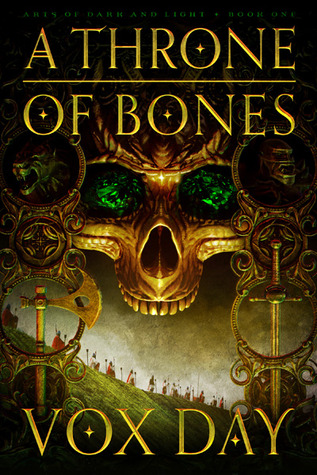
As a totally separate aside; I did fairly recently read A Throne of Bones, the first book in the epic fantasy series by Vox Day himself.  He's right, even if it is just him saying so.  It's quite good.  I picked up the second book while it was free briefly a month or so ago, but I'm not going to attempt to read it until it's actually the complete version of the book.  I think the update to the Kindle file is due late in the year.

Monday, March 20, 2017

High fantasy cliche

From The Toast: How to tell if you are in a High Fantasy novel.
  • The Elders would like a word with you.
  • The Ritual is about to begin.
  • Something that has not happened in a thousand years is happening.
  • You are going to the City.  There is only one City.  It is only said with a capital C. No one needs to bother saying the name of the City.  It is the City.
  • Certain members of the Council are displeased with your family's recent actions.
  • A bard is providing occasional comic relief; no one hired or invited him and his method of earning a living is unclear.
  • The high Priest is not to be trusted.
  • Someone is eating an apple mockingly.
  • There is one body of water. It is called the Sea. The Great Sea, if you are feeling fancy.
  • You live in a region with no major exports, no centralized government, no banking system, a mysteriously maintained network of roads, and little to no job training for anyone who is not a farmer.
  • You have red hair.  You wear it in a braid. Your father was a simple man, and you don't remember much about him—he died when you were so young—but you remember his strong hands, as he fished or carpentered or whatever it was that he used to do with them.
  • You're going to have to hurry, or you're going to miss the Fair—and you never miss the Fair.
  • There is trouble at the Citadel.
  • Your full name has at least one apostrophe in it.
  • It is the first page, and you are already late for something. Your mother affectionately chides as you gulp down a few spoonfuls of porridge; she will be dead by page forty-two.
  • There are two religions in your entire universe. One is a thinly veiled version if Islam. It is only practiced by villains. The other is "being a Viking." You are a Viking.
  • There are new ways in the land that threaten the Old Way. Your grandmother secretly practices the Old Way as do all of the people of the hills.
  • The real trouble began the day you arrived at court. Every last nobleman hides a viper in his smile.  How you long for the purity of life in your village, which is currently on fire or something.
With two exceptions, these are laughably fatal cliches.  I've seen very little thinly veiled villainous analogs for Islam—it's usually Christianity that high fantasy authors want to bash in surrogate.  This para-Christianity also is often the "new ways" that conflict with the virtuous grandmotherly "Old Ways."  And, the comment about central government, banking, etc. is pretty historically ignorant.  It's not unusual that that could be true—it is, however, also likely that banking and a federal bureaucracy, even if they do exist, are hardly essential to the plot and play no role in the high fantasy novel.

And the last one I don't really mind so much.  Rural living really is pretty cool compared to urban "sophistication."  

Anyway, if your novel—or your RPG adventure—features any of these very tired tropes, you might want to rethink them.

Thursday, July 24, 2014

Romanticism as an essential element of fantasy

Let me start with a few quotes from Wikipedia:
"Fantasy is a genre of fiction that commonly uses magic and other supernatural phenomena as a primary plot element, theme, or setting. Many works within the genre take place in imaginary worlds where magic and magical creatures are common. Fantasy is generally distinguished from the genres of science fiction and horror by the expectation that it steers clear of scientific and macabre themes, respectively, though there is a great deal of overlap between the three, all of which are subgenres of speculative fiction.
In popular culture, the fantasy genre is predominantly of the medievalist form, especially since the worldwide success of The Lord of the Rings and related books by J. R. R. Tolkien.
"The identifying traits of fantasy are the inclusion of fantastic elements in a self-coherent (internally consistent) setting, where inspiration from mythology and folklore remains a consistent theme."
Here's something from Andy Greenwald, in reference to The Game of Thrones TV show.  I think it's broader in its scope than just that show, however.
"So I listened closely as Tyrion told his tale of Orson, the simple Lannister cousin who spent his time not planning out wars or paying off debts but sitting in a garden smashing bugs. Day after day, Orson would pick up a stone and settle into his grim task, splattering beetles by the thousand. There appeared to be no rhyme or reason to Orson’s slaughter, no motive or purpose. Just the endless “kung kung kung” of a big man murdering something smaller, again and again and again.
But Tyrion, we learn, wasn’t satisfied. Though he was born to a powerful family, he couldn’t help but empathize with the littler creatures. And so his interest in his cousin morphed from mockery to curiosity to something bordering on obsession. What was the reason for this constant extermination? It was inconceivable to Tyrion that butchery on Orson’s scale could simply be the way of the world. A life was a life, whether it was protected by a suit of armor or a carapace. Surely, it deserved better. If that wasn’t possible, then at least it deserved an explanation. What, after all, was the point?"
Recapping a specific episode, he said the following:
"It was all quite thrilling, for a time, with the Red Viper leaping balletically through the summery air and Alex Graves’s camera swooping vertiginously to catch him. Game of Thrones has often punched me in the heart, but it’s rarely had it fluttering so mightily in my throat. But then, just as Tyrion was getting his hopes up and Cersei was reaching for her Big Gulp of merlot, Oberyn spiked the ball at the 1-yard line. Rather than finish off the Mountain, Oberyn was just getting warmed up, demanding much more than an improbable victory. Instead, like Tyrion in the garden all those years ago, Oberyn demanded logic and an answer. And we all know what happened next. Kung. Kung. Kung.
Actually, the sound of Oberyn’s head exploding was much more terrible than that. The defanging — and defacing — of the Red Viper was among the worst things I’ve ever seen on a screen, but it was definitely the worst thing I’ve ever heard: It somehow managed to remind me both of my own mortality and of Gallagher. (Trust me when I say I’m not sure which was more unbearable.) And in that gruesome, hideous moment I realized that the real takeaway from Tyrion’s story isn’t that he’s a fool for wanting order when there is only chaos. It’s that we just might be for greedily tuning in to the Orson Hour every week and expecting the same thing.
Look, contra Ramsay Snow, I have been paying attention. I harbor no illusions of a happy ending. But even in the midst of an epic, excellent season that has provided more wit, resonance, and emotion than I had previously thought possible, I am growing slightly weary of being taught the same merciless lesson again and again. I’d like to think that Charlie Brown had some grudging respect for Lucy the first time she pulled away the football. But the fifth? What happened to dashing Prince Oberyn was gripping, horrifying television. But, unlike his skull, it was also rather hollow. Few authors could introduce such a fantastic character with such economy and skill (and fewer showrunners could do the same on television, with even more of both). But only George R.R. Martin would so sadistically run that character into the buzz saw of disappointment and plot that is Game of Thrones just to prove a point — and, I suppose, to tighten the noose a bit more around Tyrion’s neck. Like a beetle, Oberyn was born to die, and in the most gruesome, splattery way possible. And to what end? Shocking us isn’t the same thing as challenging us. A simpleton with a rock might not need to explain himself, but a writer usually does. At this point, the most radical thing Game of Thrones could do is to make the audience exhale in relief."
This is in stark contrast to what Tolkien himself felt about fantasy, which was fundamentally—and profoundly—mythic and even romantic (not in the Romance genre sense of the word, however.)
"Eucatastrophe is a term coined by J. R. R. Tolkien which refers to the sudden turn of events at the end of a story which ensures that the protagonist does not meet some terrible, impending, and very plausible doom. As such, it is a kind of deus ex machina common in fantasy literature. Tolkien formed the word by affixing the Greek prefix eu, meaning good, to catastrophe, the word traditionally used in classically inspired literary criticism to refer to the "unraveling" or conclusion of a drama's plot. For Tolkien, the term appears to have had a thematic meaning that went beyond its literal etymological meaning in terms of form.[how?] In his definition as outlined in his 1947 essay "On Fairy-Stories", eucatastrophe is a fundamental part of his conception of mythopoeia. Though Tolkien's interest is in myth, it is also connected to the gospels; Tolkien calls the Incarnation the eucatastrophe of "human history" and the Resurrection the eucatastrophe of the Incarnation."
In this sense, which the more I think about, the more I believe strongly that there's something to this.  The bleak, nihilistic sense of much of the modern fantasy genre is completely opposed to fantasy that I (and many like me) grew up on, and which made us love the genre in the first place.  As John C. Wright said (this is my last quote in this post; I promise!)
"An artist can draw a picture of the rotting skull of a dead dog on a dungheap with maggots and blind worms crawling on its exposed brains with perfect perspective, shading, composition, and balance of light and dark, and yet it is still a picture of a dead dog."
And yes, I'm actually mimicking somebody else's post about a similar topic; quoting some of the same material (and some other material) because he made the point first and he made it well, and well, why not ride his coat-tails in that case?  But if this bleak, nihilistic, "crapsack" world fantasy is in opposition to "real" fantasy as we have known it, as we grew up on, and as we think of the genre, why is it relatively prevalent?  And why is (at least some of) it relatively popular?  And what does that have to do with DARK•HERITAGE anyway?

1) I think it's perceived by some to be more sophisticated, more mature, etc.  I think this perception is false, however.  Bleakness, nihilism, hopelessness, despair—these are not mature emotions.  This is not the perspective of an adult, it's the perspective of a whiny, angsty, bratty adolescent.  It's not sophisticated and deep, it's merely empty and soul-less.  2) Is it really that popular?  Sure, GRRM is a pretty big deal, and guys like Joe Abercrombie and a few others.  But how much room for more is there?  Is there any nihilistic work that is still read 100 years after being written?  And how much of it can you stand, even if you can stand it, without needing to break for something more light, anyway?

Keep in mind, I'm referring specifically to nihilism, not tragedy.  Although they may resemble each other superficially in many respects, they are not the same.  There's no catharsis at the end of a nihilistic work.  The same is also true of most works of horror fiction—they're not nihilistic (well, some of them are) although certainly they are dark and the end is not usually happy for the protagonists.

3)  DARK•HERITAGE is fantasy and horror, not nihilism.  The world is bleak, there are certainly issues that resemble that of a horror fiction story, but characters meet them like horror fiction protagonists. They may not triumph, they certainly don't "win" in a traditional sense, but their heroism can be seen and it has meaning.  Like the bleak fatalism of the Norse sagas, which Tolkien reflected in many ways, it's not purposeless.  It's not senseless.  It's not nihilistic.  This is part of the reason why fantasy is so fundamentally rooted in a romanticized Medievalism.  My own setting has looked in many ways to other romanticized adventurous periods; pirates and Westerns, in particular, but the end result is the same—without that romanticized adventure story baseline, the horror is just bleak nihilism.  It doesn't ring as profound as that of Norse sagas, Shakespearean tragedies, or even more modern works like Dracula or Lord of the Rings.  It would just feel like a tawdry snuff piece.

Anyway, between this and the earlier post on a similar topic, I think I've talked enough about the tone of my setting for the time being.  Unless I run a game or actually write a novel in the setting soon, it doesn't really matter much.

Tuesday, November 26, 2013

New Weird

For a while, a few years ago when the label had more currency, I wondered if maybe my preferred setting ramblings were leading me into New Weird.  Ultimately, I decided that they weren't, in part because a good, definitive definition of New Weird never materialized, and in part because I didn't necessarily love the work that was called New Weird, if I could get through it at all.  But ultimately, I have to admit that a lot of what New Weird is about, at least at a high level, coincides with my own recent take on anti-traditionalist fantasy.  Here's a few quotes, one from Wikipedia and one from TV Tropes, which attempt to take on a good description of what New Weird really is.  TV Tropes suffers from the over-use of too-"cute" slogans and labels, but I think it works well enough.

Of the definitions given below, Reid's capsule is probably closest to what I'm doing--basically, erasing the hard genre distinctions between fantasy, science fiction and horror.  A slipstream experience where genre conventions can migrate in or out as needed.

Looking at it that way, however, how is Star Wars not New Weird?  It's fantasy with science fiction trappings, sorta.  If you look at the Clone Wars TV show, you've got episodes that are the noir episodes.  Episodes that are the Godzilla movie episodes.  Episodes that are the Kurosawa episodes.  The ability of Star Wars to utilize and then discard a genre convention from any genre imaginable is part of it's appeal.

And yet, nobody seriously calls Star Wars New Weird.  I guess it lacks that *-punk aesthetic, which somehow seems to be a requirement.
Various definitions have been given of the genre. According to Jeff VanderMeer and Ann VanderMeer, in their introduction to the anthology The New Weird, the genre is "a type of urban, secondary-world fiction that subverts the romanticized ideas about place found in traditional fantasy, largely by choosing realistic, complex real-world models as the jumping off point for creation of settings that may combine elements of both science fiction and fantasy." According to Gardner Dozois, however, the VanderMeers' anthology "ultimately left me just as confused as to what exactly The New Weird consisted of when I went out as I'd been when I went in." Robin Anne Reid notes that while the definition of the New Weird is disputed, "a general consensus uses the term" to describe fictions that "subvert cliches of the fantastic in order to put them to discomfiting, rather than consoling ends". Reid also notes the genre tends to break down the barriers between fantasy, science fiction and supernatural horror. In comparing The New Weird to Bizarro fiction, Rose O'keefe of Eraserhead Press claims that "People buy New Weird because they want cutting edge speculative fiction with a literary slant. It’s kind of like slipstream with a side of weirdness."

Part of this genre's roots derive from pulp horror authors, whose stories were sometimes described as "weird fiction". The "weird tale" label also evolved from the magazine Weird Tales; the stories therein often combined fantasy elements, existential and physical terror, and science fiction devices.
And
The New Weird movement is a post-modernist take on certain kinds of literary genre fiction. In a nutshell, it's a specific genre of Scifi/Fantasy/Horror literature that does not follow the conventions of derivative Sci Fi, Fantasy or Horror, without being an outright parody or deconstruction. Similar to the New Wave Science Fiction movement of The Sixties, but it took off in the mid-nineties, and was at its peak in the early-to-mid Turn of the Millennium.

New Weird incorporates elements from certain genres, but tries to avoid being typecast as stereotypical examples of any of them. The purpose of the movement is partly as backlash against the lack of respect that sci-fi, fantasy and horror works get. Proponents of New Weird are of the not unreasonable belief that the reason genre fiction is held in such low regards is because it caters to a very specific audience who likes to read the same sorts of things. The word "Fantasy" becoming almost a brand name that invokes the idea of pseudo-Europeans living in medieval times using sorcery while Tolkienesque elves and/or dragons putter around somewhere in the background. Sci-fi and Horror share similar fates, just with different connotations (spaceships, aliens and explosions for the former; serial killers, monsters and the undead for the latter). Some writers in the genre are playing right into the Sci-Fi Ghetto themselves, with the belief that any Science Fiction that does not involve spaceships, robots and lasers must be an entirely new genre, or that any Science Fiction that does have such elements is bad by default.

Genres such as Romance or Historical Fiction do not lend themselves as well to the concept of New Weird. Writing characters in a non-mundane setting would end up with the work in question being recategorized as science fiction or fantasy.

Works in the New Weird genre are therefore, heavy in their use of Deconstructor Fleets and Mind Screw. Some of them may even take on a disdainful stance against the genres they hailed from, with liberal amounts of Take That. New Weird fiction will often — but does not have to — take place in an Urban Fantasy setting. For some reason, the various "punk" subgenres are acceptable, if not downright embraced in New Weird fiction. For the most part, anything goes as long as it doesn't Follow the Leader.

Monday, August 12, 2013

Cover art

I’ve said before that DARK•HERITAGE is an odd combination of a number of facets, and a number of genres and a number of tones. While it’s clearly a dark fantasy setting, dark fantasy can be a number of different things, and have a number of different “shades” if you will. One “shade” as an overly, or filter, if you will, of noir over the dark fantasy. Another is an overly of the Golden Age of Piracy, a third is Arabian Nights romanticized Orientalism, and a last is classic Westerns. Those Western and Noir shades come with a tinge, if you will, of steampunk, almost by default. I’m OK with this; while I’m not really (at all) into the steampunk subculture, the rather vaguish steampunk themes in early Iron Kingdoms D&D material were influential in encouraging me to continue to wander afield from “classic” fantasy as my ennui with the genre was developing, but I still wasn’t quite sure what to do about it. Earlier versions of the setting were more overtly steampunk than the version that exists today, where any steampunk elements are exceedingly (and deliberately) vague and rare.

Part of what brings this up is my growing motivation to continue work on my long-suffering novel attempt. Perhaps I should just write the darn thing and then worry about what to do with it, but I’ve been very interested following the career of successful self-published authors who have avoided using “the system” and published their novels as ebooks, without much of the hassle, and with greater control over the finalized project. Some of these guys have been successful enough that major book publishers have then come to them as cold-calls and reissued their books as regular books again. Not saying I expect that to happen to me (although wouldn’t that sure be nice?)

In thinking about what kind of cover art I could get on the (extremely) cheap to use as on a self-published work, I’m leaning towards the following. Dress up my teenaged son, who’s a lot better looking than I am, in a kind of pseudo fantasy/cowboy/steampunk get-up (or at least his top half), take a bust shot, Photoshop that in front of a landscape picture of my own taking of the American southwest (like somewhere in Big Bend or Arches National Parks, since I have some decent and recent pictures of those areas, then sepia tone the whole thing, and add some noise to make it look like a grainy old photo. If I have my son grow a scraggly week or so of Indiana Jonesish scruff, or the best he can do, anyway (he’s only 17) he’d be a close enough approximation of one of my main characters. Maybe a little on the young side, but anywhere from late teens to mid twenties all look about the same, right? Close enough, especially if the image is later manipulated with some grainy noise and color-toning.

My only concern is that rather than looking like a Larry Rostant cover for a good buddy comedy dark fantasy weirdo hybrid, it’ll look like the cover for some kind of really cheap romance novel in fantasy/steampunk drag. But that’s the risk I take for doing this on my own on the cheap. If I were a little bit better artist in my own right, I’d try to paint my own cover, but that’d just end up being embarrassing.

Wednesday, August 31, 2011

Dark fantasy defined

While I don't think it's meant to be definitive or exclusive, a writer of novels called "dark fantasy" by most has taken a stab at defining what the subgenre means. It's not exactly how I would define it, but it's an interesting discussion nonetheless. Check it out!

Thursday, January 20, 2011

A little more of the world

I've been reading some stuff lately about the theories on the settlement of the world by populations of early modern humans, and how their mtDNA haplogroups spread and got to where they are, mostly in the early prehistoric era--tens of thousands of years ago. Modern theories of population movement focus less on culture, language, and stuff like that, and emphasize consistency of the majority of the genetics in places for thousands and thousands of years.

Of course, we know that this isn't always true; people of European and African descent didn't get genetically swamped by the native populations of North and South America, for example. But it appears that it most frequently did. When Sanskrit and Indic culture came to India, it didn't make a huge dent in the population genetics of the area, even though it clearly made a major change in the political, cultural and linguistic map of the subcontinent. Similarly, the Mongols and the Manchus are genetically invisible across the face of most of China.

So, thinking about this, I decided to make a slightly more expanded, albeit sketchy, map of the lateral hemisphere of my fantasy world, with the more "local" Mezzovian Sea region that is really the heart of my setting shown in context with the greater continental picture around it. And, for fun, I thought I'd speak in very broad and vague patterns about the migration of humanity across the face of these continents; where they came from and how they diversified and migrated across the face of the land in ancient times, tens of thousands of years ago, long before anything like the current civilizations were a spark in anyone's eye. These broad patterns speak more to physical type than they do to culture or linguistics, clearly. Cultures and linguistics are much more recent and transient than biology.

Anyway, this'll be helpful to me when I need to come up with slightly more far-flung representatives of humanity, or when I want to describe what humanity really looks like in a given area. It occured to me that I really had no idea what the substrate population of Qizmir or Kurushat was like, even though I said that there was a healthy substrate population; in Qizmir in particular, where I said the ruling caste of jann was a minority. I can use the broad patterns established in this post to extrapolate other population groups as needed.

To me, this is important because I don't want to actually develop them in detail--but I want to suggest that they are out there; that the world is bigger, more complex, and more realistic (or verisimilitudinous, to be nitpicky) than what I can reasonably come up with on my own. Plus, sketching out this very broad, handwavy prehistory of population movement gives me something that I can use as a backbone to maintain consistency as needed as well.


The large landmass that makes up the central (and slightly to the east and south) portion of this map is about the size of Africa or North America (10 million square miles or so) although geographically very different. The developed portion of the world is centered on the area where the labels are; from the equator southwards to Kurushat, the most southerly labeled area (but not as far as the southern coast; my "regional" map shows no southern coastline.) Laterally, it also does not cover the most westerly or most easterly portions of the continent, and the other shown continents, microcontinents, and islands are not shown at all, of course. Although the inhabitants don't have a name for this continent as a whole (nor do most of them suspect the existance of this geography, frankly; the entire concept of a continent would be foreign to them) for ease of use, I'm going to call this the Mezzovian continent, named for the gigantic sea that floods most of its central portion, and which is the central feature of the detailed area of the map.

You can also see a much larger continent--a supercontinent, really, made up of several continental plates and terrenes that have been united together for millions of years--looming across the ocean. Nobody in my area of the map even suspects the existance of this continent, really. This large continent is (roughly) the size of Eurasia and Australia jammed together, so about 25 million square miles--more than twice the size of the Mezzovian continent. The supercontinent is also the homeland of humanity who came in daring mariner waves, not unlike the Polynesians or the Vikings. Subsequently, much of their technology was lost both on the supercontinent and the Mezzovian continent, as ecological disasters associated with glacial stages destroyed the existing civilizations and introduced a prolonged global dark age.

The first wave, perhaps the most daring, crossed the ocean south of the equator, stopping off to populate the islands, then moving on to land on the southern shores of what is today known as the d'Acs Sea. From there, they spread southward, eastward and northward. Initially, this group can be described as "Med1"--Mediterranean in nature; on average, shorter and more gracile than some other groups, with dark hair and eyes, and a bronzed skin coloration. As they spread, they encountered groups of Neanderthal humans still living in some areas. Today, these Neanderthals have been pushed back to the far southern limits of the continent, and to the steppes of Cavusto, while the Med1 physical type spread over much of the continent except the far north and far west, especially north of the Mezzovian itself, where the Forbidden Lands are; places that even tens of thousands of years ago were of ill-repute and were carefully avoided.

Possibly some groups of this first wave intermingled with the Neanderthals, or possibly it was just diversity starting to pop up as the initially homogenous population wave separated into smaller and more isolated groups, split by natural barriers such as mountain ranges, rivers, dense forests, deserts, and other hazards. To the north of the Mezzovian sea, the population developed paler skin and became Med2--the basis of what was later called the Balshatoi ethnic group and the Tarushans, and others. On the shores of the vast Lake Karkose a genetically isolated population (Med3) grew taller on average and their eyes turned an icy pale gray, nearly white--the antecedants of the Kurushi groups. Their skin tone remained bronze, and some of them developed narrow eyes marked by modest epicanthic folds, as well as aquiline noses. Along the southern shore of the Mezzovian, all the way to the oceanic coastline and even the Qizmiri islands beyond, the original Med1 physical type did not radically alter, however, and a physically (if not culurally and linguistically) homogenous population spread and grew, giving rise to the Qizmiri substrate, the Terrasans, and other, smaller ethnic groups that still remain in the area today.

From somewhere amongst the Med2 population sprouted the vucari or wildmen--individuals cursed with lycanthropy who fled their people to live in the wilds of the vast forest that stretched over much of the northern portion of the continent in those days. These groups grew, while the curse of lycanthropy was still potent and strong, and others fled their homes to live with other poor werewolves as well. Over generations, the curse weakened. Fewer individuals came by it, and those who did had descendents who were only lightly touched by its ravages. These became the first wildmen, and while their original homeland was deep in the Shifting Forest, in the years before the rise of Terrasa, a major diaspora and exodus from that region led to their spreading into various areas, including the population of the Erau river basin, and the minority populations throughout the Terrasan city-states.

Two other waves of humans came from the supercontinent. The first of these came from the equatorial regions of the supercontinent, went north to the microcontinents and islands (which were larger and less separated, since glacial maximums would have lowered sea levels globally). This physical type, which I call Nor1 (Nordic), were pale-skinned and flaxen haired, with blue and green eyes--not too unlike the population of modern Northern Europe in our world (despite their tropical origin). When they arrived, the earlier wave of Med1 immigrants were already fairly well esablished all around the Mezzovian sea region itself as well as the westernmost coastal regions. While there was significant admixturing and hybridization of the two waves of population, a large group of this Nor1 wave said, "Screw it" and settled northward where the land was uninhabited. They quickly covered most of this territory, spreading across the coastline until they came to the northern edges of the Forbidden Lands. Some few of them bravely attempted to colonize this area, but they were uniformly either killed or corrupted by the forces that lurked in those dark lands. This may be the origin of the cannibal inhabitants of the offshore islands, although physically there is no longer any resemblance to the Nor1 population group.

The final wave of settlers to the Mezzovian continent came from the far north of the supercontinent, and crossed on the northern edges of the microcontinents and islands, completely unaware of the meager population that was settling in on the southern shores. This group, called Pol1, were more robust than most other inhabitants of the Mezzovian continent, with dark hair, eyes, and brown skin. They would have appeared to us not unlike Polynesians: Maori, Hawaiians, Samoans, etc. When they arrived on the continent, young settlements of Nor1 peoples already ringed the coastal areas, and they came into immediate contact. In fact, the numbers of Nor1 settlers had grown to the point where they outnumbered the Pol1 significantly, and the hybrid cultures that grew along the northwest coast lost much of their physical appearance to both; many of them became much more lithe; tall and rangy. The paler skin, hair and eyes proved to be genetically recessive, although Pol2, the population that grew out of this admixture was sometimes lighter in most instances than the original Pol1 peoples had been. In comparing Pol2 to populations here on earth, they probably would have looked somewhat like North American Indians. Close enough, anyway.

Pol1 and especially Pol2 physical types penetrated deep into the interior of the continent, stopping only when they came to well established settlements of Med2 peoples, with which they further mixed and hybridized. The various tribes of the Hamazi-lands; Tazitta, Untash, etc., as well as the Hamazin themselves (after making a literal deal with the devil) are descended from these groups, as are other, undescribed peoples to the north.

Remember again; this is physical type only. This is meant to describe how various population clusters of folks with similar genetics and physical appearance got to be where they are, literally tens of thousands of years prior to the campaign setting as it's presented. Two individuals of, say, Pol2 physical appearance who speak completely unrelated languages and practice completely disaparate cultures might not recognize any kinship with each other at all, even though they do share some gross physical similarities that suggest that in very ancient times their ancestors came to the Mezzovian continent as part of the same wave of prehistoric settlers.

Shortly after this third wave arrived, the glaciers receded, sea levels rose, the technolgical "dark age" globally occurred, and both continents lost contact with each other (assuming that contact was even maintained in the first place.) No additional waves of migrants arrived on the shores of the Mezzovian continent until the jann did so in historic times, this time from the unknown east instead of the west--the first such migration to come from that direction. Groups mixed, mingled, and developed locally into very divergent and diverse cultures and ethnic groups. So many generations passed that there was no hope of recovering evidence of common languages anymore. Time, evolution (both culturally and physically in some cases) eliminated the evidence of the three waves of migration, leaving only the cultures that grew from those roots to become the new native cultures, societies and ethnicities of the Mezzovian world.

Monday, January 03, 2011

New Year's Resolutions

I used to be a person who resisted the notion of New Year's Resolutions. "Life should be about continuous improvement," I'd say to myself. "Make goals when you recognize the need or desire to do so, not arbitrarily, just because it's a New Year." While I still believe this, I've found that personally, that was just justification, and I wasn't making goals continuously. So, I've embraced the concept of New Year's resolutions, at least until such point as I don't need them because I have managed to cultivate a kaizen lifestyle. Don't hold your breath.

So, last night, Sunday night, which was the last gasp before we all had to go back to work and school after our holiday, our family all sat down and made some goals. I won't share with you the family goals that we set, or the couple goals that my wife and I came up with on our own after the kids went to bed, but I had been thinking for a few weeks about some personal goals, which I might yet share here, and when I checked the Paizo blog, they also talked about the concept of gaming goals or resolutions. I thought that sounded fun, so I made some there too, although they're much more frivolous than my personal goals. I'll check in once a quarter or so and report on how I'm doing with these goals here on the blog, just for the heck of it. Besides, the lack of any kind of meaningful self-audit is probably the biggest reason for failed goals anyway.

Personal Goals
  • During the half-hour 8:00 PM to 8:30 PM is rigidly set aside for the kids as "reading time" when they can read what they want to... but read they must. I've often squandered this time myself, but my goal for the new year is to study my set of Scriptures during this half-hour. I'm currently reading the New Testament, which I'm also teaching to a class of teenagers at church, so it's appropriate and timely. Plus, good example for the kids of spending time in productive activities.
  • No snacks or drinks during the workday. This will not only improve my caloric intake, but will also help in our family goal of keeping a tighter, more thrifty financial ship this year, since that's the majority of my contribution to the budget revisions that we need to make on the fly.
  • Write at least three times a week and at least 3,000 words a week. My whole life I've wanted to write a novel, and I've had several fitful and abortive attempts recently to put one together. In the middle of last year, a drastic revision and re-imagining of my setting due to my disillusionment with the direction I was headed caused me to throw out 20-30,000 words and a plot outline that I'd been revising and tinkering with for quite some time. I've now got somewhere around 15,000-20,000 words in a new draft put together, but my progress has been fitful and sporadic. Frankly, I've got too many other temptations for how to spend my free time in the evenings--books to read, movies to watch, TV to watch, video games to play--to say nothing of the other things that are not just my own personal free time: Friday night date-night with my wife, football games and other activities for my kids, etc. This just needs to be made a priority. I don't necessarily have a wordcount target (other than that I'd like to end up with a novel of publishable size when I'm done, or I've kind of wasted my time with it) but with those two minimums, I should be able to finish a draft sometime this year.
  • Improve my patience and don't lose my temper at home. Simple enough. Difficult to do for one with a bad habit of getting snarky at the first hint of frustration or annoyance.
  • Walk/hike at least three times a week; stairs in the winter and outside in the spring. To get ready for my trip to Glacier National Park with my daughter in June.

After listing these, I came up with some gaming related goals too:

  • Maintain participation level in my current Rise of the Runelords campaign. This will actually be easier for the next several months, but as the kids' schedules explode in the summer and fall, it will be difficult. I want to make sure that this is sufficient priority that I'm still hitting 75% or more of the sessions with our group.
  • Improve content offerings on both this blog and my wikis--complete the houserules documents, and the Dungeoncraft and Yog-Sothothery series of posts. Well, Yog-Sothothery is an open-ended format, I don't suppose it'll ever be complete in so many words... but complete enough of it that I can feel comfortable calling it a complete set of posts rather than merely yet another abortive series that I was excited about when I started, but which faded away ignominously as interest waned.
  • Run a Dark•Heritage campaign. Find a secondary group to run it with, if necessary. Hoo-boy. That one's going to be a stretch. First off, our current campaign, at the rate we're completing it, is not going to end in 2011 with my current group, which I enjoy a lot. And while I'm often thought it would be fun to have a second group on the side that I could run whatever I wanted to run without worrying about what all the rest of the group was interested in, the truth is, I have trouble finding as much time as I'd like for one group, let alone two. But at the same time, I've been frustrated that this setting I've been tinkering with for so long is really just a theoretical exercise. The last time I ran, I didn't use this setting, and in the meantime, we've had three or possibly even four campaigns that other guys in the group have run. While it's one of the great things about our group, that almost every member of it is as much a GM at heart as a player, it also means that us GMs don't get to run nearly as often as we'd like, too.

Wednesday, December 22, 2010

Blog updates

I've made some changes to the design, look and feel of the blog. I've got a new logo, a new tagline, and I've played around a bit with what tools or "gadgets" I'm using. At first, I added more gadgets, but decided in the end that I wanted a more stripped down, Spartan, and clean look; I'm no longer showing followers, popular posts, and a number of other gadgets. On the other hand, I added the famous first paragraph from Lovecraft's "Call of Cthulhu" because it's just such a great quote; probably the best paragraph Lovecraft ever wrote, and certainly that story's greatest claim to fame (well, other than the introduction of Cthulhu himself, of course.) And I added those nifty Cthulhu runes at the very bottom of the blog too.

Why am I doing this? Part of it is to refocus the blog a bit. A while ago I split off my musing and ramblings about martial arts fighting video games, paleontology, and synthpop music, but I still feel like this blog is a bit rambly and occasionally lacking in focus. I want to refocus it more on the development of my setting, both with my long-lingering fiction endeavors (one of these days, I will finish that novel!) and as a gaming venue. I'll continue to also write book reviews of what I read (mostly gaming books and "genre" books, but occasionally some mainstream books too, if I think that there's some value to gamers in general. I'm going to not post as many "random" posts as I used to (not that I posted a lot) and will finish up my Dungeoncraft series, and otherwise focus much more on those kinds of posts, along with the new Yog-Sothothery tag; in general, I want to be creating more content and a bit less commentary. Change the balance a bit, so to speak. Today my balance is probably about 95%+ commentary and less than 5% content; I'd like to migrate that eventually to something closer to 50%/50%.

Now, although I've removed my tagline of "Most opinionated guy on the Internet" I don't think that I've become any less opinionated; it's just that that tagline is a more generic one and I want to have one that's more related to the focus of the blog, and the focus of my gaming and fantasy tastes in general.

Tuesday, November 30, 2010

Organization stat block

Although there was much to criticize about the last phase of 3.5 edition D&D design decisions, once thing that I quite applauded and enjoyed was a common "stat block" that the designers came up with to describe organizations that the players could interact with in the campaign, either by joining, working with them, opposing them, or in a pinch, just to add color (although for the latter, this is rather more involved than you need.) For quite some time now I've thought about using this format to come up with some organizations for my Dark•Heritage campaign setting that can be used a la carte in any other setting, i.e., they'd be perfect modular elements, like my original idea of campaign setting modules that could be plugged and played into any setting.

However, I never did it. In fact, I never even looked over the organizations from a few samples of WotC products to see exactly what all the categories are that I'd need to write about. Until now.

This post is just to put out the outline template on how to describe an organization, but in subsequent posts, I'll actually detail some organizations. I had with me, by coincidence, a copy of Fiendish Codex 1: Hordes of the Abyss and Complete Scoundrel and between the two books had four sample organizations to look at. Anyway, here's the template:

Organization Name
------------------------------------
Start off with an introductory blurb of text... some color, a description of how the organization may have been founded, who the important founders may have been, or something like that.

Joining the Organization: Since it's possible that PCs may want to join your organizations, even "bad" ones, if you tend to get rather rascally PCs, as I do, talk a bit about how you go about joining the organization. Sub-headed under this is Entry Requirements which are not unlike prestige class requirements; they may include minimum ranks in certain skills, access to certain spells, a certain base attack bonus, or certain special roleplaying requirements (i.e., PCs must have been killed and ressurected, or something unusual like that.)

Playing a member of the organization: So, if the PCs do join, what does that mean? For that matter, if NPCs feature prominantly in the campaign, who are members of this organization, what do they do? This is largely just text blurb, but it does also have some subheadings, which might vary depending on the organization. They might include: Combat, how the members try to conduct combat, if necessary, Advancement, refering to advancing with the heirarchy of the organization itself, not "leveling up", Benefits of belonging to the organization, Responsibilities that members have to the organization once inducted, and possibly Missions that the organization would require the characters to undertake on its behalf.

The Benefits subheading could also have sub-subheadings, including Gear or Services that you can get from the organization, Information that the organization can provide to you, Status that being a member of the organization could provide to you in certain situations, or Access to specialists or important people who could support the members in the carrying out of thier various duties or tasks.

The Organization in the World: Describe a bit how the organization fits into a campaign setting. What is the organization's... uh... Organization? Who runs it and how do they govern? Is there an organizational HQ? Does the organization control any territory overtly? What are typical NPC Reactions to the organization? And finally (and very optionally) how does the organization fit into some of the standard campaign settings, i.e., The Organization in Eberron or The Organization in Faerûn?

The Organization in the Game on the other hand, is more metagame discussion. Rather than talking about the organization in the setting, how do you utilize the organization in your actual game? Are they likely to be allies? Antagonists? Rivals? Something else? How can you adapt the organization; for example, the Black Cult of Amn, which codifies and studies demonic lore, is suggested as an adaptation, it could be applied to any other type of outsider, including devils or even celestials. What are some potential Encounters the PCs could have with organization members, and then include the statblock of a sample NPC organization member.

Wednesday, November 24, 2010

On the evolution of the fantasy genre

On the evolution of the fantasy genre... as well as my tastes therein.

In at least one manner of speaking, fantasy is the original mode of literature. Beowulf, The Iliad, The Epic of Gilgamesh, Journey to the West, etc.--all clearly full of fantastic elements, even if they weren't necessarily meant in the same sense that modern fantasy writers mean them. The modern fantasy genre no doubt springs from the fascination in the West with medievalism, romances, Orientalism, "The Northern Thing" (i.e. fascination with Germanic folklore and mythology) and other movements in the 1800s. Coming out of this environment, George MacDonald and William Morris wrote what are considered to be among the first true fantasy novels: The Princess and the Goblin, Phantaste, The Well at the World's End, etc. While holding out a fairytale and medieval romance vibe to them, both were content to essentially invent the "secondary creation", or a completely fantastic setting for their stories to take place in.

Sadly, both were often considered works more suitable for children, and for many years, anyone who wrote anything fantastic had their work relegated to children's literature: Peter Pan, The Wonderful Wizard of Oz, and others did not manage to break out of their "literary ghetto" in spite of their success. Lord Dunsany, H. Rider Haggard, Rudyard Kipling, Edgar Rice Burroughs, Abraham Merritt and others started changing this, at first gradually by incorporating fantastic elements that had a tinge of scientific "plausibility" around them, and had characters who were more rooted in the everyday world that their readers knew interacting with these fantastic elements.

Concurrently, another genre had been developing for a number of decades that also featured fantastic, supernatural elements, but which utilized them in another fashion entirely: gothic horror, best exemplified by the works of guys like Horace Walpole, Edgar Allen Poe, Bram Stoker, Charles Maturin, John William Polidori and others.

All of these influences collided in the 1920s with the founding of the American pulp magazine Weird Tales where works of H. P. Lovecraft, Clark Ashton Smith and Robert E. Howard gleefully combined supernatural horror, secondary worlds, and even science fiction into the first uniquely 20th Century expression of fantasy. This type of fast paced, lurid fantasy adventure, often with prominent horror elements and nearly anti-hero protagonists came to be known as sword & sorcery, and is today one of the main pillars of fantasy as we know it.

In the 1950s and on into the 60s and later when these works really started gaining in popularity, the world was introduced to the writings of C. S. Lewis (the Narnia Chronicles) and even more particularly those of J. R. R. Tolkien (The Hobbit and The Lord of the Rings) which almost instantly changed the face of fantasy literature forever. Because of Tolkien in particular, sword & sorcery took a bit of a plunge popularity wise as high fantasy stepped in to achieve notable mainstream success. One of the side effects of that was that long fantasy came to be predominant. Not only long novels, but series of long novels. The Wheel of Time series, for example, is estimated to clock in at over 11,000 pages in mass market paperback format. 11,000! The Sword of Truth series and the Malazan Book of the Fallen series are only marginally shorter, and George R. R. Martin's Song of Fire and Ice series is going to be a real backbreaker too.

But this is all an extension of "Tolkienian" fantasy; one of the interesting things about fantasy in the last few decades is that it has "multifurcated" into a number of subgenres that stick to significantly different turf, for the most part. We've got resurgent sword & sorcery and high fantasy, still. We've got contemporary fantasy, some of which is little more than melodramatic romance novels with supernatural elements, but others of which are genuine fantasy set in a contemporary setting, like Harry Potter or Harry Dresden. We've got New Weird stuff like that written by China Mieville or Alan Campbell. We've got military fantasy, like Glen Cook's Black Company series. And we've got fantasy that's more difficult to classify that just does it's own thing; Scott Lynch's heist/caper fantasy, or Joe Abercrombie's cynical revenge fantasies and anti-fantasties being another.

I've sampled quite a bit of all of these modes, but my own personal history is a tortuous affair of what I like and don't like. I was predisposed to like fantasy; as a small child I already loved fantastic things: dinosaurs, dragons, monsters, fairytales and the like. I discovered fantasy as an older kid with the high fantasy works of Lloyd Alexander, C. S. Lewis and J. R. R. Tolkien, and for many years, high fantasy and fantasy overall were nearly synonymous to me. This lasted through my teenage years, most of my twenties, and on into my thirties, although I was aware of other modes of fantasy, especially sword & sorcery, I preferred high fantasy.

As my thirties started getting a little long in the tooth, that started changing. Part of this is that the demands on my time make the prospect of reading phone-book sized novels that are only one part (of ten or more) in a series seem much more daunting than it would have when I was younger. But part of it, honestly, is that I've just become bored with Tolkienian fantasy. I've also come to realize that nobody besides Tolkien really does it well enough. Since being too similar to Tolkien invites comparisons that aren't likely to be flattering, I've decided to distance myself from Tolkienian fantasy in the last few years, and have looked at sword & sorcery influences, dark fantasy and horror influences, and just plain old blending of tropes and conventions from other genres altogether into my fantasy.

In this, I believe I'm part of a greater cultural zeitgeist of expanding and pushing on the rather calcified and falsely rigid barriers of what is considered fantasy and what isn't. Which makes my timing fortuitous, because I've got a lot of source material to borrow as I'm looking for ways to expand my own gaming enterprises in new directions.

Wednesday, September 08, 2010

I'm a quitty quitter

I'm not going to read Valentine Rising right now after all. I hadn't picked it up in almost three weeks (due to my vacation, which was not one of those relaxing sit on a beach reading type vacations) and my bookmark fell out leaving me completely confused as to where I had been. Plus, it had already been renewed once at the library, and I don't like to renew things more than once except in really unusual circumstances. So I'll just try again later on that one.

Instead, I picked up Dave Gross's Prince of Wolves which is the first of the Pathfinder fiction novels from Paizo. Dave Gross wrote a novella (I'm guessing, I didn't get the wordcount or anything) in six parts in a recent adventure path, then wrote another smaller bridge piece on the Paizo website for these two characters that star in the novel. I was quite impressed with Gross's style and craft. He's a good writer with two distinct character voices that are both excellently done. I've said many times before that I'm wary of game fiction, but at the same time, I've really got my hopes up that this is going to be much better than most of the competition in the field.

Speaking of Pathfinder fiction, I'm almost certainly not going to do the Pathfinder short story competition after all either. I was actually really excited to do so, but the timing was terrible. I had thought that a massive two week vacation right smack dab in the middle of the four week window that we had to work on it wouldn't throw me off, but I failed to account for how busy I was getting ready to go on vacation, how busy I actually was while on vacation, and how busy I've been since getting home trying to catch up on everything I missed. Technically I'm not giving up... I'd still like to do something, but I've realized that realistically I probably won't have any shot at all at hitting the deadline. It's only a week away, and I'm still struggling to get a plot outline together that really "snaps."

I'll probably still write something anyway, once I can get time to get a good plot together (because I think for this kind of fiction, a good plot it essential--I'm already quite happy with the characters that the scenario) but it'll probably be later, and I'll probably just post it online somewhere.

Friday, July 09, 2010

Wildman houserules

I've blogged before about how I really like the concept of shifters (from Eberron) and other "wildmen" archetypes. And while the rules for shifters work quite well, they have two problems in being adapted to my homebrew. 1) They're not open content, and 2) They're a bit too long, complex and involved for easy retyping and representing anyway.

So, I decided to create some new rules for shifters. Since my setting doesn't have half-orcs, I decided to use the half-orc stats as a baseline, and then modify from there. Thanks to "The Orc Within" (from ENWorld) for the baseline concept and the text of the Feral Form special ability. Now, the half-orc racial stats were frequently criticized as being too harsh, especially the ability adjustments, where a +2 to Strength was frequently not judged equivalent to a -2 to both Intelligence and Charisma. The design notes on the half-orc purported that since Strength makes them better at combat, and combat is so important to the game, that it was balanced despite the obvious... well, imbalance. That, of course, depends on the game.

I've played many half-orcs in my day (in fact, I am doing so currently), but I don't particularly like the stat block for them.

Anyway, here's the entire ruleset for my vucari, or wildmen. Obviously based on the same idea as shifters. I've used D&D linguistics, just for completion; I, of course, use a completely different linguistics rule for my homebrew.


Wildman (Vucari)
• +2 Str, -2 Int
Lowlight vision
• Survival is always a class skill for wildmen, regardless of what class they actually take.
• Wildmen gain the Scent ability
• Feral Form (Su) - Once per day a wildman can take on brutish form that lasts a number of rounds equal to 3 + the character's Constitution modifer, granting him +2 Str, +2 Dex, +10 ft land speed, and two claw attacks (1d4 +1/5HD damage). The character may use manufactured weapons while in his Feral Form, if desired. While in his Feral Form, a wildman also gains the benefit of the Pounce ability. This benefit only lasts while in the Feral Form, however. The wildman gains one additional use per day of his Feral Nature at every 5th character level he attains.
• Automatic languages: Sylvan
• Bonus languages: Common, Elven, Goblin, Orc

Tuesday, June 15, 2010

Setting: another POV

As I've re-read my last post, it occurs to me that while it's a benefit to encourage some level of richness to a setting, it's also potentially a trap for the unwary. Let me explain.

The example I gave in the last post is how a language extremely closely related to Ma'anyan and other eastern Bornean languages ended up on Madagascar, and in fact the native language of the whole of Madagascar and Mayotte, where it outnumbers all of the rest of the speakers of the entire east Barito language branch put together. The entire Austronesian diaspora, and particularly that of the group that moved to Madagascar is a somewhat mysterious process; the how and why of it is unknown, and all kinds of interesting stories regarding the move could be told, albeit speculatively.

While these kinds of mysteries are part and parcel of the real world, and therefore encourage richness and verisimilitude in a fantasy world, they are also potential distractions from the efforts of a gamer or a writer, unless catering to a real fan of simulationism or exploration. I think most fantasy fans have at least some element of that; they like their settings to feel "real." Even as they understand that of course they are not, they are likely to demand sufficient detail to maintain an illusion of reality to aid in suspension of disbelief. Also, I think that most fantasy fans like exploring settings, and seeing what the gamemaster or writer has come up. Tolkien's richness to his Middle-earth setting is frequently cited as one of the main draws of the setting and story both.

But, more is not necessarily better, and even Tolkien knew enough to put most of his detail in other sources, out of the way of the main story. The fact that most fantasy fans are at least somewhat fans of exploration doesn't mean that they want to experience vicarious travelogues or ethnologues of fiction places and peoples. I've seen several games (and novels!) fall victim to this trap, and the end result is that the characters and the stories that surround them suffer as a result.

Be very careful of integrating details into your campaign setting. For the most part, if there's a mystery or secret, the point of it is so that the characters can discover the solution to it. Occasional red herrings can be fun, but a world full of mysteries and secrets that never get solved might be realistic... but ultimately probably isn't very fun to explore after a while.

Tuesday, June 01, 2010

Arches, and other natural features

We here in America are justifiably proud of a lot of the scenic opportunities we have in the west. In particular, right now I'm thinking of places like Arches or Canyonlands National Parks, which are singular in their presentation of a weirdly beautiful landscape.

Well, or are they? Actually, there is one more place in the world renowned for its arches and weirdly fluted rock formations. That is Tassilli N'Ajjer National Park in Algeria.

Check ouf a few examples of what they offer, sprinkled throughout this post. As a fan of fantasy, I'm always on the lookout for unearthly or spectacular scenery with which to populate my fantasy worlds, but it is frequently driven home to me we really don't need to go to another world to get spectacular and unearthly scenery. (For yet another example, Talampaya National Park and neighboring Ischigualasto Provincial Park in Argentina offer yet another stunning example of similar scenery.) There is plenty of inspiration for fantasy worlds right here yet in our own world; plenty of unusual scenery, or interesting formations, or otherwise just bizarre and fantastic locations in which to set our fantasy stories of fiction or roleplaying games, either one.

Also: although scenery and setting is an interesting window dressing, it's important not to let setting get in the way of what's really interesting about fantasy. While there may be some small element of "travelogue" in the genre; the ability to explore a fantastic and fictional landscape, that's only a small element of good fantasy. Fantasy that loses sight of that and focuses too much on setting is fantasy that is much weaker as a result. That some elements of fantastic landscapes, either from the real world or from your imagination (although I still daresay that our imagination can rarely top reality in most cases---reality is really strange and wonderful enough on its own) but don't ever let that become the focus of our game. People don't play roleplaying games for the ethnologue or the travelogue. A little bit of that can go a long way.

Friday, May 28, 2010

Setting evolution

I mentioned this in my last post, but my old description of my setting as a combination of Edgar Rice Burroughs' Barsoom, H. P. Lovecraft, Sergio Leone, Charles Dickens and Robert Ludlum isn't really accurate anymore, as my setting has evolved.

Some of the Dickensesque Inudstrial Revoluation urban dystopia has faded. Lovecraft's breed of horror fascinates me in some respects, and makes me shake my head wondering what he was thinking in others; but certainly some kind of supernatural horror vibe is still important. The alien-ness of the world has been an almost complete casualty of my setting evolution; rather than being a bizarre foreign planet with almost all alien lifeforms except human, I now see it as a Pleistocene era planet, albeit one in which advanced civilizations flourish. I've played up the cowboy angle even more overtly, and added a very prominant pirate angle too.

It's still swashbuckling horror, but I think my influences are now better described as:
  • A politically balkanized Mediterranean Sea. This can be similar to Rome in decline with Barbary pirates added in for fun.
  • Arabian Nights
  • H. P. Lovecraft and classic, gothic horror
  • Sergio Leone (especially up in the northern desert areas of Baal Hamazi, which I haven't yet typed up on my wiki.)
  • Rafael Sabatini
  • Robert Ludlum (for plots and conspiracies, mostly)
  • The X-files

An incoherent mess of ideas and conventions? Possibly. But influences does not mean straight borrowing without modification, so there's room for me to make it all seamless.

Also, I'm reminded of something Corey once said about setting design every time I start to worry about coherence. For his Barsoom setting (no relation to ERB's Barsoom, except in vague thematic terms), he just threw in everything that he thought was cool without worrying about how it all worked out. And... well, it did appear to work out brilliantly. And I'm arrogant enough to think that if he can do it, there's no reason I can't too.

And his Barsoom was pretty diverse too---Spanish mafia, dinosaurs, Plains Indians, Red Martians, Hong Kong theater and Glen Cook's The Black Company all were significant and obvious inclusions or inspirations. I don't know that my settings more bizarre than that, really.

Thursday, May 06, 2010

Hyborian History

"Know, O prince, that between the years when the oceans drank Atlantis and the gleaming cities, and the years of the rise of the sons of Aryas, there was an Age undreamed of, when shining kingdoms lay spread across the world like blue mantles beneath the stars ... " -- The Nemedian Chronicles

I've blogged before about the brilliance of Robert E. Howard's idea to create the Hyborian Age. It's important to remember that Howard wrote several decades before the formulation of the theory of plate tectonics, and while continental drift had been suggested in vague terms by a few scientists, there was little acceptance of the idea because it lacked compelling evidence until it was combined with sea-floor spreading, radiation heat, and various other lines of evidence that crystalized in the late 1950s and early 1960s into the theory of plate tectonics.

Therefore, Howard's Golden Age, the Hyborian Age, was framed by disasters; global cataclysms on the scale of the Biblical flood, that plate tectonics now tells us were impossible.

However, of course, in a fantasy setting there's no reason why scientific rigor has to be maintained. The more I think about it, the more I think I was perhaps wrong, or at least barking up a slightly wrong tree, when I wrote my blog post "Realistic" maps. Rather than realistic by plate tectonics standards, I think realistic by earlier 20th century standards would be more fun. After all, the allure of lost continents, (Zealandia, Sundaland and Kerguelen notwithstanding) and massive natural disasters shaping the history of life on earth is ingrained in our cultural heritage, and too alluring a prospect to ignore.

Speaking of which, I had two options for some images of lost civilizations, both by Les Edwards. Since I couldn't decide which one I liked best, I attached them both.