Tuesday, September 29, 2015

Those Who Were Taken

I'm a big fan of the concept of the Ten Who Were Taken from Glen Cook's The Black Company series; an epic 10-volume tale of dark, military fantasy and one of the godfather achievements in the sub-genres of dark fantasy and military fantasy alike.  My Heresiarchy of the Twelve is not unconsciously modeled, at least in some respects, off of the Ten.

I've also been a fan of a lot of the Warhammer World fiction.  Nagash, in some ways, who I've referenced here before many times, can be seen as analogous in many ways to the Dominator; a leading sorcerer who created other sorcerers, who's black legacy still haunts the world many centuries or even millennia after his initial time of power. I've been reading Mike Lee's Nagash trilogy lately (about time too; I've owned the books for many years.)  The first of the books, Nagash the Sorcerer I found somewhat difficult; the plot was convoluted, the characters less than compelling, and the time frame and politics made for somewhat stodgy reading.  Because I had been a fan of the "lore" of Nagash for many years (dating back to my picking up a White Dwarf way back in the early to mid 90s that described his "secret history" in textbook style) I was anxious to see this committed to novel form.  The first book was disappointing, though—and I let the series sit fallow for quite some time.

Only recently have I finally picked up the second book, Nagash the Unbroken and quite honestly, it is tons better.  It alternates between far fewer point of view characters; Neferata being one of the main ones, and her drive to essentially create the vampiric race in Lahmia with the aid of a captured Arkhan the Black is fascinating.  Every other chapter then turns to Nagash, who having faced a crippling defeat in Nehekhara, has now wandered over to Cripple Creek and on his way to becoming more than simply a self-made vampire/sorcerer lord, but rather the master sorcerer Nagash the lord of the Undead.

One of the things Warhammer does quite well is to not really explain everything—in spite of the fact that they're turning what was a few pages of textbook style history into a novel trilogy, there are a lot of holes in the setting.  Stuff that doesn't quite add up.  Stuff that contradicts other stuff.  Mythology that refuses to be classified and nailed down.  Stuff like that.  This deliberate uncertainty principle gives it a very verisimilitudinistic feel; as events are removed from the current continuity in time, more uncertainty about what actually happened and what stuff actually means seems to be de rigour.  This is, of course, often the opposite of what many high fantasy fans are used to, where thousands of years of detailed timelines and maintained status quo seem to be common.

I also really like, of course, the notion of digging up the past that should be better off left alone.  This is a very Lovecraftian concept, but it is also one of the main drivers behind some of the Black Company novels (Bomanz, the wizard who "accidentally" unleashed the Ten Who Were Taken back on the world) and I was reminded of it again as Arkhan the Black and Neferata and Lamashizzar and others worked to try and recreate Nagash's experiments on the Elixir of Life—which is really, of course, the elixir of undeath/vampirism, not life.

These powerful memes and conventions have their place in fantasy, especially darker fantasy with a more sword & sorcery and/or horror feel, than they do with a high fantasy feel, but even high fantasy, of course, has characters like the Ringwraiths who fill a similar function, etc.

Tuesday, September 22, 2015

The Horse The Wheel and Language

Last night I swung by the library and picked up David Anthony's The Horse, The Wheel and Language: How Bronze Age Riders from the Eurasian Steppes Shaped the Modern World.  If there were such a thing as a long-time reader of my blog, my fascination with Indo-European archaeology and linguistics as tools to reconstruct Indo-European pre-history should be readily apparent.  As long ago as twenty years ago, my still teen-aged sisters-in-law thought it was kinda funny that I read (for fun) Indo-European Origins by John Day or In Search of the Indo-Europeans by J. P. Mallory, or that I even liked the latter so much that I bought my own copy as a trade-paperback from the school bookstore (this was as yet in the pre-Amazon age of the internet.)

I was amused to see on the dust jacket the following two claims: "Until now [the identity of the Proto-Indo-Europeans] has remained a tantalizing mystery to linguists, archaeologists, and even Nazis seeking the roots of the Aryan race.  The Horse, The Wheel and Language lifts the veil that has long shrouded these original Indo-European speakers," and, "The Horse, The Wheel and Language solves a puzzle that has vexed scholars for two centuries—the source of the Indo-European languages and English—and recovers this magnificent and influential civilization from the past."

Although I've only read in a couple of hours or so last night about 100 of it's just under 500 pages, it's clear that it's really just a rewrite of Mallory's own book, really, with a summary of what has been learned in the years since (Mallory's book was first published in 1991.)  And for that matter, Mallory's book was really just a summary and update of Marija Gimbutas' kurgan theories which were first published in the 1950s.  The idea that Anthony's book "solves" a mysterious "puzzle" is ludicrous.  What he does is rewrite for a general audience the basic state of Indo-European studies, focusing on the mainstream theory of their origins.  He does make a slight note of the competing theories and explains why they are unsatisfactory (as Anthony says; few archaeologists understand linguistics and vice-versa, making monodisciplinary solutions fail—the biggest single alternative is, of course, Colin Renfrew's Anatolian Neolithic hypothesis, which was already pretty thoroughly discredited by Mallory in his book.  Since then, little has changed that paradigm.)

So... yeah for overly dramatic copy editors trying to shill a book, I guess?

Anyway, now time for me to divert to a bit of a rant.  I haven't finished the book, so I'm not going to review it yet, or even comment on it, other than what I've already said, which is that it clearly offers little that is "new" to the field; it mostly comes across as an update to Mallory's own book.

But Anthony took quite a bit more time, word-count and energy doing something that Mallory only did briefly (and in my opinion, somewhat tongue-in-cheek, almost)—signaling his political correctness with regards to the subject in an attempt to not be called a Nazi by cultural Marxists which have thoroughly invaded academia in the West.

As may be apparent from my own slightly earlier post, linking to and commenting briefly on the physical characteristics of the early Greek aristocracy and the Roman patrician caste, I think this is nonsense.  There clearly was an ethnic element to the spread of Indo-European languages, and denying that requires denying the testimony of almost every classical author, the testimony of a host of newer DNA studies, the testimony of statuary and artistic representations from the past, etc.  Ignoring this vast body of evidence because of a paranoid fear of being tarred a possible neo-Nazi because apparently only a Nazi could possibly think that white people have any value or merit or something is absurd, hateful, cowardly and stupid.

And when you get down to it, being so afraid of the Nazi label is kinda silly anyway.  As current events show an increase in nationalism across the world, the spectre of the Nazis is constantly drummed up by cultural Marxists in the media and academia anymore.  But it's readily apparent that it wasn't the nationalism in national socialism that was problem, it was the socialism.

What?  You may say.  The Nazis weren't really socialists, they were right wing!  Dude; you're not tall enough for this ride if you say that.  Have you read the Nazi party platform?  Have you read the Fascist manifesto?  What about other so-called "right wing" socialist parties?  Franco? Peron?  Have you read reports and journalism from the time when those were current about the obvious similarities between Mussolini, Hitler and Roosevelt and their policies?  It escaped exactly nobody's attention in the 30s and 40s that Roosevelt's administration and Wilson's administration before that, were essentially completely fascist in nature, even though they didn't officially use that label.  In fact, as foreign relations with Hitler and Mussolini soured, Roosevelt had to intervene specifically in the field of journalism to make reporters stop drawing the obvious parallels between Roosevelt and Hitler.

It's leftists who are always the mass murders.  Always.  Hitler was to the left of Roosevelt and Wilson on every policy position that any of the three articulated.  The Nazis and the Communists block voted together in the Reichstag for every Marxist policy that they could think of.  He's responsible for the Holocaust, which murdered "up to" 6 million Jews (nevermind that it's not entirely certain that there were any more than 6 million Jews in all of Europe at the onset of the Holocaust.)  Even a raging over-estimate of the deaths that can, even tangentially with the wispiest and flimsiest of excuses, be laid at Hitler's feet comes to 17 million.  That's, of course, monstrous—but a guy I know of online was trying to make the case to me that we absolutely had to ally with Stalin to stop Hitler because of... Hitler!  Stalin himself, also of course a leftist, is responsible for many more deaths than Hitler.  Solzhenitsyn gives an upper estimate of 60 million, and even the lowest, most pro-Communist report you can find still has to grudgingly put a lowest floor estimate of 23 million deaths at Stalin's feet.  And that's just Stalin himself; if you give the entire Russian communist movement, it grows considerably.

In reality, of course, we should have adopted a version of Kissinger's maxim: "It's a pity that they can't both lose," but you can quite easily make a case that if we really had to back one evil, mass murdering dictator against another, we probably backed the wrong one.  Stalin was considerably worse than Hitler.  And those numbers don't even count the Germans murdered, starved and raped after the surrender and the end of WW2.  Heck, Eisenhower himself can be tagged with the starving death of up to a million Germans in concentration camps in Europe after the war was over.  Soviets embarked on an industrial scale rape and murder of the Germans of East Germany.  The worst Holocaust of WW2 wasn't the Jewish dead, it was the German dead, and it was perpetuated by us and our "allies."

And both of them are chumps compared to Mao, who is responsible for up to 78 million deaths, most of them during the so-called "Great Leap Forward" although his "Agrarian reforms" prior to that still killed millions of nationalist Chinese.

The bottom line?  Leftism leads to mass murder once they get enough power and control to implement it.  It happened in Germany, Russia, China, Argentina, Chile, Cuba, Vietnam, Cambodia, Korea, Romania, Bulgaria, Hungary, Tibet, Afghanistan, Colombia, El Salvador, Spain, and more.  Nationalism has no such stigma.  Signaling your righteousness by rejecting nationalism and tacitly accepting Marxism/leftism is self-defeating.  It has the exact opposite affect on anyone who's actually educated as opposed to being merely shallowly indoctrinated.

Friday, September 11, 2015

Settings galore

I'll have to be honest, since it's my wife's favorite place in the world, my big vacation was to Orlando, where we saw GatorLand, DisneyWorld (including Typhoon Lagoon—a total of 6 days spent in the parks themselves, with another day for Downtown Disney and another for some resort hopping.)  We finished up by spending two days at Universal Studios, where the Diagon Alley area was new to us (we'd already seen Hogsmeade a few times, and the rest of the stuff, minus a few new rides in FantasyLand, we're old hats at.)

This isn't meant to be a travelogue post, though—but rather an indication of some thoughts kicking around in the back of my mind while we were there.

First off, the Magic Kingdom itself has a wonderful group of set themes—TomorrowLand, FrontierLand, FantasyLand, AdventureLand, etc.  Each is a great example of a setting microcosm; or at least, the tone and feel of one.  TomorrowLand is actually the least cohesive in many ways, as it can't quite decide if its a relatively near future harder sci-fi, or a wahoo space opera.

I hardly need more setting projects, after mothballing most of the ones I already had, but if its nothing more than an exercise for this post, because I just felt like it after coming back, here's how I'd do something useful with the ideas:

TomorrowLand
  • A near future solar system setting where water and mineral mining claims riddle the asteroid belt and distant moons and bodies of the outer solar system.  There's a strong frontier ethos out here, and there has to be, since miners and others are alone in the harshest wilderness known to man and extremely self-reliant by necessity.  Of course, the governments on Earth and even Mars are interested in bringing them into greater control and exploiting their resources to greater profit.  Think The Moon is a Harsh Mistress combined with, I dunno, Silent Running and Outland or something.
  • I'd like to still make a more wild space opera, but I think I've probably got that handled already with AD ASTRA if I ever develop it.
AdventureLand
  • This land as a kind of exotic adventure feel; Westerners in southeast Asia and Africa and South America with a kind of Dr. Livingstone or Professor Challenger type feel.  It would be very much like Indiana Jones, the Brendan Frasier Mummy, the old TV shows Bring 'Em Back Alive and Tales of the Gold Monkey, but instead of taking place on our earth, it takes place in an alternative 1920s.  During the Seven Years War, alien technology was discovered that could take people to alternative worlds where entire past ecosystems were "archived" by some mysterious beings.  Modern Westerners weren't the first to go through them, so late surviving Egyptian and other past societies, degenerated into savagery for the most part, make up a burgeoning native population.  Colonies of Prussians, Austrians, British and French travel these foreign worlds, stuffed with dinosaurs and savage, exotic peoples.
FrontierLand
  • DARK•HERITAGE is itself kind of a fantasy western more than a Medievalist fantasy or sword & sorcery style fantasy, so I don't think I need a FrontierLand setting per se.  I admit, I did flirt with changing the pseudo-Mediterranean/Latin culture of the Terrasan Empire into something more compatible with typical Westerns, i.e. Anglo-Saxon American-themed, to make it feel more like a Western even, but I doubt that I'll actually go through with that.  And there's no great reason why it'd be necessary anyway.
FantasyLand
  • Even though I largely don't work in it much anymore, one of my first great loves is, of course, High Fantasy of the J. R. R. Tolkien, Lloyd Alexander, William Morris, etc. But of course I need to put a twist on it.  In fact, what I'm thinking of off-hand right now is adapting my so-far not very developed anyway MAMMOTH LORDS setting as a fantasy alternative world.  Rather than High Medieval, what if I set it during the Migration Period, as the Late Antiquity transitioned into the Early Middle Ages.  And what if some geologically unlikely event happened; like Asia breaking off in a rough line more or less from the Indus River Delta to the Yenisey mouth and the far east suddenly lurching farther to the east, the space in between filling with seawater.  Likewise, North America is thrust up nearly to Europe, with distances no greater than that of the Straits of Dover between some of the westernmost shores of Eire and Hispania—maybe they've even completely collided in some areas.  This brings the Iroquois Confederacy, Cahokia, maybe even the Aztec Empire into contact with the failing Roman Empire, lingering Celts on the fringe of the Empire, and vast hordes of Goths, Vandals, Franks, Alamanni, Huns, etc. into contact—along with prehistoric North American megafauna.  Yeah, yeah, it's a big mix of a bunch of weird stuff, but why not?  Throw some Atlantean refugees in there too, why dontcha?

Wednesday, September 09, 2015

Greek and Roman physical type

An interesting article.  Go read it, then I'll make some comments:

http://www.unz.com/article/what-race-were-the-greeks-and-romans/

OK?  A few minor nitpicks to start with.
We know something about the early Hellenes from the Iliad. It was first written down in the late eighth century BC, at the end of the Greek Dark Age, after the Phoenicians taught the Greeks how to write again. It recounts events some four to five hundred years earlier. Although we think of the poem as being about the Greeks, Homer’s warrior heroes belong to the Achaean nobility, which suggests that it was the Achaeans who overthrew Mycenaean civilization, not the Dorians, who would descend upon Greece and displace the Achaeans a hundred years later. Archeology confirms this supposition, for Troy was burned around 1200 BC, and the traditional date for the Trojan War is 1184 BC. The Dorian invasion is dated by various ancient historians at 1149, 1100, or 1049 BC.
He's either never read the Iliad, or doesn't understand it, and he understands little if anything of the scientology and historiagraphy of the Trojan War.  Menelaus and Agamemnon were kings of the Mycenaean civilization; saying that they overthrew it as part of broader picture that saw the sacking of Troy as merely one event in the greater Bronze Age Collapse makes no sense.  Either the Achaeans were an important element of the Mycenaean palace civilization of "Ahhiyawa" already, which makes sense given that it's supposedly a Hittite transliteration of the word that comes to us as Achaea, or you can't take the classical narrative of successive waves of Achaean and then Dorian invasions too literally.

But this is a minor nitpick that doesn't much impact the general thrust of his argument really.

The second nitpick, which is also minor, is that he repeatedly calls the Romans and Greeks "northern Europeans." This is obviously false, since they are attested in southern Europe; Rome and Greece, respectively, although both tended to get around in the Mediterranean region and beyond from time to time.  What he means to say, of course, is that they are of a physical type which is today associated with northern Europe rather than with southern Europe.  There is no convincing model by which the Greeks and Romans are literally from northern Europe—the best model is the so-called Kurgan Theory or its proposed update, the Revised Steppe Theory, which has Indo-European languages and culture spreading from the Pontic-Caspian steppes, mostly during the early Bronze Age, and certainly before writing came to Europe.  Most likely languages ancestral to proto-Greek and proto-Italic were already forming in the Balkans, although models that get us from putative late Proto-Indo-European cultures such as Cucuteni-Triploye to the historically attested Greeks and Romans is a bit hazy, the general story that derives them from the steppe is strong; and it does not derive them from the steppe via northern Europe.

Why those physical types are under-represented in the region today is, of course, the big question.  There are obviously lots of different migration models.  Some proposed for Indo-European expansion include a cultural and linguistic dispersion that had little genetic basis behind it at one extreme.  The other extreme is a nearly complete population replacement—which most archeologists decry as too radical, despite the fact that we have at least three historical models that I can think of off the top of my head for exactly this happening: modern day North America, Australia and New Zealand.

A slightly more nuanced model which is the one that fits best with the scenario described in the article is rather the installation of an invader force which conquered and installed itself as a cultural elite over a larger population of authochthonous natives, but who managed first to impose its civilization, language and material culture to at least some degree on the conquered nation.  A good modern example of this would be Mexico, where Spanish conquistadores claimed the nation and imposed Spanish culture and the Spanish language on a large population of natives.  Although they were successful, naturally, in doing so, the basic physical features of the Mexican nation owe much more to the Aztec and other native populations than they do to the Spanish even today—even though the cultural and administrative elite and upper class is still demonstrably and observably more physically European than the masses.  Even today, many centuries after the fact.

This is probably the model by which the Greeks and Romans transformed Greece and Rome into the nations we know them today, and yet which turn up repeatedly in ancient texts and art as observably more like the northern European than the present day southern European—because the cultural and administrative elite still got that way as invading conquerors rather than as natives.  Only after many, many generations did the invaders eventually get more or less genetically swamped.

UPDATE: Although what I wrote back then is still completely accurate with regards to the Greeks and Romans, in particular, archaeogenetic studies (i.e., DNA sampling from skeletons found at archaeological dig sites) suggests very strongly that there was actually considerable population replacement and folk movement going on.  The Corded Ware cultural horizon (admittedly, more northern European) shows that 75% of the DNA comes from the steppes—the Yamna horizon which is the Proto-Indo-European homeland.  What this means is that the northern European "stock" is the Indo-European stock to a great degree after all, and it comes from the steppes of Eastern Europe originally.

This means of course, that the Greeks and Romans—or at least the original people who brought the languages that later evolved into Greek and Latin—were also, as the article suggests, built and colored like northern Europeans.  Because the substrate population density in southern Europe was greater than in northern Europe, the steppe physical type remained in northern Europe (which, honestly, probably had a similar physical type already.  Look at the non-Indo-European Finns and Lapplanders relative to the Indo-European Swedes and Norwegians, for example.)  In southern Europe, it was eventually swamped.  But it probably took many generations for this to happen.  Today, many centuries after the Spanish conquest of Nueva EspaƱa from a variety of Aztec, Toltec, Inca and other empires, the elite classes of Latin America are very visibly and notably different than the lower classes.  The former is very Spanish and European in physical type while the latter is very indio.  In India, the physical distinction between the Brahmins and the lower castes seems to preserve an ethnic distinction described in the Rigveda between aryas and dasyas that has persisted for millennia.  The Rigveda's timing is a bit uncertain but most likely it was written before the fall of Troy.

I haven't read that any archeaogenetic studies have tried to track the spread of steppe elements (i.e. Indo-European languages) into the Balkans or elsewhere in southern Europe, though.  No Baden culture archeogenetics studies that I know of—although I'd be real interested to see one done.

Tuesday, September 08, 2015

Vacation

It hasn't been the best year for me in blogging anyway, but lately I've been away on an extended family vacation, so it's been even more spotty than normal.

I do have a variety of topics to address once I can manage to hit my stride again, though—so stay tuned.

Tuesday, August 11, 2015

Reading fail

I gave up on two books I had from the library: Star Wars: Dark Disciple and Cold Dish, the first in the Longmire series.  The second one was the least interesting in terms of why it happened, so I'll get it out of the way first—it was clear that the plot for the novel was used to make one of the episodes of the TV show.  Whether or not it added more or did something else, I'm honestly not that interested.  It would be rehashing a story that I've already just watched recently on Netflix.  That may work for some types of books, but for mysteries, if you've seen the screen adaptation, reading the novel afterwards is usually a let-down.  Nevermind.

Too bad.  I would probably have liked to have discovered the novels before I discovered (belatedly) the show, but it didn't happen that way, and there's no point in wishing for something that didn't happen.

For the Star Wars novel, on the other hand, the story is quite different.  I was initially excited about it because it was based on a number of scripts written by Katie Lucas that were to have been episodes of the phantom Seasons 6 and 7 of The Clone Wars, a show which I greatly enjoyed and still rewatch on occasion (my son has been "marathoning" the episodes for a few weeks now; he's just finished Season 4, I believe.  They're on Netflix in HD which makes it easy and convenient.)  In fact, heck—I was really excited about all kinds of stuff that didn't make it into the season.  The novel was written by Christie Golden.

Instead, and as a result of this abortive attempt to read the novel, I've decided that I'm going to offer my answer to the infamous K. Tempest Bradford challenge.  I'm going go deliberately not read any author who isn't a white, straight male author, who appreciates Western civilization.  At least not without multiple, trustworthy recommendations.

Sure, there's the odd Leigh Brackett or C. L. Moore in the field, but by and large, I find that "diversity" authors do not write about things that I want to read.  Almost every so-called science fiction or fantasy book I've read in the last several years written by a woman has actually been a bodice-ripper romance novel in fantasy or science fiction drag.  And Star Wars: Dark Disciple is no exception.  The official publisher's summary of Dark Disciple is as follows:
"The only way to bring down the dark side's most dangerous warrior may be for Jedi and Sith to join forces.
In the war for control of the galaxy between the armies of the dark side and the Republic, former Jedi Master turned ruthless Sith Lord Count Dooku has grown ever more brutal in his tactics. Despite the powers of the Jedi and the military prowess of their clone army, the sheer number of fatalities is taking a terrible toll. And when Dooku orders the massacre of a flotilla of helpless refugees, the Jedi Council feels it has no choice but to take drastic action: targeting the man responsible for so many war atrocities, Count Dooku himself.
But the ever-elusive Dooku is dangerous prey for even the most skilled hunter. So the Council makes the bold decision to bring both sides of the Force's power to bear—pairing brash Jedi Knight Quinlan Vos with infamous one-time Sith acolyte Asajj Ventress. Though Jedi distrust for the cunning killer who once served at Dooku's side still runs deep, Ventress's hatred for her former master runs deeper. She's more than willing to lend her copious talents as a bounty hunter—and assassin—to Vos's quest.
Together, Ventress and Vos are the best hope for eliminating Dooku—as long as the emerging feelings between them don't compromise their mission. But Ventress is determined to have her retribution and at last let go of her dark Sith past. Balancing the complicated emotions she feels for Vos with the fury of her warrior's spirit, she resolves to claim victory on all fronts—a vow that will be mercilessly tested by her deadly enemy . . . and her own doubt."
A more accurate one would be as follows, modified from the publisher's summary to 50 Shades of Grey:
"When self-proclaimed maverick Jedi Quinlan Vos goes to interview young bounty hunter and former apprentice of Count Dooku Asajj Ventress for a startling mission assigned by the council, he encounters a woman who is beautiful, brilliant, and intimidating. The naive, emotionally out of touch Vos is startled to realize he wants this woman and, despite her enigmatic reserve, finds he is desperate to get close to her. Unable to resist Vos’s wry humor, wit, and independent spirit, Ventress admits she wants him, too—but on her own terms.

Shocked yet thrilled by Ventress’s singular erotic tastes, Vos hesitates. For all the trappings of success—her successful bounty hunter business, her own ship, her undeniable skill—Ventress is a woman tormented by demons and consumed by the spectre of the Dark Side. When the couple embarks on a daring, passionately physical affair, Vos discovers Asajj Ventress's secrets and explores his own dark desires.
Oh, and they try to kill Dooku, which obviously won't succeed, since he's still kicking around at the beginning of Revenge of the Sith."
Of course, even the official summary hinted at the uncouth romance genre nature of the story. But rather than learn to get better at reading between the lines, I'm just giving up on women writers completely.  It's been at least five years since I read a work by a woman writer that I'm honestly glad I invested the time in reading.  Major let-down.  And I've been let down far too many times now.  I don't want to read a crypto-romance in space or in fantasy drag.  I don't want to read a screed against Western civilization or "the Patriarchy" or white privilege or any other such inane, ridiculous, insulting concepts.  Never again.

So, like I said, I'm countering Bradford's challenge.  I won't read an author who isn't a white, straight, "cismale" writer this year.  I may not read one ever again, and certainly not without a really significant endorsement from multiple, trustworthy sources.

Tuesday, August 04, 2015

Borrowing from my own past

I totally ditched my old plot outlines for a potential novel set in the DARK•HERITAGE setting.  One of these days, I'm really going to kick myself for not having buckled down, written it, and put it out there on Amazon as a Kindle ebook.  But I've decided that for my first real outing, I needed more compelling characters than the ones I had whipped up, and in looking back at my gaming past, some of the most compelling characters to ever feature in a game I ran are probably the best place to start.

Scourge
Not saying that I'm going to use them per se, but rather that I think using the core concepts of them is where I want to start.  The following list of misadventures were referred to obliquely in the back stories of Lash and Ricardo, and gives an idea of the kind of people that Scourge and Raimundo will end up being.  Once adapted out of a more overtly D&D-like scenario into my own setting, of course.

  • While at a wharf saloon in Iclezza, Ricardo and Lash brokered a deal with a fight promoter and a goblin prostitue. The details are unclear, but what is known is that at one point they ended up upside down and naked.
  • Ricardo had at least one incident with a cross-dresser in Kadath. 
  • He also had a rather unfortunate incident with a pair of twins in Torregina.
  • Ricardo and Lash once ended up strapped to logs and floating toward the plateau edge in that little town in Nevistimo . Apparently this involved an innkeeper's horny widow that somehow pissed Ricardo off.
  • There was also a time in Iclezza when Ricardo told Lash to do whatever he thought best and two hours later everyone else in the tavern was dead.
  • And there was the time (location unspecified) when Ricardo was apparently keeping a noblewoman distracted while Lash robbed the house . Unfortunately, Her Ladyship the Duchess Borishonova screamed so loud she alerted not only her husband upstairs (busy with his neighbor's daughter), and the neighbor, but most unfortunately that troop of Kisraak's that just happened to be prowling the street, looking for "that cheating hobgoblin and his dandy friend." Lash just about had the safe open, too, when her husband, the daughter, the orcs, and the neighbor all arrived in the study at the same moment. Our heroes were forced to leave town in a manure wagon.
Raimundo
Lash was a hobgoblin con artist, thief and pirate motivated almost solely by greed.  Scourge, of course, can't be a hobgoblin, but I think letting him be a wildling accomplishes much of the same "vibe"—a member of a race typically seen as savage, but cunning and worldly.  His signature weapon (and source of his "name") is a whip, but he also carries plenty of knives and pistols.  He has a history of cat-burglary and general thuggery.

Ricardo, like Raimundo, is equally straight-forward; a dandy, a fop, and yet a sadist and dangerous swordsman, who is motivated almost solely by lust.  I see him as a cosmopolitan fellow, originally from somewhere like SĆØnt-Haspar, but who's favorite places are the picaresque dens of iniquity of Terrasa or Porto Liure.  He's a spadassin.

For whatever reason, the two of them have been together for almost as long as either can remember, and can't envision capering about the Mezzovian area without each other.  This is perhaps rather ironic, as the fatal flaw of the one character will frequently tend to foil the schemes of the other and vice versa and they argue like the caricature of an old married couple.

But as I cast my net wider towards protagonist archetypes, the notion of two buddy con artists, Bob Hope and Bing Crosby of the Road movies but with more competent action/fighting abilities was the one that appealed to me the most.  And since I had seen that archetype played out in a former game (two, actually) that I'd run, it seemed like the easiest place to start modeling novel characters.

Wednesday, July 29, 2015

Mammoth Lords vs. Totems of the Dead

One of my setting germs is MAMMOTH LORDS, and it's one that I've actually been very excited about for a long time.  Not that I've talked about it much here, but it's still one of my favorite potential settings.

The idea of it was Howard's Hyborian Age but instead of using various Bronze Age, Iron Age and even Medieval peoples and nations of Europe and the Middle East, I applied the idea to the Viking settlement of America.  This allows me to use, as Howard did, alternate names for historical peoples, but because they're alternate, I don't have to worry about chronological exactness or correctness, or other details of actual historical fiction.  I whipped up a draft map that looks a little bit like North America, but not exactly, and put names and places down so I knew who was sitting around next to who.  Because it was specifically Hyborian style sword & sorcery, I also added some Atlantis in the moundbuilder area, and decided that the pre-Clovis peoples like Kennewick Man, etc. were from the sunken continent of Mu, and would be represented by New World Ainu or something like that.  Sounds like a great idea?

Well, apparently it was, because Gun Metal Games totally stole my thunder and did almost exactly the same thing when they published Totems of the Dead for the Savage World game.  I don't have this product still, but I do have the sample pdf that they released a while ago that had was a demo or teaser for the product, and which describes very briefly the concept, the geography and some of the peoples.

Sigh.

I also found their map.  It looks a lot like mine again.  Sigh.  Of course, I have the pluvial lakes, and I have a much bigger Chinese (Fusang) presence on the west coast, and I have my Vikings (Vendels) a bit more southerly as well; they're not just up there by L'Anse aux Meadows, they're also the builders of the Newport tower, and the Kensington runestone and the Spirit Pond runestone, etc.  In other words, it's not just a handful of villages far up on the Canadian east cost, it's a significant Eastern Seaboard presence.

Like every other setting using the Hyborian model of fantasy everywhere, it's fairly easy to tell who is supposed to represent who.  Where I was Vendels for Vikings, they use Skadians.  Yeah, that's easy.  Where I use Fusang for west coast Chinese settlement, they have the one settlement of Shen.  Where they have Anazi badlands and the Ahabi desert, I have the Azani and Kayenta cliff-dwillers.  Where they have the Maztlani Empire I have... well, actually I don't really get into Mexico or have an Aztec analog—the American southwest is as far south as I really go.

Anyway, I found this map of the setting, and thought I'd post it.  Again: Sigh.  I need to make my own draft into something presentable and post it too, but given that I haven't even done that for CULT OF UNDEATH or even DARK•HERITAGE yet, don't hold your breath.


Monday, July 27, 2015

Cult of Undeath 5x5

Well, here's the 5x5 matrix.  It actually ended up being 6x5 when all was said and done, but I do have to point out that this ended up being a hybrid between the campaign model and the module model.  I think it's actually best interpreted or seen a "mega module" rather than a campaign per se.  And why not?  One of my big complaints about the Pathfinder adventure paths is that they are too long and end up being big sloggish death marches anyway.

In the campaign model, each box would be the equivalent of a "module" whereas here most of them end up being brief shorthand notes for an encounter or series of interlinked encounters at best.

A few other notes.  Ideally, there would be a lot of cross pollination between the various boxes, but because I did a rather simple "transcription" of the outlines of the various modules in the adventure path into the matrix, there isn't nearly as much of it as would be ideal.  Most of the columns end up being rather discrete "chimneys" that don't interact much with the others, and there is relatively little opportunity to bounce back and forth from one campaign stream (i.e., column) to another.  Assuming I'm happy with the CULT OF UNDEATH experience, I might try to do a slightly more radical restructuring of another one of the adventure paths down the line (Legacy of Fire, Serpent's Skull and/or Skull & Shackles stand out as the most likely candidates for me.)  But for the time being, each column reads a lot more like a traditional module than like something that can be remixed with other modules to create a more organic feeling campaign.

I'll need to add a few new optional monsters; I realized (somewhat belatedly) that while I have wraiths, I don't have any other kind of ghost or incorporeal monster.  Among a few other misses.  I honestly don't want a proliferation of ghostly like creatures, but I do want to have an a la carte option of special abilities that can be added or layered on as needed to basically turn the same monster into the equivalent of wraiths, ghosts, spectres, allips, and who knows what other similar standard D&D monsters.

Playing this as an m20 game, I'd figure that a "mega module" is still only a 4-5 levels at the very most, so if I start the game at 1st or 2nd level, I'd only get to 5-6 or so by the end.  That means we won't be fighting Orcus at the end, I guess.

To start the campaign off, prior to even embarking on the matrix, keep in mind that the PCs are all going to be called to Ialomita for the funeral of an old friend, a professor.  They won't know this yet, but he was murdered by followers of the Black Path, a cult that seeks to resurrect the Charnel God trapped under Grozavest.  They're on one of those rather video-gamey quests to assemble a bunch of artifacts, and the professor had at least one of them.

Anyway, the will of the professor gives the PCs some incentive to stay in town for a few weeks to make sure that his heir and daughter lands on her feet, and column #1 happens while they're still in town.

Cult of Undeath 5x5
Columns 2, 3 and 6 have an optional block, depending on how the pacing goes and what happens.  Pacing can also be modified somewhat, if desired, by throwing in encounters with bandits or the occasional monster or wild animal while traveling, or the proverbial Raymond Chandler advice, modified for the fantasy genre, of course—when in doubt, have a man come through the door with a gun.

After you're done with the matrix the capstone adventure is a simple set of a few encounters, where the PCs go to the Pit of Neb Ankh where Tarush is buried under a gigantic, enchanted and chained pit.  They won't go all the way down to find Tarush, of course, which would be a foe well beyond the PCs no matter what level you're currently running at, but the Black Path's cult leader Grigore Stefanescu must be faced along with his inner circle of undead.  I thought about making Grigore a lich, but my liches according to the rules I came up are really formidable and are only suitable for really high level opponents to face in combat.  So I'll have to make him a unique statblock, I guess.  That's OK.

Grigore Stefanescu, the cult leader of the Black Path 
Anyway, what's next?  Over the next several weeks, I'll be filling out more details on each of the blocks in the matrix and the steps before and after the matrix, and when I'm done, this will be a complete, ready to run campaign of sorts.

Then, I just need to actually run it!

UPDATE: Have a slightly more detailed version of the matrix in Google Docs, which should be, I believe, made viewable to anyone with the link, which is right here.

Friday, July 24, 2015

Cult of Undeath Outline

My method of adventure design usually bears little resemblance to the running of a pre-published game like Carrion Crown.  Not only do I like to incorporate a pseudo-sandboxish approach where the PCs aren't led by the nose from one encounter to the other, but where they feel like they have some elbow room to wander.  This doesn't mean converting adventures into hex-crawls, but it does mean offering a slightly different approach in terms of addressing the adventure.

Usually, I have several "hooks" and the PCs could potentially follow one of several hooks.  Each hook, in turn, has a number of "suggested" or likely outcomes, usually spelled out as vaguely defined scenes or encounters.  These aren't exact or precise, because depending on which hooks the PCs prefer to follow, and how they resolve the scenes and encounters, the following ones could be very different either in terms of what they actually are, or in terms of what characteristics they have when the PCs get there; i.e., the PCs might have a more or less hostile situation on their hands depending on what they've done previously.

There is a method that works very much like this already, although it's a bit more organized than my more intuitive approach, called the 5x5 model.  Strictly speaking, the 5x5 model is meant to be used to develop  campaigns rather than adventures, but it's also been adapted into the adventure design approach.  Given that I'm actually attempting to adapt the entire Carrion Crown adventure path into a simplified campaign, I can use the 5x5 model to do so, and then use the 5x5 model to adapt each of the adventures as well.

To be honest, the way I've done it in the past is often more like 3x5 or 3x7 or something like that, with many of the permutations down the line not ever really defined.  So specifically attempting to use the 5x5 method is very familiar to me, yet also a bit more disciplined and organized than what I normally do.  What the 5x5 method doesn't  really seem to offer, though, but which I think is important, is a 1x1 introduction and a 1x1 conclusion.  The PCs can start driving the adventure from what the options are on the table after they've managed to get a handle on their characters, but I believe in a little bit of "virtuous railroading" at the beginning of the campaign and then I prefer to funnel them back into a conclusion.

Also; check out Dragon Magazine #429 for the most recent (and author's favorite) write-up of the 5x5 method.  I'll be posting my 5x5 list/grid as soon as I've finished it up, which with any luck, will be quite shortly.

Tuesday, July 21, 2015

m20 Updates

I've updated the m20 document to version 1.1.8.  This is mostly just a fix of some typos and a few minor issues.  It's more of a clean-up and very slight rebalancing than it is anything else.

Of perhaps more interest is that I added a Supplemental and Optional section; not to the document, but to the wiki.  Once I have enough material here—a critical mass, if you will—I'll create a Supplemental document pdf and make it available as well.  But until then, you'll have to get the goods on the wiki, which conveniently, I'll give you the link for right here:

https://sites.google.com/site/fowldwimmerlaik/home/system

A few designer's notes, if you please.

  • The Shadow Sword class was one that I wrote up quite some time ago on this blog.  If you search the m20 tag, you'll find it, and it's not much (if any) changed from that.  
  • Optional class features: I'd already played around a bit with making a la carte classes, similar to how I did races in my m20 Star Wars game.  This more or less incorporates that.  Each core class has a major schtick, or core mechanical conceit, if you will: for the fighter, it's the bonus to hit and damage, for the Rogue it's Sneak Attack, etc.  Each also has a minor mechanical benefit, a +3 to a skill.  This allows for you to trade in your minor mechanical benefit for a different minor mechanical benefit, to get a customized version of the class.  It can be as simple as changing the skill which gets the +3, giving non-Experts limited access to an Affinity, or even giving any class the ability to gain an animal companion or familiar.
  • As an aside, there is some play in terms of what is a core mechanical bonus vs. a minor mechanical bonus.  The Outdoorsman really has three minor mechanical bonuses rather than a core and a minor mechanical bonus, so I'm treating two of them as if they are together a single core mechanical bonus.  The Affinity bonus of the Expert, if limited to only one affinity, can serve as a minor mechanical bonus even though when it's one to start with but more to come as you level up, it serves instead as a core mechanical bonus.
  • The Shadow Sword isn't subject to modification in this way, at least not without more work than I was willing to put into it at this point.  It's core mechanical conceit is a bit more powerful than most, being basically a core mechanical conceit plus about half a minor mechanical benefit too.  To accommodate this, the Shadow Sword's minor mechanical bonus is more limited than for the other classes, meaning that you shouldn't be able to trade it out for a regular minor mechanical bonus.
  • Although the Outdoorsman animal companion is meant to be switched out for more powerful animals, I can see that one might rather keep the same signature animal and have it grow in power commensurate with what a switched out animal would be, more or less.  Since an animal companion (also a familiar, although there aren't separate rules for them if that's what you want to call it) is now a electable minor mechanical bonus, I figured the concept needed some bulking up.  I also added a list of more animal stats, including a number of what I would consider to be the most traditional animal companion or familiar type animals.
I'm keeping this at the optional house rule level for now.  I have to admit, though—some of these rules changes I like enough that I may decide at some future date to incorporate them fully into the main rules, and if I do, that will finally be what brings me to consider it a sufficient enough revision to update the version to 1.2.

Cult of Undeath updates

I've made a minor executive decision, and I'm going to rename Prezov County; I'm going to use the word Timischburg, which is a combination of the Romanian and German names for an actual city in Transylvania (Timişoara/Temeschburg).  I've decided over time that the name Prezov County just didn't really feel right, and in a game that's supposed to evoke the visceralness of the horror genre, how the name feels is important.  Prezov still works as a name for a location somewhere within the country, though.  I'll log that one away as a useful name I can still recycle.

In any case, I've also made a sketchy map, bulked out in pencil rather fast on a handy piece of printer paper.  Eventually, I'll make a nice map, on resume paper and with ink and watercolors, scanned and names and labels with Paint.NET or GIMP or something (I don't have Photoshop, and I'm not paying for a graphics package I'd rarely use.)  But the sketchy map is sufficient for now to block out the geography.  In fact, I'm somewhat following the guidelines from this article in doing the map in this format. But I love a good, beautiful map, and it's long past time that I really put one together for this world.  This isn't it, but it's a map at least, and like I said, it sufficiently blocks out the geography for my needs right now.


The map also, in case that isn't obvious, isn't labeled per se, and it applies equally to Timischburg and to Tarush Noptii, since I'm deliberately making them the same with one main exception: Tarush Noptii is meant to be a region within my DARK•HERITAGE setting, while Timischburg needs to stand alone for the CULT OF UNDEATH setting.

Anyway, let me give a little context to all of the labels.

  • Haunted Forest - infamous as the redoubt of a group of wildlings who brook no trespassers.  Very dangerous to pass through; makes an effective barrier to the world beyond to the north.
  • Eltdown Fens - actually fens, ings and carrs -- all a former lake that is gradually disappearing into marsh.  Rumors have it that the Lost Lake still hides somewhere in the fens, and that as it dries, the ruins of a fabulously ancient benighted city will reveal themselves.  Named for the nearby hamlet of Eltdown.
  • Eltdown - a small, suspicious little hamlet that has been here since before the rise of the modern nation.  Infamous for a number of inscribed pottery shards found nearby that, when partially translated, proved to be terrifying works of darkest occult provenance.
  • Thursewood - another dense forest, infamous for the ferocious thurses, or beastmen, who inhabit it.  Even more dangerous than the Haunted Forest.
  • Mittermarkt - in the shadow of a Lone Mountain, Mittermarkt is most famous for its Academy.
  • Vetala County - the lands that belong to the Vetala clan of vampires.  Mittermarkt is located within.
  • Strix County - rural, agrarian lands that belong to the Strix clan of vampires.  They have no major cities, but the land is dotted with many farming villages and hamlets.
  • Innsburough - on the shore, technically claimed by the Baron of Strix.  This decrepit fishing town is shunned even by the citizens of an already frightening country.
  • Vyrko County - lands claimed by the Baron of House Vyrko.
  • Ialomita - a prosperous village not terribly far from Baron Vyrko's castle.  Was once the site of the Hellstone Prison, which burned to the ground a number of years ago.
  • Nosferatu County - lands of House Nosferatu.
  • Grozavest - belongs to no county, but is the capital of the entire nation.  Located along the Black River, its most impressive physical features include the fact that it is always night in city and for many miles around it, an astronomically improbable occurrence to say the least, and the large sealed crater in the center of the city where Tarush the Charnel God is, according to legend, buried after his fall along with the Primogenitor Vampires.
  • Bitterwood - a large, forested part of Ubyr County where the nobles and well heeled often hunt.  Rumored to be frequented by werewolves who remain undiluted from the Ancient Days.
  • Ubyr County - lands of the Ubyr clan of vampires
  • Rusalka County - lands of the Rusalka clan of vampires
  • Dracul County - lands of House Dracul
  • Orlok County - lands of House Orlok
  • Veszok - large coastal city in Orlok County
  • Inganok - relatively large city associated with the onyx mining operations in the nearby chain of volcanic hills and mountains.
  • Prezov - city that grew around the castle of the Lord of House Dracul, one of the largest in the country and a rival, in many ways, to Grozavest itself.
  • Dragomiresti - site of a former town which is now abandoned; a terrible massacre during a three-way House War between Dracul, Ubyr and Orlok.  The conflict was resolved in the capital, but the site of the former town sits still abandoned.
  • Sighing Farms - farmland worked by slaves who lived in and around Dragomiresti.  For many years, the farms were undermanned due to the House War.  This resulted in widespread shortages and even famines across the country, but the Sighing Farms are gradually being reclaimed and reworked.  Many of them remain overgrown with weeds and wild beasts.
This list of locations that are charted on the sketchy map is not, of course, meant to be exhaustive.  Other cities or towns could easily be worked in all over the place, and hamlets and villages are assumed to be ubiquitous, although largely unshown on this map.  Other features such as additional rivers, brooks, streams, creeks, etc., hill lands, cliffs and bluffs, downs, wetlands, woods, are also assumed to exist that are not shown.  For the most part, I have only marked, labeled and described areas that either 1) I think are interesting enough to get a mention and I may yet have a desire to use them for something, 2) were identified in my trawl through the Carrion Crown adventure path as locations needed to adapt the adventures, 3) already existed as part of my development of Tarush Noptii, or 4) were so obvious that it seemed silly not to call them out.

Wednesday, July 15, 2015

Minor pantheon updates

I decided that "Latinizing" my deity names was an unnecessary and in fact more troublesome than it was worth, since the benefit of suggesting that if Cthulhu were an actual entity that was worshiped in real life by a "Hispanish" culture it would probably be written something like Cathulo is a dubious benefit at best--one that really only caters to a kind of philology nerdism--I'm tweaking my DARK•HERITAGE pantheon yet again, a slight amount.  Whew.  Long sentence.

Here's the modified list:

The Four Horsemen
  • Chernavog - the Black Pharaoh.  Said to be the "father" of Baal Hamazi and the kemlings.
  • Perun - The Thunderer - a "slavic" Thor - a kozaky god who's worship has spread throughout the region
  • Culsans - The Judge
  • Charon - The King in Yellow.  Often followed in iconography by Tarush, the Fallen One
Other Major Deities
  • Ishtar - The Heirodule
  • Dagon - The Sleeping Sea God.  I prefer Dagon to Cthulhu.  Cthulhu's just a little bit too on the nose.
  • Susinac - The Traveler
  • Cernunnos - The Hunter, stag-headed god.  I liked the Celtic title better than the more esoteric Etruscan one for a god of the woods and wild-places.  Plus, I like the antlered iconography.
  • Surtur
  • Pan, the Great Beast of the Woods (ape-god)
  • Azathoth - Blind Idiot Daemon-sultan
  • Yog-Sothoth - The Gate
Lesser Deities
  • Grigori - The Watcher
  • Samyassa and Iblis - Fallen Angels
  • Herne - The Green Man, master of the Wild Hunt
  • Dog
The Heresiarchy (not actually deities, but demigod-like characters)
  • Bartolommeo, the Many Angled
  • Esmeraude, She Who Ushers the Apocalypse
  • SĆ©bastien, He of the Beast Aspect
  • Kefte Taraan, Mistress of Forgotten Secrets
  • Kadashman, He Who Peers Into the Void
  • Djemaa Mennefer, the Gnomic
  • Amrruk the Ancient
  • Jairan Neferirkare, the Soul-less
  • Arzana, Clad in Black
  • Siggeir Sherihum, the Sangremancer
  • Shimut the Flesheater
  • The Master of Vermin

Tuesday, July 14, 2015

Tarush vs. Naggazz

As I was attempting to modify my CULT OF UNDEATH setting of Prezov County somewhat to allow it and my DARK•HERITAGE nation of Tarush Noptii to overlap and to allow development of one to fit seamlessly into the other (in spite of a few minor differences at the macro level, like what races are available for PCs, etc.)  In other words, I want to go back to my old idea of making it a modular campaign element; one that can fit in a more "standard" D&D-style fantasy world, and one that with a name change, can fit into my DARK•HERITAGE setting without issue as well.

One thing that became obvious after I starting noodling over the details, though, was that I had overlap I didn't necessarily want.

After making a big deal out of Naggazz, the Dweomer Lich, which is basically a retooled Whispering Tyrant (since the point was to adapt the Carrion Crown adventure path, which features him as an element quite prominently), it occurred to me that of course I already had a big, buried, slumbering Necromancer figure in Tarush Noptii; Tarush himself.  While it's true that they're not exactly the same conceptually, is it really all that different to say that there's a buried, slumbering, imprisoned arch-Necromancer slash lich vs. a buried, slumbering, imprisoned Charnel God of vampirism and undead?  Especially in a setting where "gods" are somewhat less like deities of mythology and more like glorified super-antagonists; Kina, The Dominator, etc. from the Black Company books are more like what I imagine "gods" to be; combined with powerful demon princes, fallen angels, and powerful nature spirits--not exactly the same thing as, say, Zeus or Thor.  But even if it's not exactly the same thing, it's a little hard to see it as really meaningfully different.

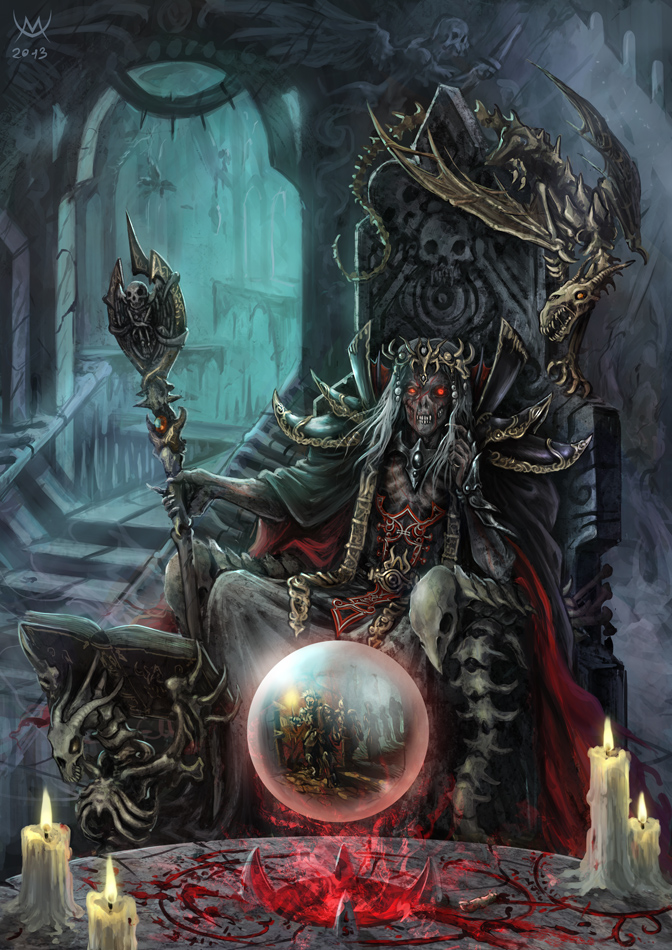
So that kind of nixed my more overt homage to Warhammer and Nagash (although I still love the recent artwork of him, and may find a way to use it, if possible)--the Dweomer Lich is going to be Tarush, the Fallen Charnel God.  In both versions of the setting--CULT OF UNDEATH and DARK•HERITAGE.  Because why make it different?

A few other names harmonization things: For Tarush Noptii, depending on whether you look at the entry here for the blog, or at the map (which is still private--never digitized and hand-drawn on a poster board, for now, the capital city is either ƈrdely or VĆØzhok, whereas I came up with the name Grozavest for Prezov.  All three are from Hungarian and are deliberately meant to recall the Transylvania region to some degree, and to represent the Tarushan language.  I like the most recent the best, in part because it avoids diacritics and is therefore easier to type--honestly, I long ago decided that I didn't really like ƈrdely anyway, even though it is the Hungarian name for the region of Transylvania.  Especially after the scandal of Sabrina Rubin-Erdely, the totally fake journalist for Rolling Stone came out earlier this year.  Let's harmonize to Grozavest, and the name of VĆØzhok can still be used for another location within Tarush Noptii as necessary.

Anyway, although I've been very busy, having just come back from vacation, needing to catch up at work, I had some friends blow through town from their expat work assignment, and we visited with them--but I still have as a high priority open item to remap and digitize said map, the Tarush Noptii region, to be followed by the rest of the DARK•HERITAGE setting.

Friday, July 10, 2015

In case you were waiting for the movie...

Because it's always better to see a slideshow of a hike with moody spaghetti western music in the background, right?

Wednesday, July 08, 2015

Hiking!

I've been out of town for the better part of two weeks (and very busy preparing for a week or two prior to that) which is why I haven't been posting.  Check out my hiking blog to see what I've been up to!

http://lonestarhiker.blogspot.com/

And then, give me a day or two to get back up to speed; I should have some more CULT OF UNDEATH and DARK•HERITAGE updates coming in shortly.  Got some great ideas brewing for both.

Wednesday, June 17, 2015

Cult of Undeath, summary of progress

First off; I've had the idea that... maybe I can use some of my Prezov County along with my Tarush Noptii from DARK•HERITAGE and kinda sorta merge them together?  I had a number of changes I was going to make to Tarush Noptii anyway, at least in terms of geography and some names.  It occurred to me that there's no reason why the two can't essentially be merged, even if I keep separate names for them for the two settings; i.e., treat one as a complete copy of the other simply with different names.  It's not like I have a lot of locations for Tarush Noptii established anyway, nor is it like any of the details I have for Tarush Noptii are completely incompatible with Prezov County.  With, of course, a few minor exceptions.

  • Prezov County is a county, ruled by an Elector Count, who is (presumably) part of the selection process of a Holy Roman Empire type government.  In DARK•HERITAGE there is no such organization, so Tarush Noptii could never be a county and could never have an elector count.  Well, OK--that's semantics.  Unless I get involved in nation-building politics, who really cares anyway, right?
  • One of the conceits of Tarush Noptii is that it is ruled openly by vampires.  One of the conceits of Ustalav, of which Prezov County is a bowdlerization, is that the monsters are just below the surface and it is possible to not believe in them.  There are other hybrid models; Karrnath, for instance, from Eberron openly uses some undead (usually mindless undead like zombies and skeletons) as military resources, and is ruled by a vampire king--however, not openly; the vampire king poses as his own mortal grandson, who is actually dead.  I need to ask myself the following question, really: does my own bastardization of Ustalav suffer from having an openly vampiric ruling caste, or does that not even matter for the modules that I'm going to adapt.  Well, I can also ask myself the next follow-up question: does it matter if those two don't align completely between Prezov County and Tarush Noptii, and does it affect at all my effort to re-use elements of both in a hybrid manner?  And if the answer to that is no (and I think it is) then I can just keep that particular detail separate between the two settings.  It doesn't really matter, since in the Carrion Crown adventure path--either the original or my likely adaptation of it, it's not like the PCs are going to meet the king or get involved in any kind of dynastic intrigue, etc.  The only difference it will likely make, and this may be more cosmetic than anything else, is during the 5th module when the PCs get involved in vampire politics a bit in the capital.
  • Well, now that I've talked myself through the difficulties, I think I've kind of decided that having an openly vampiric aristocracy is actually kind of cool; it establishes way up front the themes of the area and its nature as a fantasy setting that feels more like a horror setting, in many ways. It also gives me the opportunity to work through more details of how I can apply this to Tarush Noptii as I go through my continued revision of  DARK•HERITAGE as part of its migration to Google Sites.  So Tarush Noptii and Prezov County converge more and more--but I'm going to continue to keep them separate for the time being.  I still don't want to forcibly adopt Cult of Undeath into DARK•HERITAGE complete with the regional details of that setting, the races of that setting, etc. so I'll keep the two extremely similar areas of the setting technically separate.
  • And I do also like the notion from Karrnath (and from Hollowfaust before that) of using some undead as a natural resource for some manual labor or conscript services.  I can find some way to use that in Prezov County and Tarush Noptii both.

Here's a summary of the names I came up with in the earlier posts.  Nice to have them all listed out, right?
  • Ialomita - small village, location of...
  • Hellstone - a former prison site, now abandoned and ruined after a fire.  Also: haunted.  Of course.
  • Mittermarkt - larger city, site of the Academy
  • Naggazz - the Dweomer Lich (obviously a variation of Dwimmerlaik) the Great Necromancer.  Despite the open nature of undead and necromancy in Prezov County (or Tarush Noptii either one), this guy is still the main Enemy.  Dead and locked away.
  • The Black Path - The cult of Naggazz, dedicated to his reanimation and reinstatement
  • Bitterwood - werewolf infested forest.  Similar in tone to Mirkwood from The Hobbit.
  • Dragomiresti - site of a former village, now infamous as a massacre site.  Abandoned, and... of course... haunted.
  • Innsburough - seaside village of Deep One cultists
  • Grozavest - capital city
  • Seneslau Lechfeld - captured nobleman
  • Spire of Neb Ankh - prison of Naggazz; his former lair/capital
  • Grigore Stefanescu - head honcho of the Black Path.

Tuesday, June 09, 2015

Gorillas in our Midst

I stumbled across an archive of my old wiki for Demons in the Mist; the very successful and very wahoo crazy "odd D&D" game I ran as a play-by-post starting in late 2008 and into the first quarter or so of 2009.  Wow, has it really been more than six years?  It has.

Anyway, I've been motivated to restart my long dormant novel project, and in looking at my past notes, I was unsatisfied with the directions I had been heading.  Thinking that a scoundrel "Odd Couple" pairing like Lash and Ricardo would actually make the perfect "first among equals" of an ensemble cast, I wanted to reread their original adventures in my Mist setting.

And I'm not done yet; I'm maybe 25% finished with the Pbp game threads which are probably nearly the equivalent of a modest novel in terms of actual amount of text.  Briefly, I had the wild idea that I could adapt the entire game--not just the characters, but the plot and everything--into DARK•HERITAGE, but the more I read of it, the more I think that's probably not really doable, or at least, if I did it, the result would be relatively unsatisfying.  The tone and feel and even the very details of the two settings are simply too incompatible for that to work.  But it has made me think two things about DARK•HERITAGE as it currently stands that I now need to address...

First; I think some of my stuff is too concentrated.  The FORBIDDEN LANDS, for example, is the specifically Lovecraftian area of the setting, with names cribbed from Lovecraft's Dreamlands sword & sorcery tales and other stories in the same public domain ouvre, like the Vale of Pnath, Carcosa, the Plateau of Leng, etc.  Do I really want that all concentrated in one area, separated from the rest of the setting?  I think not.  In my drive to concentrate influences, I found that I basically had made completely separate mini-settings with a different tone and feel.  This wasn't surprising; in fact, to a great degree, it was deliberate.  But I don't necessarily like it anymore, or desire that now; unlike in an Indiana Jones movie, the characters can't hop on a plane and have a faded montage while a red line moves across the map, and then they're in a different part of the setting with a different tone, feel, and challenges.  It would be easier, and more conducive to what I want to do if I had blended them more thoroughly; it would be better to have the slavers and onyx traders of Sarkomand more readily available rather than tucked away in an obscure and esoteric corner; it would be better to have the apes of N'gah somewhere where I can reasonably have interactions of some kind with them, etc. What's the point of having Lake Hali and Carcosa right on the edge of the Plateau of Leng and within sight (well, not literally, but figuratively) with Kadath?  Then they interact with each other, but not with anyone or anything else.

So second; a restructuring of the map of the setting is needed.  I've still wanted to come up with a new version of the map for some time, and this is the best opportunity to make it a reality.  Because my tools for digital map-making are more limited than I'd like, what I think I'm going to do is stop trying to make a professional RPG product style map, and go back instead to a Middle-earth as drawn by Christopher Tolkien type map.  I'll actually draw--by hand--the map itself, maybe do some very light/limited colorizing, and then add the labels as text on a new transparent layer.  This will be relatively easily done; I just need to find a few hours to pull it off (as opposed to many hours with my previous plan.)  Of course, a limiting factor is determining exactly how much of the map to change and in what way--I may need to go through several drafts before I'm happy with the layout of the setting.

And to come full circle; I am thinking of having Lash and Ricardo--or transparently similar characters, at any rate--be my main protagonist characters in an all new novel outline which I'll also start working on and be disciplined enough to actually finish the thing this time.

Tuesday, June 02, 2015

Cult of Undeath template, part 2

Wake of the Watcher is part 3 of the Carrion Crown, and I can actually do this particular module more or less as written.  Sorta.  The concept is that one of the artifacts stolen earlier on in the series (from the poor guy who's funeral brings together the PCs in the first place, actually) isn't one of the McGuffins needed for the ritual to bring to life the Dweomer Lich after all; it's instead a Deep One (of Lovecraftian Innsmouth fame) idol that the Black Path have stolen to trade with the Deep Ones for the actual artifact that they want, which is actually located in the undersea (actually a large inland sea-scale lake rather than the ocean in this case) city of the Deep Ones, here represented by SRD scum.  There are actually a fair number of fish-people analogs in D&D; the scum and the kuo-toa are the most similar to Deep Ones.  Wizards of the Coast decided to keep kuo-toa "product identity" however, so they are not in the SRD.  My own ruleset for m20 does have Deep Ones identified as such, and again--I'm less likely to prefer the proliferation of the same concept into a large variety of different monsters than D&D itself is prone to do.

However, the concept of Wake, as described by the designers, is to be a "reverse Innsmouth."  The PCs are meant to discover that the Deep Ones have somehow been discovered by a cabal of mi-go, who have now enslaved them.  In attempting to overthrow their new mi-go overlords, some of the scum (or maybe it's human cultists from the city) have attempt to contact Shub-Niggurath and Dark Young are at risk for manifesting (which, if I recall, is actually the climax of the adventure.)

I, again, find the concept of monsters and cultists being presented as sufficiently sympathetic that we're supposed to save them, a difficult concept to swallow, and sadly, its a recurring theme throughout this adventure path.  But that's relatively easy to work around; if the PCs need to either find the McGuffin, or stop the bad guys from finding the McGuffin, or at the very least find the clue that leads them to the next adventure--as campy, predictable and railroady as that concept kind of is--then we at least have sufficient motivation to play the adventure out more or less as written, even if they don't want to bother saving the cultists of Illmarsh (Innsburough--let's be plenty clear what we're pastiching here) or the Deep Ones--which seems to me to be perfectly reasonable--they still can explore the area, have the requisite encounters, and whatnot.

I certainly won't include the detailed exploration of the caverns below the city where the Deep Ones live, because again--dungeons.  I don't do them.  I dislike strongly the blinders that module designers have where they can't help but turn everything into a dungeon.

When we get to the penultimate adventure in the arc, we--again (sigh)--find ourselves meant to ally with the monsters, and save vampires from something worse than vampires or something like that.  In the backstory of the campaign, in the waning days of the reign of the Dweomer Lich, many vampires turned away from him, looking instead to capitalize on their parasitic relationship with humanity and therefore foster their continued existence.  The Black Path adherents, however, have allied with a coven of witches and made a deal with them in which they brew a potion or elixir which is like a drug to lesser vampires, particularly spawn.  Hooking a lesser vampire with this, they've convinced him to betray the vampire hierarchy in the capital city (Grozavest).  This guy has been running around murdering vampires secretly and framing a patsy for it.  He's also moved quickly up the hierarchy of vampire social status in the meantime.

The PCs are meant to enter this entangled web of deceits and to some degree sort it out.  They may well have little or no sympathy with the entrenched vampire hierarchy and may in fact well celebrate the fact that it's being destroyed, but the fact that it's to be replaced (in the mind of the young vampire responsible for the murders) with a younger, more aggressive, less cunning generation of vampires means that it's likely worse for the poor citizens of Grozavest.  Also; there are two side effects of the success of this scheme; the Black Path gets the last item that they're looking for in their quest of a string of McGuffins and can go attempt to bring the Dweomer Lich back.  This is, of course, the whole deal that the PCs have been chasing after the entire time they've been playing this.  However, we introduce another wrinkle; the two witches are trying to reform their hag mother, who has been stuck in a swarm form for years, by gathering all of her bones and assembling them together.  That's the stake they have in this whole thing, and what the Black Path has bartered for their help.  Stopping this from happening, or better yet, putting the entire trio out of their misery, is a great secondary goal.

In the final chapter of the series, a very prominent nobleman (Seneslau Lechfeld) has been kidnapped; supposedly if the various McGuffins are used on him, the spirit of the Dweomer Lich can possess him and thereby return to the world from its trap in the tower/prison in which it remains today (the Spire of Neb Ankh.)  The PCs have to race to the sinister cursed lands surrounding his ancient capital, work their way through various undead haunted areas to confront the head honcho of the Black Path (Grigore Stefanescu) who has by now himself turned into a powerful lich, and stop him from enacting his ritual, save the damsel in distress (who happens to be a man, sorry) and halt the plans for the return of the worst villain the entire campaign setting has ever known.

There's also a gratuitous slam at right-wing type guys because on the way, you're supposed to find a group of crusaders falsely accusing a "witch" of being a witch or something.  Blah.  I'll absolutely either cut or completely change that one.

While numerous details of this don't appeal to me, and the structure of the entire thing feels way too much like simple slogging from one combat to another without anything more interesting happening, at a rather basic level, I think it works fairly well and I'll probably approach this with a slightly lighter touch than I have some of the previous chapters in this arc.

There's some interesting suggestions at the end for continuing the campaign from there.  One is that our damsel in distress, Seneslau Lechfeld, starts having visions after his experience of the seals that hold the Dweomer Lich captive failing.  He has reasons to believe that there's something to them, so he contacts his trusted friends and rescuers, the PCs, for help.  Another suggests that the hag mentioned in part 5 is reborn.  Another is that the vampires from part 5 have an all-out vampire war break out in the capital city.  Another is that various former lieutenants of the Dweomer Lich from the time of his undead rule manage to sit up and take notice, etc.

Anyway, we'll see.  Clearly, I'll have some work to do to clean this up into something that will resonate for me personally and my tastes, and the slightly bohemian "misunderstood monsters" and "evil intolerant crusaders" vibes will have to be excised as well as the dungeons, and if I can figure out how, the heavy-handed railroading that the modules assume.

Friday, May 29, 2015

Cult of Undeath template, part I

In order to both decide what needs to be included in my bowdlerized version of the Ustalav setting, and how to modify the modules to be what I want them to, I need to go back through them and keep less unwieldy summary handy.  For this post SPOILERS ALERT I'm going to summarize the modules, both for my own benefit, so I have a template on which to work, and a guideline for where this campaign will go.  It also gives me a guide as to what locations I need to include in my homebrewed up reflection of Ustalav, so I can go on a hunt for names.

Keep in mind SPOILER ALERT that I'm writing this from the perspective of a GM running this thing.  If that's not you, and especially if you're possible to play this adventure path, you should avoid this post.

Enough SPOILER ALERTS yet?  Don't read if you might play the Carrion Crown.

First, The Haunting of Harrowstone is the module that kicks this whole thing off.  It starts off in a small rural town (Ialomita) that is infamous as the site of the worst prison in the entire realm (the Hellstone).  However, about fifty years ago, the prison was destroyed in a fire during a prison riot, and the prisoners, warden and many of the guards were all killed.  As you can imagine, the place is haunted and no small part of the adventure includes an exploration of the Hellstone and the putting down of five infamous serial killers who are now ghosts.  There are no other locations necessary for this adventure, but it makes reference to the larger city with a major Academy that's also in the Realm somewhere (Mittermarkt.)  It also introduces, via shadowy hints and clues, that there's a sinister force, the cult of the great Necromancer (Naggazz) also known as the Dweomer Lich, that's running around causing trouble, although at this point, little of their goals or even their presence will be detectable.  The PCs show up for the funeral of a friend, which involves them, via a somewhat contrived railroad, to stay in town for a month, and have to deal with the failing of the barriers that keep the ghosts of the prisoners confined to the ruins of the Hellstone.  They'll almost certainly also pick up on clues as the nature of the death of the friend--who was murdered by the cult of Naggazz--and they're also obligated as a stipulation of the will, to return some sensitive books to the Academy mentioned above.

So to kick all of this off, I merely need to name two places; the village in which they start, and the city in which the Academy is located.  I also need to decide if I'm going to stick with Naggazz as the name of my Great Necromancer, and give some kind of name to his cult (which I think I'll keep simple and just go with the Black Path.)  I discovered, or at least guessed, that Nagash is an alternate spelling for Najash or Nahash (or Nachash) is the Hebrew word for snake, and is thus the word used to describe the serpent in the Garden of Eden.  It seems most likely to me that the good folks at Games Workshop meant for Nagash to be a subtle reference to the Devil himself.  That makes me like the name even more, of course, although I won't necessarily stick with the Naggazz corruption.  I also don't want to be obviously doing the exact same thing as Warhammer, though.  Melek Taus, the name of the devil to the devil-worshiping Yezidi is another option with a real world origin.

Because I'll be setting the tone for the entire Realm, I'll also need to just establish some minor backstory.  I've called it a county already, and the reason for that is that I want to emphasize that it's a small, Ruritanian-style realm.  The ruler is an Elector Count, and the character of the country should be like that of the eastern Austro-Hungarian Empire; a combination of rural eastern Europeans (i.e., I'll re-use my Romanian name list) combined with German names as well.

The second module, Trial of the Beast, will require more work on my part.  It only takes place in and around the city above with the Academy; Mittermarkt, called Lepidstadt in the original.  It's basically Frankenstein's monster who is captured and due to a quirk of someone's idea of justice, rather than simply being put to the torch, it's put on trial.  The twist in the plot here is that the beast is innocent--at least of these specific murders for which it's being put on trial--and its secret creator is the real monster, although he's supposed to be sympathetic too, because he's sad about his family or something.  Yeah, yeah, yeah--I've read Mary Shelley and I know that's kind of the point (at least to some degree) but the whole thing feels a little too White Wolf: The Impotent Whining to me.  I don't want to run a module where the PCs are running around trying to keep a monster from being framed for murders.  I mean, I guess I could go all Primal Fear on them and keep it interesting, but I'd rather just rework the entire thing.

From a meta-perspective, the point of the module is that the Black Path has come after the creator of the beast in their standard "collect enough McGuffins" quest, which is where the PCs get their next clue which is meant to lead them into the next module.

For Broken Moon, the PCs, now actually directly trying to track down the cult, find themselves stuck in a wild forest where the assassination (by the Black Path) of the most powerful werewolf in the region has thrown the entire werewolf community into disarray.  Here the PCs must negotiate politics between evil demon werewolves and... slightly less evil regular werewolves, or something.  Again; lots of fighting of werewolves, but there's a kind of sympathetic ring to at least some of the "misunderstood monsters" that doesn't ring like it belongs in any kind of horror story.  This may need some reworking too.

Of course, they also get sent out to an old battlefield where the cultists are digging up bodies to reanimate them to have an army ready for the Dweomer Lich.  Here they fight undead/necromancers and get the next clue.  For locations, I need a reasonably large, dark Mirkwood-like forest (again; let's keep it simple (the Bitterwood), and a haunted area that was once the site of a great slaughter and which has now been salted and cursed into complete uselessness (the abandoned and deserted village of Dragomiresti.)  This one may require some rather significant rework as well.

Next time; the next three modules.  This post is longer to write than I expected because I have to skim through all of the modules to summarize them, so I'll split it into two.