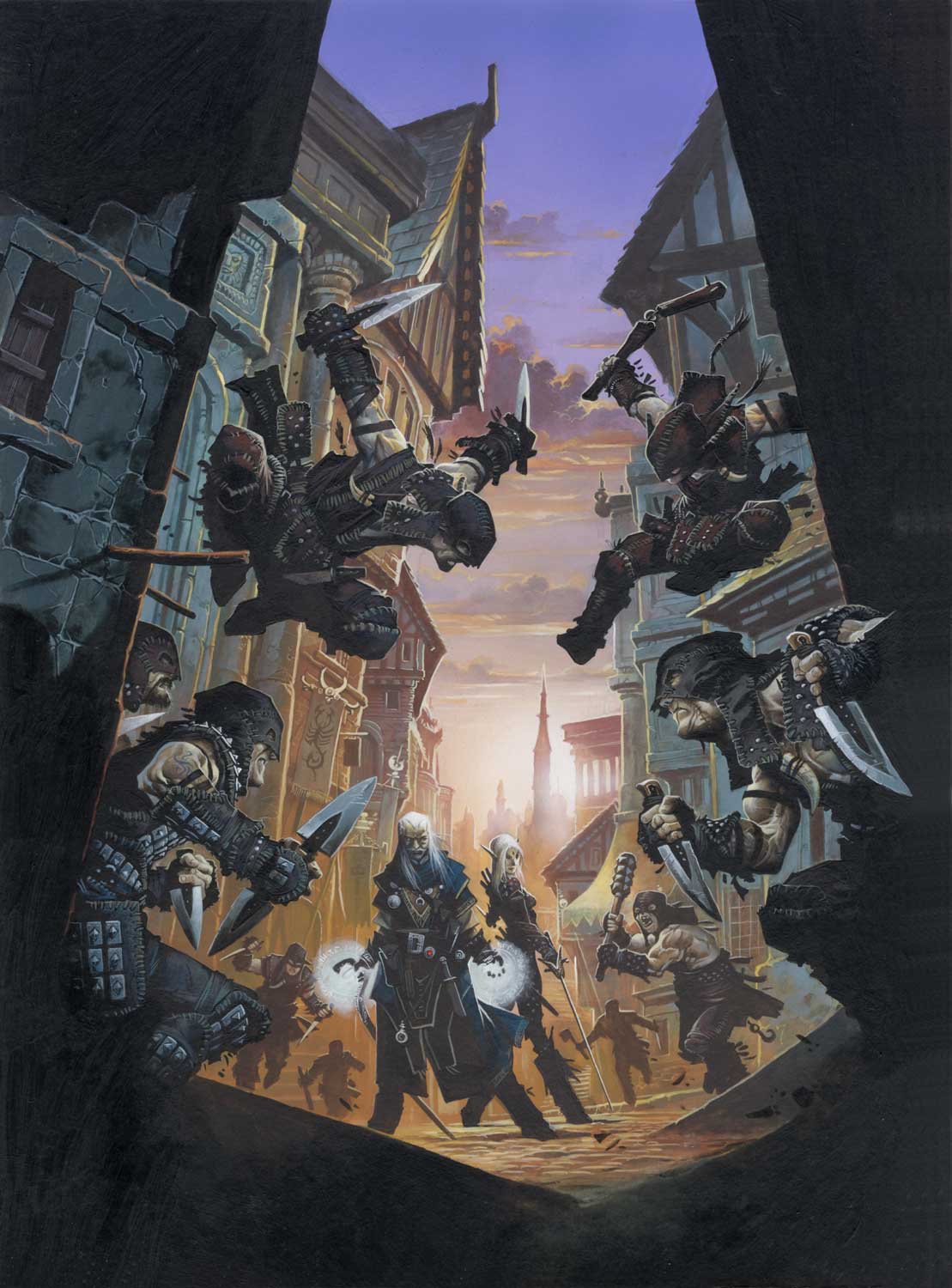
Wednesday, July 08, 2009

Taldor: Echoes of Glory

Just read the quick little book Taldor: Echoes of Glory from Paizo last night. The Pathfinder Companion series are short little books, 32 pages. About a third of the book is a description of the country itself, a third is a description of Oppara, the capital city, and a third is mechanical options like a prestige class, some spells, feats, and NPCs.

Taldor as a setting element is kind of interesting; it's got a lot of clear (and purposeful) correllations to the late Byzantine Empire (including even an analog to the Varangian Guard); it's a country on the brink, teetering towards dissolution. Maybe not even teetering, a succession crisis is brewing as well. Qadira even works as an analog to the Ottomans (or the Sassanids before that); a powerful Eastern rival with smoldering border conflicts and territory that often goes back and forth.

Although the book was a very interesting read, one thing that I don't think it did as well as some of the other Pathfinder books, however, was give immediate and obvious adventure hooks. The text is great information for supporting games, but if you set a game in Taldor, what do you actually do? I'm not sure. I mean, I'd have to think of it myself; the book itself doesn't immediately suggest a lot of gaming activity. There's some vague mention of brigands and river pirates, and it says in several places that ruins abound due to the decayed state of the empire, but that's not much to go on, and it's kinda generic to boot. Maybe Paizo doesn't really see that as a problem; they are primarily, after all, an adventure publishing company, and this Pathfinder Companion product line is supposed to merely be support. I don't know that I see it as a problem either, because I've been running games for a long time and am confident I can think of plenty of things to do. But it's worth noting.

The next volume in the series is Qadira and after that Cheliax, both areas of the Golarion setting that interest me greatly (enough so that I wish they were getting the larger Pathfinder Chronicles treatment rather than the relatively more abbreviated Pathfinder Companion treatment. Oh, well.) I imagine I'll pick both of those up in short order as well. In the meantime, I'm still marching through Monster Manual V and have picked up my copy of Dark Markets: A Guide to Katapesh to read (and review) next.

Tuesday, July 07, 2009

Balor ilo


I'm curious in an academic sense about the upcoming release of the Pathfinder RPG by Paizo Publishing, a kind of "3.75" Edition D&D alternate. I'm not actually interested in updating my 3.5, to be honest with you, but I might grab a handful of house rules from the betas of that game that I've got from them.

I am, however, very interested in what Paizo is doing with their setting, the Golarion setting, which I've reviewed here in the past. I've got many of their setting books, and I think they're excellent. And although I'm not actually a huge fan of the concept of published adventures, Paizo's are genuinely fun to read, and even if I don't run them as is, they've got tons of stuff I can "borrow" including great monsters, locations, NPCs, and just concepts in general.

As part of their Pathfinder RPG, they're releasing their own version of the monster manual, and they've put up a few art samples. Here's their version of the balor (I presume; it wasn't actually labeled as such), and frankly, it's one of the best illustrations of that iconic, balrogish monster that I've ever seen. The four eyes makes it look just alien enough that it differentiates itself from other balrog rip-offs, like Warhammer's bloodthirster, for instance.

Good stuff. Congrats to Paizo for putting together what looks to be (yet again) another quality product. I'm a big fan of their writing, their design, and---for that matter---their production values, which I think is an often overlooked and undervalued commodity in the RPG business.

Monday, July 06, 2009

Libris Mortis

I finished Libris Mortis, actually a few weeks ago before leaving town. All in all, I found it the least impressive of the monster speciality books, which is disappointing, because undead are incredibly iconic to the fantasy genre. In fact, I'd daresay I have more occasions to use undead than dragons by an order of magnitude, but the text in this book was fairly flat. It did little to make undead seem "alive" (no pun intended) or much more than a mechanical challenge for the characters to face. The new monsters section was fairly underwhelming. I found finishing the book to be a chore. Even the organizations near the end, and the alternatives for various monsters---sections I was looking forward to---didn't impress me much.
 
Of the series as a whole, I think Hordes of the Abyss is my favorite. It's extremely well done, the subject matter of the book is very iconic and interesting, and it's engagingly written and the ideas spark the imagination. It's diabolic counterpart is also good, although Hell as corporate cubicle culture was either an extended joke that went on too long, or just plain not that great an idea in the first place. But in general, the series quality overall has been excellent, and I have little but good to say about Lords of Madness and The Draconomicon too. Which is why Libris Mortis is so disappointing; it's not that it's a bad book by any means, it just feels very pedestrian and boring compared to its collegues in the monster speciality subseries.

In any case, I've moved on to Monster Manual V for now. I think my next gaming book forays may be into some Paizo material that I've had for some time, but not read because the format is so difficult for me to work with. I'm actually going to buy some hardcopies of books I already own on pdf, and I've learned my lesson not to go that route anymore thinking that it's a time saver and a convenience. Clearly, at least for me, it has not been. Maybe if I had a laptop it would be different. And maybe in the next year or two I will have one. But for now... it's been difficult to read pdf books, and I've made very little headway on books that I've owned, literally, for years in some cases.

Tuesday, June 16, 2009

Monday, June 15, 2009

3e wishlist

Every once in a while, I like to make lists. I may have made this list before, in which case it probably hasn't changed too much. This is the list of 3e (or 3.5) books that I want to buy but still never got around to. Actually, that's not exactly true. This is the highish priority list. There's a few more also that I wouldn't mind picking up, although I wouldn't go too far out of my way for them. Anyway...

The rest of the Complete series that I don't already have:
Complete Mage
Complete Arcana
Complete Divine

As you can see, I don't much care for spellcasters. I mean, heck; I've already got Complete Psionic for cryin' out loud, before I got any spellcaster completes. But; I want to complete the set.

The rest of the monster manuals:
Monster Manual IV

Yeah, that's it. I count Fiend Folio as a MM. But I've already got it.

The rest of the environmental books:
Sandstorm
Stormwrack
Cityscape

I actually am not counting Dungeonscape. I don't care about that one. I've actually only got Frostburn, but holy crap, great idea for a line of sourcebooks.

Other books I want that aren't exactly part of a series per se:
Player's Handbook 2
Heroes of Horror

That's nine books. In nine books, I could be done.

Of course, I could also be not done. If I get past those nine books, I've got another list of lower priority books to buy.

The rest of the Races series:
Races of Stone
Races of the Wild
Races of the Dragon

I bought Races of Destiny on the cheap years ago, and I wasn't impressed with it enough to make a point of collecting the rest. But, probably, one of these days I'll get around to it.

Two of the Complete books I've never been that interested in, but the completist in me will probably eventually drive me to buy:
Complete Champion
Complete Scoundrel

A few other books, that belong to no series per se that I can percieve:
Magic of Incarnum
Tome of Magic
Tome of Battle: The Book of Nine Swords
Spell Compendium
Dragon Magic

So; ten more. Low priority, but still; I'd eventually like to have them.

Of course, then we start on the Forgotten Realms and Eberron books that I don't have.

D'oh. I've got a lot of buying to do after all.

Still; only the first nine are really "high" priority, and by "high" I mean, even though they've been out of print for a year and a half (or longer) I still haven't gotten around to buying them. High being a very relative term in this instance.

Fantasy subgenres

As a self-professed genre-bender, who likes to mix and match fun genre conventions regardless of origin, you'd think I wouldn't care much about the rather nitpicky and esoteric subgenres of fantasy, but actually, I think that they're quite interesting to examine. As a reader, occasional writer, and long-time fantasy roleplaying game fan, I also care quite a bit about the "feel" of certain genres, and often try to implement this feel regardless of other conventions sometimes.

This list isn't meant to be exhaustive, although it does catch most of the major categories.

High Fantasy: The grand-daddy of them all. Well, not really, but High Fantasy is what so many people think of when they hear the term fantasy that for all intents and purposes, to them High Fantasy is synonomous with Fantasy. High fantasy usually takes place in a secondary creation (i.e., a fantasy world, not the real world), often includes quests to save the world, often includes a dynamic of good vs. evil, and often follows such conventions as Campbell's Hero's Journey very blatantly, including the farmboy turned hero/king. Tolkien's Lord of the Rings is High Fantasy, for example.

Sword & Sorcery: This is the other major pillar on which most modern fantasy rests, and it was pioneered by writers such as Robert E. Howard, Clark Ashton Smith, Fritz Leiber, etc. S&S does not feature "save the world" as a plot element, it is often told in short story format, the protagonists are often fairly amoral guys, looking for adventure and glory rather than higher ideals. It's focus is on exotica, action, and fast pacing. S&S originated in the pulp magazines (especially Weird Tales of the late 20s and early 30s) and as such, it bears a strong helping of the "pulp aesthetic." As already mentioned, the most prominent and iconic Sword & Sorcery fiction is the Conan cycle of stories by Howard.

Heroic Fantasy: This is a slightly unclear definition, and seems to be used most often to label something that would include both High Fantasy and Sword & Sorcery, making it an umbrella term of dubious value. However, it's worth pointing out that games like Dungeons & Dragons, which feature an intriguing mix of High Fantasy and Sword & Sorcery conventions mixed together, is perhaps best served by this label.

Low Fantasy: This is probably a bad label, but you may see it frequently. It's defined more by what it's not than by what it is, i.e., it's not High Fantasy. So, this includes Sword & Sorcery, for example. And dark fantasy

Dark Fantasy: Best described as a hybrid between horror and fantasy. Some dark fantasy "leans" more towards one endpoint or the other. Dark fantasy is also often "non-heroic" i.e., characters are vulnerable to nasty death at every turn, often don't have plot immunity, and the grittiness and "realness" of life is emphasized. Glen Cook's Black Company series could be considered dark fantasy (as well as other things), as could George R. R. Martin's Song of Fire & Ice.

Contemporary Fantasy: Fantasy that doesn't take place in a pseudo-medieval setting. It could be, literally, the real world of today, or it could be a fantasy setting with modern trappings. The most obvious and popular contemporary fantasy today is J. K. Rowling's Harry Potter series.

Urban Fantasy: A subset of Contemporary Fantasy, urban fantasy takes place in the dark alleys of the modern metropolis. Growing out of a dark fantasy/horror scene, urban fantasy features a lot of overlap with that scene. The Anita Blake and Dresden Files novels are a great example of Urban Fantasy. For that matter, so is much of the World of Darkness line of roleplaying games from White Wolf.

Romantic Fantasy: Fantasy mostly written by women and targeting a women audience, this subgenre combines elements of traditional high fantasy with the romance novel. Mercedes Lackey wrote a ton of this kind of material, and a roleplaying game by Green Ronin dedicated to it even came out, Blue Rose. I don't know how successful that game was, but it was the direct predecessor to the True20 system, so it's worth it for that alone, if nothing else. In case a bit of bias is showing through here, I'll go ahead and officially say it: I have yet to read a single book of this subgenre that I like, and I actively avoid it now.

Science Fantasy: Perhaps not so much thriving subgenre in its own right as opposed to a label retroactively applied to a few works that don't easily fit in other subgenres, science fantasy is a subgenre of fantasy that has science fiction trappings, but other conventions (and even cliches) from high fantasy, or other fantasy works. Frank Herbert's Dune is probably one of the earliest well-known varieties of this, but the Star Wars franchise is usually what it meant when this label is applied. Of course, things like Warhammer 40k could also be called science fantasy, and for that matter, you could easily retroactively call a lot of space opera science fantasy today, like E. E. "Doc" Smith's Lensmen series.

Historical Fantasy: As the name implies, this is fantasy that takes place in a historical setting. Celtic fantasy, Homeric fantasy, Arthurian fantasy, etc. If it takes place in the real world, using real (or real legendary) characters, at least as window dressing, if nothing else, then it's historical fantasy. Regardless of how much magic, monsters, dragons, and whatnot happen to infest this fictional real world.

Epic Fantasy: You probably hear this term a lot, but it is unclear. Some people use it to mean something that's identical to High Fantasy. Others use it to refer to how long a work is. Neither is a particularly useful definition, in my opinion, so I tend to ignore this label as nonviable.

Thursday, June 11, 2009

Parralox

New musical discovery, y'all. Parralox, an Australian synthpop duo that's been compared to Dare-era Human League, and fairly too, in my opinion. They've got a full-length CD out, and a remix single for the song "Sharper Than A Knife" which I'm embedding from Youtube.

Love this stuff.

Tuesday, June 09, 2009

D&D Horror

"Mr. Joshua, why in the world would you want to use the rules of D&D for horror?" I can already hear the cries (actually, I can; I started a discussion about this on one of my gaming messageboards, and right off the bat, the idea of "why don't you use an existing horror game?" came up.)

The reason is: everyone has D&D. Everyone who games, that is. The rules are right there, easy to find and nobody needs to relearn them. And even if you don't, hey, online SRD. They're free. Plus, D&D has tons of horror influences. Vampires, zombies, demons, Cthulhu-esque monstrosities; the game is rife with this kinda stuff.

What D&D doesn't have is a paradigm appropriate for horror. In D&D, you're expected to charge heroically into battle against the horrors of the night and smite them or whatever. In a horror genre game, you do that, you're dead or worse. Every time.

I think a few other small mechanical changes can help encourage players to keep in mind the paradigm that, even though we're using D&D rules here, we're actually playing Call of Cthulhu.

1) Level isn't necessarily something that players scale like a ladder. I can pick a level that has the PC power and capability that I think is appropriate for the game, and peg it there. All players create third level characters. You don't ever level up. Ever.

2) That doesn't mean that you can't have character advancement. You still get experience points. You can spend 1,000 to gain a skill rank (up to the maximum skill rank at 3rd level, which for class skills is 6 ranks) and you can spend 5,000 XP to gain a feat.

3) Forget CR. Forget wealth by level. Forget dungeoncrawling for profit and thrills. They are completely inappropriate for this genre. For that matter, be very cautious about combat. A primary theme of horror is that you're in over your head before you start. A straight up combat, unless it's with regular guys, cultists, or whatever, is one that you can expect to lose. You've got to be more clever than that.

4) 3rd level means any magic using classes have 2nd level spells. At best. If, for some bizarre reason, you really need higher level spells than that, they'll have to be converted into incantations and cast outside of combat. And expect to pay a hefty price for them while you're at it. Magic is unknown and scary, not a utilitarian tool for PCs to wield with impunity.

5) Still casting around for a potential fear/madness mechanic. I've actually got lots of options; I'm trying to figure out which one I like best.

Anyway, any comments? Other than that the image I picked for this post is only, at best, tangentially related to the topic at all by virtue of being a Google Image Search result for horror?

Monday, June 08, 2009

Monsternomicon II

I quietly removed Monsternomicon II from the "What I'm Reading" list. Not that I'm not reading it (slowly), just that I don't think it should really count, as I have read it before.

The two Monsternomicon books are almost unique in terms of monster books compatible with D&D. They're fascinating to read. Every single entry screams with flavor. Every entry is enjoyable ( enjoyable! really!) to read. There are very few gamebooks that I read more than once, and very few that are actually really fun (as opposed to utilitarian) but the Monsternomicon books certainly fit that bill.

Friday, June 05, 2009

New book

You may have noticed (most likely not) that I quietly put away the image of Blood and Honor in the "What I'm Reading" sidebar, and replaced it with one of The Dying Earth, the first of the Dying Earth series by Jack Vance. It was simply taking me too long to get through the D&D novels, and I, frankly, wasn't enjoying them enough to attempt to renew them at the library for a third time. So, back they go, the last one unread except for a few pages in. I'll try it again some other time.

In the meantime, I've never actually read Jack Vance. The Dying Earth is not really a novel per se, but a "fixup", which means that it is a series of loosely related short stories that have been strung together, bridged, slightly modified and framed to approximate the form of a novel. So far, I've only read the first of the short stories that is essentially Chapter 1: "Turjan of Miir."

Interesting stuff. I'm not going to say that I've been blown away by its brilliance (nor that I expected to be) but it's one of those kinds of things that pretty much every fantasy fan, and particularly D&D fans are expected to have read, so I figgered I better get on the bandwagon already.
Anyway, because I have more than one cover image, I'm attaching a different one to this post than I have in the "What am I reading?" sidebar. Actually, the version that I'm reading has neither cover; I'm reading an omnibus edition with all of the Dying Earth series combined.

Wednesday, June 03, 2009

RIP David Eddings

I'm not actually a big fan of his (and I've been guilty of making fun of his work many a time, and his characterization of fantasy fans has at times bordered on insulting) but the original Belgariad series is still a decent read. So, it's with some small sadness that I announce the news that David Eddings passed away at the age of 77 last night. It's been floating around the sci-fi and fantasy news circuits today, and I just stumbled across it.

The Grand Unification Theory of Supernatural Evil

It's been more than twenty years, but the last time I was formally trained in physics, the Holy Grail of physicists was the Grand Unification Theory that would link conceptually the strong and weak subatomic forces with the electromagnetic force and gravity. To be honest with you, I'm not that concerned with unifying forces that occur at a subatomic level, but I am interested in merging forces that seem redunant. (We still haven't proved that those forces are redundant, for one thing.)

In particular, the genesis of supernatural evil in D&D is… overdone. The Monster Manual is rife with creatures that are supposedly powered by, if not generated by, supernatural evil force. Add in the other monster books and quickly this gets out of hand. You've got devils, demons, daemons (or yugoloths), demodands, night hags, kythons, hordlings, rakshasas, and… oh, I dunno, literally scores more of individual monsters that don’t belong to a greater class per se.

You've also got Undead, which are powered by Negative Energy. Conceptually, negative energy is quite silly in my opinion, and really at the end of the day, its just another euphemism for evil.
Why does D&D have this? Is it an artifact of any cultural genesis of the creatures being represented, i.e., a folkloric or mythological basis for this? No, absolutely not. If anything, folkloric and mythic basis would argue for a Grand Unification of Supernatural Evil. Does it make sense from a cosmological scheme endemic to D&D? Not really. Kinda sorta, in that several of the varities of fiend are there to represent the nine point alignment system, which makes, fundamentally, three kinds of evil which are separate from each other. And Negative Energy is the counterpart of Positive Energy. So, there's a weak endemic situation that this explains, but not well… it fails to explain a lot of other supernatural evil creatures, for example, as well as being… again, conceptually kinda silly. I don't like it, in other words.

Rather, I'd like to turn to a more folkloric basis for supernatural evil for my games. Something that's more consistent, which allows for as much variety as you want, yet has the same underlying philosophy behind it. A Grand Unified Theory of Supernatural Evil, if you will.
From a fundamental metaphysical level, then, this post will describe my "ideal" cosmology a bit more. This borrows somewhat from Judeo-Christian and Islamic thought (as does "mainline D&D") but I'm not attempting to make any comment on that. My sole purpose is to create a scenario that facilitates the kinds of games I want to run. This is because it makes it easier and funner for me, and for no other reason.

So, I'm also a "hands-off" kinda guy when it comes to cosmologies. Did the universe just appear, complete with metaphysical context one day, or was it created as such by some divine agent? I don't even want to answer that question, and evidence points both ways. One piece of evidence that points for the latter interpretation is the existence of spirits, intelligences, or sentiences of "evil"---those whose purpose is to undo the universe, or those that live in it. Where did these spirits come from? What is their genesis? Even they don't know. It's possible they simply appear as forces of cosmic opposition, although others have theorized that they come from "outside" creation somehow. These sentiences and forces animate undead as well as take corporeal form as various fiends. They don't choose to do so, but the end result is the same. Undead that contain the spark of the person they were prior to becoming undead are actually a fusion of a living mortal soul and this evil spirit.

For the most part, prior to incarnating as a fiend, these spirits are unaware and largely insentient. A very few exceptions exist; spirits that remember multiple lives as different types of evil creatures, but none of these remember their genesis; their memory does not stretch all the way to the beginning.

Non-supernatural evil, of course, requires no explanation. People are just bad. Frequently.

Monday, June 01, 2009

Expanded Psionics Handbook

I've had this book for many months, but I hadn't read it all the way through until... well, until just a couple of hours ago, actually. In fact, I didn't even buy it until very late, since psionics was loaded into the SRD, and I didn't think I really needed it.

It's one of those books that's actually difficult to read; mostly mechanics with very little flavor. That said, psionics has always interested me as a totally new way of doing magic. I don't actually think that psionics alongside divine and arcane magic is all that interesting, but psionics instead of divine and arcane magic is a topic that fascinates me.

In any case, the book is pretty solid. The mechanics are cleaned up and better all 'round than the original 3e Psionics Handbook. I've gotta believe that this product only serves a niche market, but I happen to fall into that niche.

The notable thing to me is that psionics is very much simply magic. Lots of D&D players will tell you (or at least I've seen this expressed frequently) that psionics is too "science fictiony" for their tastes. This obviously doesn't turn me off, because I've expressed here before how I like the combination of science fiction and fantasy (and horror) elements in the old-school, classic "weird tale", but in this case, it's particularly irrelevent. There really isn't anything science fictiony about psionics, at least as presented here. It's really just nothing more than magic, except with different mechanics.

In the Claws of the Tiger

James Wyatt's Eberron novel, In the Claws of the Tiger, is another surprising jewel in the War-Torn series. In case you've missed it so far, this "series" features a completely different author for each volume, completely different characters, and no ties other than that they're all part of the Eberron campaign setting. I'm not quite sure why they get binned as a "series", other than that they have the same layout and cover artist. Even the title isn't necessarily descriptive; the first volume didn't feature characters who were unduly affected by the war, or anything. Which is odd, because considering the scope and timing of the war, you'd think an author would be hard-pressed to not have his character impacted by the war.

Anyway, all that's neither here nor there; James Wyatt's novel is, as I said, actually pretty good. It's a fairly breezy "Indiana Jones" esque foray into a set of ruins buried in the desert of the southern continent "of adventure", Xen'drik. It features travel across the face of the setting, intrigue, betrayal, a Belloq-like character who exists to be the anti-protagonist who thwarts him repeatedly. There's romance, danger, death, undead, demons, and more. Fun plot, well-developed characters, reasonably witty banter and dialogue, fun settings... it's got everything you could want from a light-hearted pulp-inspired adventure story, and ranks up there among the better D&D specific novels I've read. I do quibble a tiny bit with the game mechanics "showing through" the text on occasion, but it's not nearly as bad as I've seen in some other D&D fiction. In fact, to some readers, that may even be a positive. To me, however, the fact that they needed to find a substitute for the missing "cleric" smacked of "we need the typical well-balanced party structure, otherwise game balance will be affected" rather than something that I could accept in the prose of the novel. I prefer to forget that I'm reading a novel based on a game, and just think that I'm reading a novel. Period. The description of magical healing and damage reduction also reminded me forcibly that I was reading a D&D novel, not just a novel, when it could have been written in such a way that it was more subtle.

But, that's a fairly minor quibble, really. I thought the book was reasonably fun, fast-moving and easy to read, and a great example of what a prototypical Eberron campaign could be like with a good GM who gets the vibe of the setting and is able to see beyond the typical D&D paradigm. I highly recommend it to someone who's looking for D&D specific fiction to read, and I don't mind recommending it to any fan of fantasy literature, regardless of association with the game or the setting, although in that case my recommendation is a little bit more guarded.

Another fairly minor quibble, that this book shares with The Orb of Xoriat; I have no idea what the cover art is meant to portray. The main characters do indeed come across tiger-men in Xen'drik. However, that's in a desert ruin that should look more like the archeological dig site in Egypt where Indy finds the Ark of the Covenant, not in the jungle. I'm also not sure who the characters are: the tiger-lady is never described like that (although that's an artistic liberty I'm OK with, since she looks cool) and the main characters are also not all recognizable based on in-novel descriptions. There's also no scene in which the tiger-lady queen and her soldiers ambush the main characters in the wild.

Friday, May 29, 2009

The Orb of Xoriat

Although it took me a few weeks to read it, that was a factor more of my distractedness by other things than a commentary on the quality of Edward Bolme's The Orb of Xoriat. Orb was actually one of the better D&D fiction novels I've read, and miles above its predecessor, The Crimson Talisman. It really "gets" the Eberron vibe too... it reeks of The Maltese Falcon or Casablanca... basically the main character is a spy/assassin, who's on the lookout for a magical super-weapon that was stolen by another spy from another nation. The structure of the book is not too unlike Frederick Forsyth's The Day of the Jackal where you go back and forth from the Jackal himself and the gendarmes officer who's leading the charge to find and stop him. This book goes back and forth between Teron, an Aundairan monk, and The Shadow Fox, a Cyran spy, who's stolen the titular Orb of Xoriat.

Nobody's really a good guy. There's a megalomaniacal gnome that gets involved and becomes part of Teron's group. He, in turn, has a half-orc butler/bodyguard called Jeffers who becomes one of the most sympathetic characters of them all.

The book is fast-paced, it's an interesting twist on the fantasy genre, it's reasonably well-written, and I don't hesitate to recommend it.

The only thing it lacks, is some more development. All of the books in this "series" are within about 5 pages of each other in page-count, so I presume that a strict wordcount quota was given to the authors. And, although I won't say this much in the fantasy genre, which I believe is flooded with over-written, needlessly verbose, overly long stuff, in this case, the book felt rushed. The characters were under-developed, and the plotline raced forward leaving behind too many unfinished and unresolved loose threads. If you look at mainstream thrillers, which the structure of this book quite remarkably resembles, you'll see that most of them are longer than this book too.

This, sadly, leaves us with a book that's pretty good... but I can sense an even better book struggling to get out, but perhaps stunted by the formatting requirements of the publisher. Pity. Another aside of an observation; the scene on the front of the book never actually occurs. Those three characters are recognizable (sorta) as Teron, Praxle the gnome and The Shadow Fox, but at no point do the three of them engage in combat with ghosts. In fact, only extremely briefly are the three of them on screen at the same time at all, and when that happens, they're fighting with each other.

Anyway, I've already started on the next book in the "series", James Wyatt's In the Claws of the Tiger, which also (so far) seems to scream the Eberron-vibe really well, and seems to also be more engagingly written than much of this subset of the genre tends to be. I'm hopeful that it'll turn out well too.

Wednesday, May 27, 2009

Sabertoothed... hyena lizard?

I was poking around online for a picture of the cover of Piers Anthony's novel Phthor for a discussion online about some of the worst science fiction and/or fantasy novels we'd ever read. This one takes the cake, largely due to the minionettes, cloned women who somehow got messed up and who get turned on by rape and masochism, but who die if anyone actually loves them. Turned me off Piers Anthony for years, and I can't say that the damage was ever completely undone, because it's not like the Xanth novels were so amazing that they made up for it or anything. Anyway, this is also apparently the sequel to another novel called Chthon, but needless to say, I never bothered to look that one up and get caught up.

No, what sparked my imagination was the cover art itself, by Clyde Caldwell, who was a rather prolific cheesecake fantasy artist in the 80s whose work graced a lot of D&D products, actually.

Ignoring the very silly vaguely buglike beaked thing, and the creatures that look like ridiculous thumb-puppets behind it, we've got... the Swamp Thing, and these weird... sabertoothed hyena lizards.

Perhaps it was always the influence of Edgar Rice Burroughs' Barsoom, but I've always thought my fantasy worlds should really be other worlds; not just our world with a different geography and a few mythological creatures thrown in for fun. I could do something with those things. I could give them an interesting name, a few quirky biological habits, and find some great use for them.

Or... I could see if anyone else has any ideas they care to post here. How about it?

Tuesday, May 26, 2009

Swords & Wizardry

Although I'm rather explicitly not an old school gamer, I've been reading (as I said last post) Grognardia, and have therefore become somewhat more aware of the retro-clone movement, in which folks utilize the OGL to replicate the rules of older editions of Dungeons & Dragons, make the content open, and then write new material compatible with these cloned rulesets. In theory, I suppose, the retro-clone games themselves become somewhat superfluous, except as a gateway to the new material, since you could just use the old material itself outright and not need to "clone" it.

That said, and my tastes notwithstanding, I find this cover image from the OD&D (1974) retro-clone Swords & Wizardry to be really interesting, and evocative in a nice, nostalgic kinda way. Anyway, here's a quick snapshot from the website of the fine Swords & Wizardry folks, http://www.swordsandwizardry.com/.

Old school RPGs

In spite of the fact that I really don't consider myself an old school gamer at all, I enjoy reading James Maliszewski's blog, GROGNARDIA, which is a community hub of sorts for the "old school Rennaissance." Recently, he made a post in which he attempted to describe the need for a definition of "old school" as more than just nostalgia and emotion. He didn't provide such a definition, but he called out the need for one. Skimming through the comments, I think he's right. Very quickly, folks got side-tracked by what, exactly, was meant by the term. I don't know that I can add much to it, though, other than to discuss my own "old school" experiences and my own tastes today. Which, really, haven't changed much in over twenty five years, at least at a "high level." My preferred execution to get there has, of course, evolved significantly over time.

To me, old school is inseparable from a very gamist paradigm. The whole "challenge the player, not the character" concept (with which I'm not sure I agree) translated into traps, tricks and puzzles, which I very cordially dislike in my gaming. I take that back. I don't dislike it cordially at all, I flat out refuse to engage them. They literally turn me right off a game I'm playing. You never forget, in old school gaming, that you're playing a game. It's structured at all times to be a game. This leads old school gaming to resemble very little the very fantasy stories that brought me into gaming and made the concept interesting to me, so I wandered away from old school gaming back when it was still "current school" gaming, making me one of the few prodigal D&D sons I know who actually dislikes First Edition AD&D quite a bit, and its concomitant paradigm of playstyle.

Old school also means a great deal of arbitrariness. Stuff happens, most frequently, because it was the result of some die roll on some table. Old school especially means dungeoncrawling. I hate dungeoncrawling. A lot. There's no interesting narrative to be pulled out of a dungeoncrawl.

You'd think, then, that I'd be a strong supporter of "new school" gaming; narrative control mechanics, stuff like that. As it turns out, I'm not that either. I prefer narrative to be what happens in game, not something that is dictated by metagame concerns, or managed by actual mechanics. But, I can't be interested in gaming that doesn't incorporate interesting plots, interesting characters and interesting scenarios. Plots does not imply pre-crafted railroad tracks on which the players must run their course without deviation. Plot is what happens after you've played. But that doesn't mean that reviewing your play sessions shouldn't more resemble the outline of a cool story than it does the diary of somebody just wandering around doing random stuff.

I don't know what that makes me. "Middle school?" Perhaps, there is no school that applies directly to my gaming tastes. Be that as it may, I do really enjoy the discussion about what makes gaming fun to different people. For me, I think I've always approached the hobby as a would-be writer. I want my characters to feel like well-drawn literary characters. I want my games to develop plots organically that would be interesting to read if they were converted to novel format. And yet, I want it to be a collaborative effort, with the players themselves driving the plot, not the GM. I came to gaming already a fan of fantasy literature, and good fantasy literature has always been my benchmark for gaming as well. I don't care too much about tactical depth of combat in the game. I don't care too much about puzzle solving (in fact, I strongly dislike most of it) and I do care about motivations, intrigue, and social difficulty, as well as, of course, plenty of rip-roaring action.

Friday, May 22, 2009

Fatal Fury Redux

It's a slow day at work; I'm just waiting for a final meeting and then I'm off to a long Memorial Day weekend, and I'm feeling rambly. So, although I think this is my third or fourth blogpost for today, I'm makin' it anyway.

Fatal Fury. I posted a link about it, I've blogged in the past about how I think it's a sadly under-rated series, perhaps unjustly overshadowed by its competitor Street Fighter and it's own SNK "brother series" King of Fighters. In particular, I think it matches up very well with Street Fighter, and in fact has iterations that closely match iterations of Street Fighter. However, it's not an exact science---Street Fighter 2 came in no fewer than five official arcade versions for example (the Fatal Fury corresponding iteration only came in two) and the titles obscure an "extra" step in the evolution of the series. Let me talk briefly about the various iterations, as I see them.

Phase 1: This is made up of a single game, Fatal Fury itself. Fatal Fury was developed by the same folks who did Street Fighter (the first game) and can be seen in a way as an evolution of that concept, just... by a different company and with different characters. In every way, although it's similar, it's an improvement. However, Capcom was also developing a follow-up to Street Fighter, and Street Fighter 2 overshadowed this game signifcantly. Probably the biggest reason for that is that not only did Street Fighter 2 have all the improvements that Fatal Fury did, but it also had a greatly expanded character selection. And Capcom were always a little better at localization than SNK anyway, so Street Fighter caught on internationally in ways that Fatal Fury couldn't ever hope to.

Phase 2: I consider Phase 2 to be Fatal Fury catching up a bit with where Street Fighter was. Fatal Fury 2 is, then, a nice analogue to Street Fighter 2, and Fatal Fury Special is almost the same thing spiritually as Street Fighter 2: Champion Edition. Or perhaps somewhere between that and Super Street Fighter 2: The New Challengers, since not only did it make the bosses playable, but it also added about four "new" characters, most of which came from the older title, yet which had to be completely redrawn and designed from scratch. This one, like it's predecessor, enjoyed phenomenal success, especially in Japan arcades, but never really scratched the shine off of Street Fighter 2.

Phase 3: Fatal Fury 3 and Real Bout Fatal Fury, despite belonging to different subseries in title, actually belong together. The sprites were redesigned yet again, and the gameplay experienced considerable tweaking again as well. From a chronological standpoint, it could be argued that these are the counterparts of the Street Fighter Alpha series, but I don't believe they were really quite there yet. The next phase is a better analog for the Alpha games at their best.

Phase 4: Once again, the sprites were all redesigned (well, most of them anyway) from Phase 3, and gameplay again picked up considerable polish. This Phase has Real Bout Fatal Fury Special and Real Bout Fatal Fury 2. (The PS only Real Bout Fatal Fury: Dominated Mind would also count, but I'm ignoring anything other than MVS arcade games and their AEG/NeoCD ports). These two games were really the apex of classic Fatal Fury gameplay; sharp, quick, polished, technical but not too much so, fun, easy to pick up and difficult to master. As well as having, arguably, the best look of the series. In fact, I'd say Real Bout Fatal Fury 2 is my favorite game in the entire Fatal Fury line-up, with the only extremely minor complaint being that I dislike the way they reskinned backgrounds to minimize workload. C'mon, a truly unique background for every fighter isn't too much to ask, is it?

Phase 5: Sadly, this is the last phase, as SNK went bankrupt as work on the sequel was underway, and when they reorganized as SNK Playmore, they focused on the core titles of King of Fighters and Metal Slug only, leaving Fatal Fury in the past. The only game in this phase is Fatal Fury: Mark of the Wolves, which compares in many ways to Street Fighter 3. This is a very highly polished and well-done game. Although I just called out Real Bout Fatal Fury 2 as my favorite, this one isn't far behind it, and my ranking would probably be atypical for Fatal Fury fans. Sadly, this did not get bundled in the Fatal Fury Battle Archive 2 for the Playstation 2, like it should have been, but happily (for me, anyway) I have a copy of it anyway, because I bought it for the Dreamcast years ago.

Gnolls

I've never been overly fond of the idea of gnolls. They just don't seem to have a place in the campaign world. Hyena headed humanoids? What do you do with them?

Anyway, a picture that was part of the online Dragon Magazine article on Yeenoghu, the Demon-prince of Gnolls, made me change my mind a bit. Here's a cropped portion of it, the part which shows a couple actual, regular gnolls. This picture made me want to find a place in my settings to use them.

So, what I've stumbled upon is combining them with my militaristic hobgoblin empire, Kurushat. What if the hobgoblins worshipped a being not too unlike Yeenoghu (Yinigu, to give it some differences but still a facile familiarity. Sorta like how Clark Ashton Smith and Howard Phillips Lovecraft would deliberately spell names differently when they borrowed them from each other.) Gnolls could be "the Chosen of Yinigu"; hobgoblins who, upon undergoing a ritual, undergo a painful mutation process if they are, in fact, chosen of Yinigu (otherwise, of course, they die) they become gnolls, and are given an elite place in hobgoblin society and the military; a sort martial chaplain, or holy warrior of sorts.

To me, that's infinitely more interesting than the cliche of gnoll bandits and highwaymen.

Combining two loves

Occasionally I wonder what it would be like to combine two of my hobbies that otherwise don't intersect; Japanese anime-like superhero fighting games and roleplaying games. Street Fighter the RPG, in other words.

You may say, "but Mr. Dark•Heritage guy, there already is such a game; White Wolf published it in the 90s." You may also say, "But Mr. Dark•Heritage guy, you could also use the totally free 'homebrewed' Thrash RPG, which was specifically designed to emulate that genre."

Or you could conceivable say other things as well. I don't know that any of those games really give me the experience that I want. I've considered perhaps using Mutants & Masterminds to emulate it, and I've had some, including some game designers (If I remember correctly, Ethan Skemp, who is a Storyteller game designer most famous for his work on Werewolf, said that's what he would do to run the setting, for instance. But maybe it wasn't him, but someone else instead. Take that with a grain of salt.)

The challenge I find is that trying to emulate the specific techniques seems like a quixotic endeavor. It'll never approach actually playing the video games. Rather, it should be somewhat abstracted and suggestive, without trying to replicate the styles of the fighters in minute detail. This is where I think games like Thrash and the White Wolf Street Fighter game fail. If all you want to do is replicate the combat system in a pen and paper environment, you're better off not, really. Just fire up your console and game of choice and play it.

That's why I think Mutants & Masterminds would be a good choice. It's got just enough granularity to suggest the different perks and quirks of the various fighters without bogging you down in minutae. It also allows you to go farther afield if you want to. It allows you to create, for example, Marvel vs. Capcom 2 with Spider-man, Iron Man, Wolverine, Venom, etc. fighting against Ryu, Ken, Akuma and the rest. And you can do it without having to create house rules for various styles and moves. The system is already robust enough to suggest these differences without modelling all of the details of it.

That said; I'm still not sure how else to pull this off. I'm just rambling a bit right now, but if you've got any suggestions, feel free to let me know here. And I'm not so much looking for mechanical help as I am "what in the world do I do, assuming I set this up?"

Paleontology news

The press has been all abuzz with reports of the find of a "missing link" from the Eocene. That's all press talk. The reality is that what was found was a very primitive monkey from about 45 million years ago that is, nonetheless, not a lemur, but one of the more "advanced" clades. Because fossils of this nature are rare and usually fragmentary, this is a nice find, that advances our understanding of early primates a bit. But missing link? C'mon. Is the press going to say something that inane every time a fossil monkey is found?

Darwinius masillae, the creature under discussion (colloquially known as "Ida") isn't exactly a missing link, and the sensationalist journalism that's called it such is kinda embarrassing. As Chris Beard, a paleontologist at John Hopkins University says, "It's part of the primate family tree that is about as far away from humans as you can get and still be a primate."

That said, to call it a missing link per se isn't necessarily embarrassing. It kinda is a missing link between prosimians (lemurs) and simians (other primates). But to suggest that it's a missing link with regard to the ancestry of humans is sensationalist and silly.

Thursday, May 21, 2009

Fighting Games

Gabe may be the FickleGM, but I can give him a run for his money. My interests flit back and forth from several different things, and what is ascendant at any given time may change significantly. For instance, after being quiescent for many months, my interest in two-dimensional comic book-like Japanese fighting games has surged to new life again. I've spent much of the last several evenings with my Dreamcast, my Playstation and my Xbox, reliving the wonders of the King of Fighters series, the Fatal Fury games, the Street Fighter games, and even the Marvel and Marvel vs. Capcom games. I've been listening to my game soundtracks while doing other things (how geeky is it that I even have those game soundtracks, anyway? Those aren't exactly easy to track down outside of Japan, y'know.) And, I've revisited my old fan fiction website. Many, many years ago, I actually wrote a fairly lengthy Street Fighter fan fiction, and I'm actually pretty happy with how it turned out. I mean, it's old, and glancing through it now, there are all kinds of things I'd do differently, but there are many other things that I still think work very well, and I enjoy reading it again, with enough distance that it's almost as if someone else wrote it.

These days, though, as the picture below shows, I'm thinking more ambitiously. If Street Fighter is good, why not King of Fighters? Why not Fatal Fury? Why not Darkstalkers? Hey, why not all four of them mashed together? Well, because it's kinda crazy and intimidating to attempt such a massive undertaking, that's why. Yet, that's exactly what I'm doing.


Creating a coherent setting and narrative that combines the literally hundreds of characters and dozens of plotlines of these four games is going to be quite a challenge, and in order to do it, I'm going to have to not feel constrained to get every little detail right, exactly as it appears in the canon of the game from which it originally comes.

Which is OK. Which is, in fact, desireable. What would be the point of retelling a story that someone else has already written exactly as is? I'm adapting the characters and storylines, with an eye towards making them work together. After all, half the fun is telling stories in which Ryu and Terry can rub shoulders with each other, and the rest of their respective (and separate) casts.

Wednesday, May 20, 2009

Fatal Fury

I just found this site, which is a cool find for fans of old-school 2-D Japanese fighting games. It's an essay (or series of them, actually) on the Fatal Fury series. Fatal Fury really tried to be SNK's answer to the wildly successful Street Fighter series by rival Capcom, and although it struggled with some localization issues (it was always way too Japanese to really take off in North America, for instance) it did a good job of it in a lot of ways.

Today, the entire series is kinda obscure unless you're really into the genre (and even then it's mostly overshadowed by Street Fighter and King of Fighters titles) but it had some real gems. Fatal Fury Special was a credible substitute for some of the early Street Fighter 2 iterations. The last two Real Bout Fatal Fury titles were credible substitutes for Street Fighter Alpha titles. And the swan song, Mark of the Wolves, was even a credible competitor against Street Fighter 3. Despite the ancient hardware on which it ran.

Today, it's not too difficult to get most of the titles on the two compilation discs for the Playstation 2, Fatal Fury Battle Archives and Fatal Fury Battle Archives 2. However, that still doesn't give you Fatal Fury: Mark of the Wolves, which is (arguably; I think Real Bout Fatal Fury 2 does this credibly as well) the best game in the series and one of the best games the genre itself has ever spit out. For that, you still need to seek out the obscure and expensive Dreamcast version. Which I have, by the way. And which I played for a while last night.

Anyway, in celebration of Fatal Fury, I've attached in in-game profile pic of Terry from Real Bout 2. Are you OK? Buster wolf!

Tuesday, May 19, 2009

Edition Wars

Every once in a while, discussion online about Dungeons & Dragons erupts into so-called "edition wars." Edition wars come in many flavors, but the most prevalent over the last year or two have to do with the release of 4th edition, and therefore are between 3e (or 3.5e) and 4e. Every once in a while, I'll get involved in these discussions, but mostly I don't too much. I don't really have a horse in either race, and I don't feel passionately about editions. Not only that, these are the stereotypical unreasonable and unreasoning flamewars rather than actual good discussion, so what's the point? Occasionally it can be fun to virtually bite someone's head off for being an imbecile online, but by and large I find that an unsatisfying venture in which to involve myself.

What I hope to do with this post, however, is to provide my non-edition wars opinion on 3e vs. 4e. A chance to have that reasonable discussion, even if it's just me blogging at myself. If nothing else, it gives me a chance to write down my opinions and make sure that they hold out under the harsh light of scrutiny.

I'm a 3e guy. 3.5, I guess. Although I wasn't really thrilled with the kinda sorta change midway through, backwards compatibility between 3e and 3.5 was a breeze, requiring little (if any) work, and the "need" to re-buy stuff I already had was very low, so I just grumbled about it a little bit to myself and moved on, basically. However, this doesn't mean that I'm a huge 3e fan, or even necessarily that I think 3e is better than 4e. To be honest with you, I don't know that it is.

Rather, what happened to my taste has little to do with any intrinsic qualities of either edition, and is instead completely defined by a few externalities. Let me list and describe them real quick.

First, the easiest. Nobody in my gaming group was interested in transitioning to 4e. What's the point of buying a new game if everyone (mostly) that I'd potentially play it with has expressly stated that they're not interested? Would have been a complete waste of money.

Second, also easy. I have a lot of 3e material. I had dabbled in the rpg hobby for years, but I never really became a big spender until 2000, when 3e came out. Prior to that, I had several Werewolf splatbooks, a few Traveller editions, Top Secret S.I., MERP, and a handful of other games, but within the first year or two of d20, I bought more RPG books than I already owned across all product lines, and then I kept buying more. I've got a lot of 3e material. Much of it, I still haven't even used. Businessmen will tell you that sunk costs are sunk, and therefore shouldn't enter into decision making going forward, but in my case, I had absolutely no need to migrate. I had a game that I'm happy with, and I've got tons of material for it, and I'm still happily mentally amortizing the expense of that edition, and can see myself doing so for years to come. In fact, it feels really good to be nearing a completion stage. There's still a few sourcebooks here and there that I missed the first time around but actually do want to own, but not very many. Within half a dozen to a dozen more purchases, my need for new material will be almost completely nil, and I can just occasionally pick up a Pathfinder Chronicles or Companion setting book for fun. You know how nice it is to be out of the buying game? It's nice. It's kinda like paying for a car. If you lease one, you're always paying. But if you buy it, at some point, you've got it paid for. And then, you're no longer making payments. It's sooooo nice.

Third, I've come to the conclusion that I'm not that much of a systems person. Several years ago, when 3e was new, and there were also Wheel of Time and Star Wars variants of the d20 game engine, I was pretty happy with them, but unsure if the system was really robust enough to cover all my gaming needs. The book that sold me was the d20 Call of Cthulhu game. Here, the game engine was used for a game that has a very different tone and feel than D&D. And… it was a great game. At that point, I think I made the decision, partially subconsciously, that I was going to stop searching for the Holy Grail gaming system that does everything I want to perfectly. D20 was good enough that I could use it for anything with predictable and reasonably satisfying results. As more and more modular rules add-ons were developed for d20, often by third party publishers, this became even more true over time.

Fourth, and related to the third, most of the really innovative changes and improvements to mechanics have already been done. 4e, even if you accept that it's an improvement on 3.5, is only a marginal, incremental improvement, not a monumental improvement. In fact, what a lot of folks I've talked to like most about 4e was the changing paradigm moreso than the actual changing rules. The idea that you can simplify opponents stats down to just what you need to run a combat, and not everything else. The idea that you can generate those numbers on the fly, even, if you need to. The idea of minions, etc. However, for me, that wasn't a new paradigm. I was already running 3.5 that way. Granted, I don't think it was the designers' intentions that I do, but there wasn't any reason why I couldn't. I think it's kinda funny in a way that a lot of people never had the thought cross their mind to whack out rules elements that were time-intensive and tedious to use, when it was obvious (to me at least) that those rules elements weren't really necessary, and that if you didn't use them, nobody would actually be the wiser.

Fifth, and this is related to the fourth, I like having a robust ruleset, but also one where I can ignore portions of it that I'm not interested in without the system breaking down. D20 is pretty consistent, which means that I can (more or less) correctly extrapolate how it should work without having to actually look stuff up and make sure. If I can make a ruling on the fly and find out later that what I decided to do is pretty much the same as an "official" ruling would be, then that system wins a few points for being robust and consistent. I've found that d20 (of the 3e stripe) passes that test. This means that I can run d20 without much prep, and without even knowing all of the rules thoroughly, as long as I understand the concepts behind their design well enough to smoothly run the game. A robust and consistent system offers this benefit, and I find that 3e does this very well. For those who find that the system is too stifling or tedious to use, I say that it's not the system's fault; you're just doing it wrong. It doesn't have to be run that way, you just have the option of doing so if you want to.

Also related, sixth, is that I like a robust chargen system. Sometimes I really understand the character I'm making, but sometimes I don't. Sometimes I only have a vague idea of who he (or she) is going to be, and going through a detailed chargen helps me to quantify and figure out who this character really is. An overly simplistic chargen is OK when I have a solid mental handle on the character, but not when I need a system to help me get that solid mental handle. Not only that, I like the more exotic options. A more fully developed, robust ruleset allows me to strike out in new directions that a simple PHB would not. It's going to be a long time before 4e is really as robust in this regard as 3e, if indeed it ever is.

So, for me, my decision to stick with 3e instead of move to 4e wasn't really based on very many qualitative differences between the systems. Basically, 4e just wasn't (and probably couldn't ever have been) sufficiently improved over 3e to overcome my inertia and indifference to changing systems.

Wednesday, May 13, 2009

Psionics instead of magic?

I've always got a good half dozen or so wikis in various stages of development (usually not very developed) and one of them that I've recently turned some attention to is one based on the concept of using psionics as a replacement for magic.

Because a region of Eberron does something similar(ish) I've attached a small portion of Wayne Reynolds' cover for Secrets of Sarlona, showing an inspired woman, a psionic villain, with a little bit of a quori monster behind her. But, I don't want to recreate Sarlona, I want to take this idea my own direction. Of course. I'm too much of an egotist to simply use someone else's great ideas as is, without putting my own personal stamp on them.

In requesting feedback on how to do it, I'm finding that D&D players in general have a hard time seeing the word "psionics" and not thinking "science fiction." I specifically don't want an overtly science fictiony feel to this setting; I'm just using the rules for psionics in place of magic. If it helps, consider it magic that just happens to use the mechanics of psionics instead.

I'm leaning towards making another nod (I actually do this frequently because I like some tropes and conventions of the genre) to the Dying Earth idea; the setting is an ancient, tired world, not a vibrant, young one. Civilizations are old, decadent and decrepid, people are depraved and sensualized, and the setting is, to attempt to coin my own phrase, a "romantic dystopia"---the kind of dystopia that one might actually want to visit because, hey, at least it's adventurous, dangerous and exciting rather than tedious and dull.

The Dying Earth subgenre was named after Jack Vance's own Dying Earth stories, but Clark Ashton Smith had previously charted the territory with his Zothique stories, and heck, even H. G. Wells' The Time Machine is an early herald of the subgenre. Although dark, and suffused with a sense of doom and futility as the setting may occasionally be, I want it to still be firmly sword & sorcery too; the world may end when the guttering, cooling sun goes nova, but right up until the end, life carries on, and action is the order of the day.

Anyway, anyone with any ideas for how to develop this further, feel free to drop me a line. Frankly, for this setting, I'm more working off a mechanics idea rather than a setting idea, and that's not nearly as interesting. Although I really like the mechanics idea, I'm still struggling to develop with a compelling setting in which to place it.

Friday, May 08, 2009

Personal Appendix N

Because I try and keep track of stuff going around in the RPG blogosphere, I became aware of the challenge thrown out there to put down your "personal appendix N." The original Appendix N was part of the original First Edition Dungeonmaster's Guide and as such, was basically list of stuff that Gary Gygax saw as important source material for the game, either in that something was borrowed directly from it, or in that the feel, vibe or what-have-you owes a debt of gratitude to the work listed.

I made my own Appendix N as part of this challenge. Some of my entries aren't books (I've got several movies, a TV show or two, and several series of books) and many of them are not "genre." Some of them are recent, and therefore may be more reflective of what I like rather than formative. Despite that, they bring something to the table that I've seen as what I want my games to have.

Anyway, without further ado:
  • Alexander, Lloyd: The Chronicles of Prydain
  • Asprin, Robert: Myth Adventures series
  • Brackett, Leigh: "The Book of Skaith" and other Eric John Stark stories
  • Burroughs, Edgar Rice: Tarzan series, Pellucidar series, Barsoom series, and various other series and stand-alone novels.
  • Butcher, Jim: Harry Dresden series
  • Carter, Chris, et al.: The X-files series
  • Cook, Glen: The Black Company series
  • Curtiz, Michael, et. al: "The Adventures of Robin Hood"
  • Dickens, Charles: "Oliver Twist"
  • Dumas, Alexandre: "The Three Musketeers", "The Count of Monte Cristo"
  • Fiest, Raymond: Riftwar Cycle
  • Harrison, Harry: Stainless Steel Rat series
  • Homer: "The Iliad"
  • Howard, Robert E.: Conan stories, Kull stories, Solomon Kane stories, various other stories.
  • Kripke, Eric; et al.: The Supernatural series
  • Leiber, Fritz: Fafhrd and the Gray Mouser series
  • Leone, Sergio: "A Fistful of Dollars", "For a Few Dollars More", "The Good, The Bad, and the Ugly"
  • Lovecraft, Howard P.: "The DreamQuest of Unknown Kadath" and other short stories and novellas
  • Lucas, George, et al: Star Wars series, Indiana Jones series
  • Ludlum, Robert: "The Holcroft Covenant", "The Matarese Circle", "The Bourne Identity" and others
  • Sabatini, Rafael: "The Black Swan", "Scaramouche", "Captain Blood", etc.
  • Scott, Sir Walter: "Ivanhoe"
  • Sommers, Stephen: "The Mummy"
  • Smith, Clark Ashton: Hyperborea series, Averoigne series, Zothique series
  • Stoker, Bram: "Dracula"
  • Sturleson, Snorri: "The Prose Edda"
  • Tolkien, J. R. R.: "Lord of the Rings" and other stories
  • Unknown: "Beowulf"

The Crimson Talisman

Last night I finished Adrian Cole's The Crimson Talisman, the first book of the War-Torn series set in Eberron. I'm not exactly sure how this is a series, since I've already started the second book, and it's an all new plotline set in an all new location, with all new characters. Maybe there'll be ties, but I kinda doubt it. I'm also not sure why it's called The War-Torn, because the recent Last War (an integral part of th Eberron setting is that it's set immediately following a Great War; not unlike a fantasy version of our own World War 1 in some ways) seems to have had little effect on the plot, or any of the characters save one or two where it gets mentioned in a minor way.

In general, I am highly skeptical of gaming fiction. I've read some that wasn't bad; some was even good enough that I bought used paperback copies for a few bucks and still have them. But those are the exceptions; the original Weis/Hickman Dragonlance novels, the original Salvatore Driz'zt novels. Not great reading, but at least marginally entertaining. Even so, those tend to be among the best that gaming fiction offers; stuff that's comparable with mediocre regular fantasy fiction. Sigh.

This book, sadly, doesn't change that maxim any. It's fantasy by the numbers. You've got all the plot points you'd expect, you've got all the characters you'd think you'd have, and it does a good job of showcasing the setting (arguably, it's main purpose.) As a novel, though, it's sadly lacking. Most notably, the characters never really seem to come alive. Their motivations seem forced, unwieldy and unbelievable. They're not sketched out in such a way that I find them believable, with the exception of one or two minor supporting guys. The book is certainly not a page-turner, largely because they have no charm, no chemistry, and no life. At the end of the day, you simply don't really care what happens to them. This is in pretty stark contrast to, say, Scent of Shadows that I just read, where even though I started the book skeptically, I found after a while that I simply couldn't put it down until I was done.

Other than that, the plot is cliched, yet serviceable. The writing style was kinda stilted and stiff, and several times I caught myself being pulled out of the narrative and really noticing it, and commenting to myself mentally, "what a badly written line of dialogue" for example. Rarely did it sound naturalistic, and real.

The book also failed to generate very much tension. Part of that may well be that I really didn't care what happened to any of the characters, but part of that was that these supposedly horrible entities; vampires, demons, Cthulhoid jungles, etc. never really had any bite. They just didn't really feel like threats.

In any case, I'm going to continue the series. For one thing, all four books have different authors and different characters, so for all intents and purposes, they're four only marginally related novels. But for this one, I'm left with the somewhat unfortunate conclusion that the cover art is the best thing about the novel.

Thursday, May 07, 2009

Dawn of the Dinosaurs

I finished Nicholas Fraser's Dawn of the Dinosaurs: Life in the Triassic last night. I think I mentioned it earlier, but when I first requested this book from Interlibrary Loan, I imagined that it was a children's book like Patricia Lauber's book How Dinosaurs Came to Be. Also illustrated by Doug Henderson. I was quite shocked (and pleased) to find that it is a very thick, meaty book indeed, and fairly technically written. It also was apparent that it was a general survey of life in the Triassic period, which I was even more excited about, because that period is one that is sadly poorly covered by popular literature, so you have to be able to decipher technical literature as well as piece together facts, hints and whatnot from various sources to get a good picture of life in the Triassic at all.

However, as I delved into the book, I found that it was not without a number of very disappointing features as well. The book talks a lot about sedimentology (not too surprising; that's at the heart of actual paleontological work, after all), and makes a great survey of the Triassic background. A lot of text is spent talking about Triassic climates, for example. Triassic plants are given lots of text. Triassic insect, fer cryin' out loud, get lots of attention. The same is true for fish, crustaceans, clams... you name it, it's covered.

With the exception of the dinosaurs. For a book that's titled Dawn of the Dinosaurs, dinosaurs are, surprisingly, barely and reluctantly even mentioned at all, and only when it would be really glaring to not do so. So, for example, the chapter on the Ischigualasto and Santa Maria formations make a brief mention of Eoraptor, Herrerasaurus, Pisanosaurus, Staurikosaurus and Saturnalia. The chapter on the Chinle formation talks for a few paragraphs about Coelophysis. That's really about it. There's so much that could be said about the origin and earliest radiation of dinosaurs, and Fraser, quite simply, just doesn't say it.

That could be forgiveable if he talked about some of the other large vertebrates of the Triassic, but all of the archosaur radiations are given pretty brief mention. Phytosaurs are perhaps the most frequently referenced, but that's only because they show up in all of the fossil formations, and little more is said about them than that they appear. Aetosaurs, rauisuchids, ornithosuchids, and basal dinosaurimorphs are all treated extremely lightly, when my expectations would have been that that was the heart and soul of the book. Even the therapsids and early mammals are only lightly brushed on. I was a fairly disappointed to have read the book and discovered that it talked more about insects, little lizard-like (sorta) drepanosaurs and sphenodontians, and procolophonids than it did about dinosaurs, therapsids, phytosaurs, or the other most interesting large faunal elements.

Perhaps Fraser made the assumption that he was unlikely to say anything there that readers didn't already know (which is, I suppose, fair and probably true for people like me anyway) but that doesn't make it any less disappointing.

I did learn two words, though, that I had never seen before but which he used frequently. Depauperate (which basically just means "poor" especially in regards to a paleontological formation that is lacking in specimens) and xeric, which means 'pertaining to or adapted to dry, arid environments.' I like both of those words.

All in all, I can't really recommend this book, though, unless you've done a fair amount of independent research of your own on Triassic vertebrate life; the big patterns of large, megafaunal animals is just simply not discussed sufficiently.

Interview

Well, in that interview post, I said that was Part 1, implying that subsequent parts would follow. I'm wondering, though, if I should bother. With the "re-launch" of the Scratch Factory blog, and its refocus on pulp gaming (and stuff like that) as well as the fact that I'm now also going to be a regular contributor there, it seems like that kind of discussion is more suited to that blog. So, rather than continue the interview questions, I'll bug Corey to make some DINO PIRATES related posts or something, and that'll fill the same content void that a Part 2 of the interview would have.

It's in my blogroll, but here's the direct link: http://scratchfactory.blogspot.com/.

Ray Winninger's Dungeoncraft

Anyone remember that old series of Ray Winninger Dungeoncraft articles that were in Dragon Magazine the last two years or so of Second Edition?

I mean, I don't really, because I wasn't doing D&D in those years, but the Dragon Magazine website used to have them archived as online articles that anyone could come by and read. I grabbed them, cut and pasted the text into a Word document and kept them, which is good because not too long after that, the articles were pulled down.

Anyway, they've been archived in other places as plain text, and I highly recomment checking them out. Ray's GMing methodology is a very good fit for my personality and style, and I found that without codifying and putting it into words the way he did, I was doing things very similarly. His advice helped me really hone that style of GMing down to a much finer art.

http://www.darkshire.net/jhkim/rpg/dnd/dungeoncraft/

That's where you can find them now. Have fun with it! I bring this up because a thought occured to me not long ago, that I'll probably post on the Scratch Factory blog later, about some of my own "Rules of Dungeoncraft." And I was reminded that I hadn't read Ray's columns in a couple of years at least. It's good enough advice that it should probably be re-read once every few years as a refresher. I find the same holds true for the GMing advice in the d20 Call of Cthulhu book, which is the best chapter of that variety that I've seen anywhere.

Wednesday, May 06, 2009

W.A.R.

As well as being a generally nice guy, Wayne Anthony Reynolds (hereafter known as WAR) is one of the leading artists in fantasy RPGs today, and is possibly the most definitive artist of D&D since the WOTC takeover of the old, failing TSR offices. And although some argue with his technique, his anatomy, and his style (it's too comic-bookish!), one complaint that no one can make is that his work isn't exciting.

Personally, I'm a huge fan. I don't listen to the criticisms, and many of the things that those critics don't like are exactly the same things that I think makes WAR is so good. Not every piece of work of his is genius, but I've got a pretty nice digital collection that I've accumulated on my hard drive over the years---about 250 works, from his website, from the Paizo website, and from the WotC website mostly---and by and large, I think they rank among the most exciting fantasy art I've got.

This piece, from the Paizo website, is a pretty recent one, and it highlights his style; both the positive and the negative, and is a darn good piece of work in my opinion. Ladies and gentlemen, the mean streets of Absolom!

I take a lot of the "vibe" of WAR and really want to incorporate that into my games. I think his "vibe" is very compatible with the pulp aesthetic. It's never sitting still; always in motion, always exciting; it's action written in ALL CAPITAL LETTERS, BY JOVE!, it's exotic and "k3wl" characters, it's fantastic environments, it's classic and yet modern at the same time.

Tuesday, May 05, 2009

Roleplaying mechanics

Due to a discussion taking place on a messageboard that I frequent, I've given some thought to the desirability of "personality" mechanics, and other tools that exist to facilitate roleplaying in RPGs. Some of these mechanics have been floating around in various systems for a number of years. GURPS certainly popularized a large portion of it with its traits and flaws mechanics. The so-called Storyteller system, which billed itself as a system designed specifically for roleplaying (as opposed to merely combat and miniatures gaming) also heavily used them (by the way, I could make a whole 'nother post on whether or not Storyteller really met that goal, or if they merely wrapped that like a pretentious Christmas wrapping paper around a system that "on the ground" didn't encourage any particularly unusual or innovative behavior in its players than any other system ever did.) D&D itself has toyed with them; Andy Collins' Third Edition version of Unearthed Arcana had both traits and flaws; traits being trade-offs; you get better at one thing while getting worse at something else, and flaws being merely a way to get worse at something; but to get a free feat out of the deal.

Anyway, the guy I was chatting with is very much in favor of this type of mechanic, but the more I think about it, the more I don't really care for it. I've discovered over the years that I don't care a whole lot about mechanics. I bought into d20 in 2000 and when the d20 rendition of Call of Cthulhu was actually a very good game (and diametrically opposed thematically to D&D, Star Wars, or other offerings we'd had so far) I threw in my chips and counted myself a d20 player.

Although there are still things about the system that I don't like, I've made my peace with them and accepted that the Holy Grail system that's absolutely perfect for everything I could ever want doesn't actually exist, and I'm not even sure what it would look like anyway. The other advantages to this is that d20 is an incredibly robust system. If you need rules for something, you've probably got it out there somewhere, and it's pretty modular in how it can be used. I suppose if you slavishly adhere to ever detail of the rules, you'll find yourself quickly in over your head, but I've always seen d20 as a toolkit (remember the saying that Wizards of the Coast used to throw around in the early days of Third Edition? "Tools not rules?") and the rules as such do not trump GM adjudication. I don't need to know every detail of every facet of using, for example, the Jump skill. If I have a PC that wants to jump, I whip up a DC on the fly that seems reasonable for what he's attempting to do, and tell him to roll it. So, for me, the robustness of the d20 rules isn't a tedious hindrance, but rather a full toolkit that I can dig into to find what I need, and leave what I don't sitting there unused until I do need it.

And d20 doesn't really have any roleplaying mechanics per se. The character options are really (mostly) more about combat capabilities then they are about your actual character and personality. Alignment, I guess, passes muster, and the Traits and Flaws mentioned in Unearthed Arcana do too. My experience with using them (mostly in games other then d20, but mechanically they were more or less identical) is that roleplaying mechanics do not actually promote better roleplaying amongst players who are unlikely to be good roleplayers in the first place, and in fact lead to problems with an extremely annoying breed of metagaming and mechanical abuse.

Good roleplaying isn't something that can be mechanically enforced, and I'm skeptical of how well it can even be mechanically encouraged. If you want good roleplaying, you need to find a group of gamers who value it for its own sake and do it on their own because that's how they play, not because the system does or doesn't reward and/or penalize them for attempting it.

Comments

I just realized that my comments settings might have been keeping my blog so quiet; I had it set up so you had to have a Google account to comment!

Anyway, I've now changed that to the "default" that I've seen on most blogs; you can post anonymously, but you still need to type word verification. If I start getting spam or something, I'll revisit.

Monday, May 04, 2009

Blog updates

I added three little "What I'm Reading" gadgets there to side. What I'm Reading (Fiction), What I'm Reading (Non-fiction) and What I'm Reading (Gaming). Fun, huh? Sometimes I pick up and read a book so fast that it'll never have time to make it on the blog that way, but mostly I'm busy, and I rarely get so engrossed in a book that I read it that fast. These three have all been what I'm reading for over a week now, for instance, and the gaming book has in fact been what I'm reading for months now.

Anyway, just a heads-up. I'll still review them as I'm done in my very Spartan, not very useful review style, but at least now you can know what to expect next on the review queue.